Food Traceability: Certifying Provenance Evidence Against Fake Made in Italy
Italian agrifood exports closed 2025 at nearly 73 billion euros, the highest figure ever recorded according to Ismea estimates. Alongside that record sits a parallel market no producer ever authorised: bottles, cheeses, cured meats and preserves that borrow Italy in their name, their colours or their packaging, without a single Italian ingredient inside.
Defending against it is expensive. When a consortium challenges an imitation, or when a foreign buyer questions a batch, the defence rests on a file of evidence: plant photographs, transport documents, quality control reports, images of the lot before shipping. Almost always these are digital-native files, passed between personal phones, chat threads and shared folders. Useful material for daily work, fragile material for proving anything. A counterparty looking to weaken it only has to ask when the photo was taken, where, and who guarantees nobody retouched it.
Food traceability, then, protects a brand only when the evidence behind it can be verified item by item. Recording a supply chain step in a management system proves that somebody entered a value. Certifying at source the photo, the document and the inspection behind that value proves the value corresponds to something that actually happened at a specific moment. The difference only shows up when it matters, which is in a dispute or in front of an inspector.
How much fake Italian food is actually worth
The economic damage caused by imitation Italian food is among the highest of any European manufacturing category, and it has grown steadily for more than a decade.
Fake Italian agrifood causes estimated damage of 42 billion euros, of which roughly 40 billion comes from Italian-sounding products manufactured in the United States and 2 billion is linked to customs rules on last substantial transformation, according to the analysis Coldiretti presented at the Summer Fancy Food in New York in June 2026. Globally the same organisation has estimated the total value of Italian food imitation at 120 billion euros. The phenomenon is not limited to counterfeiting in the strict sense: it includes perfectly legal products that use Italian names, flags and imagery so that shoppers read them as domestic Italian goods on the shelf.
Counterfeiting and Italian sounding are two different problems
Outright counterfeiting reproduces a registered trademark or a protected designation without any entitlement to it. That is an offence, it can be challenged and prosecuted, and the evidence required concerns the identity of the product and its origin.
Italian sounding operates in the grey zone instead: a label that evokes Italy without lying explicitly, a foreign raw material subjected to minimal processing, an invented brand name with a familiar ring. Here the contest is not won in court alone. It is won by demonstrating what the authentic product actually is: where the raw material comes from, who processes it, in which facility, under which controls.
The damage that never appears on the balance sheet
Beyond lost revenue there is a less visible cost. In 2024, enforcement operations coordinated across Europe led to seizures of counterfeit food and drink worth around 90 million euros, amounting to 22,000 tonnes of food and roughly 850,000 litres of beverages, according to the EUIPO campaign "What's on your table?". Dangerous substances were found among the seized goods. Every episode of this kind erodes consumer trust in an entire product category rather than in the individual counterfeiter, and the honest producer pays the bill without having done anything wrong.
Why documentary traceability does not hold on its own
A traceability system records who did what and when. It does not, by itself, say whether that "what" really happened the way it was recorded. The gap between those two things is where litigation is lost.
A digital-native document has no original. A quality control PDF, a spreadsheet of analysis results, a photo of a pallet: these are byte sequences that can be altered without leaving a visible trace, and the date attached to a file can be rewritten with free tools. The technical information embedded in a photograph, the fields that indicate device, time and position, can be edited or stripped just as easily.
Supply chain evidence is verifiable when an independent third party can answer three questions without trusting whoever produced it: when it was created, where it came from, whether it was altered afterwards. A photo saved on a company phone answers none of the three. A photo acquired with forensic methodology and sealed at source answers all three, because at the moment of capture the cryptographic hash of the content, the qualified timestamp and the contextual data are fixed together, and any later change breaks that correspondence detectably. It is the difference between material that has to be explained and material that speaks for itself.
| Supply chain element | Traditional documentation | Evidence certified at source |
|---|---|---|
| Batch photograph | File on a phone or shared folder, editable date | Image sealed at capture with qualified timestamp |
| Transport document | Scan or PDF with no certain date | Sealed document, integrity verifiable by third parties |
| Quality inspection | Report filled in and stored internally | Report with photographic proof and certified chain of custody |
| Facility image | Promotional material with no reliable date | Dated acquisition tied to a place and an operator |
| Third party dispute | Reconstruction after the fact, burden on the producer | File already assembled, usable in proceedings or audits |
What European rules ask of the food supply chain
European rules have long required operators to know where a food came from and where it went, and in recent years they have raised the bar on consumer information too.
One step back, one step forward
Article 18 of Regulation (EC) 178/2002 requires every food business operator to identify the party that supplied a food or an ingredient and the party it was supplied to, with systems and procedures that make that information available to authorities on request. This is the one step back, one step forward principle. The rule mandates reconstruction of the chain, not documentary proof of every intermediate inspection: that remains the producer's burden whenever somebody questions the quality or the origin of a batch.
New rules on protected designations and labelling
Regulation (EU) 2024/1143, in force since May 2024, reorganised the geographical indications regime for wine, spirit drinks and agricultural products, strengthening traceability along protected designation chains and introducing the obligation to show the name of the producer or responsible operator on the label next to the geographical indication. More named responsibility means more exposure: whoever signs a product needs to be able to demonstrate what they declare.
Certain dates under eIDAS
On the evidentiary side, Regulation (EU) 910/2014, known as eIDAS, grants qualified electronic timestamps a presumption of accuracy of the date and time and of integrity of the data they are bound to. In practice: supply chain evidence carrying a qualified timestamp reaches a judge or an inspector with a date the other side has to disprove, rather than a date the producer has to establish. It is the same principle behind the legal weight of qualified electronic timestamps in document management.
What is verifiable provenance evidence in the food supply chain
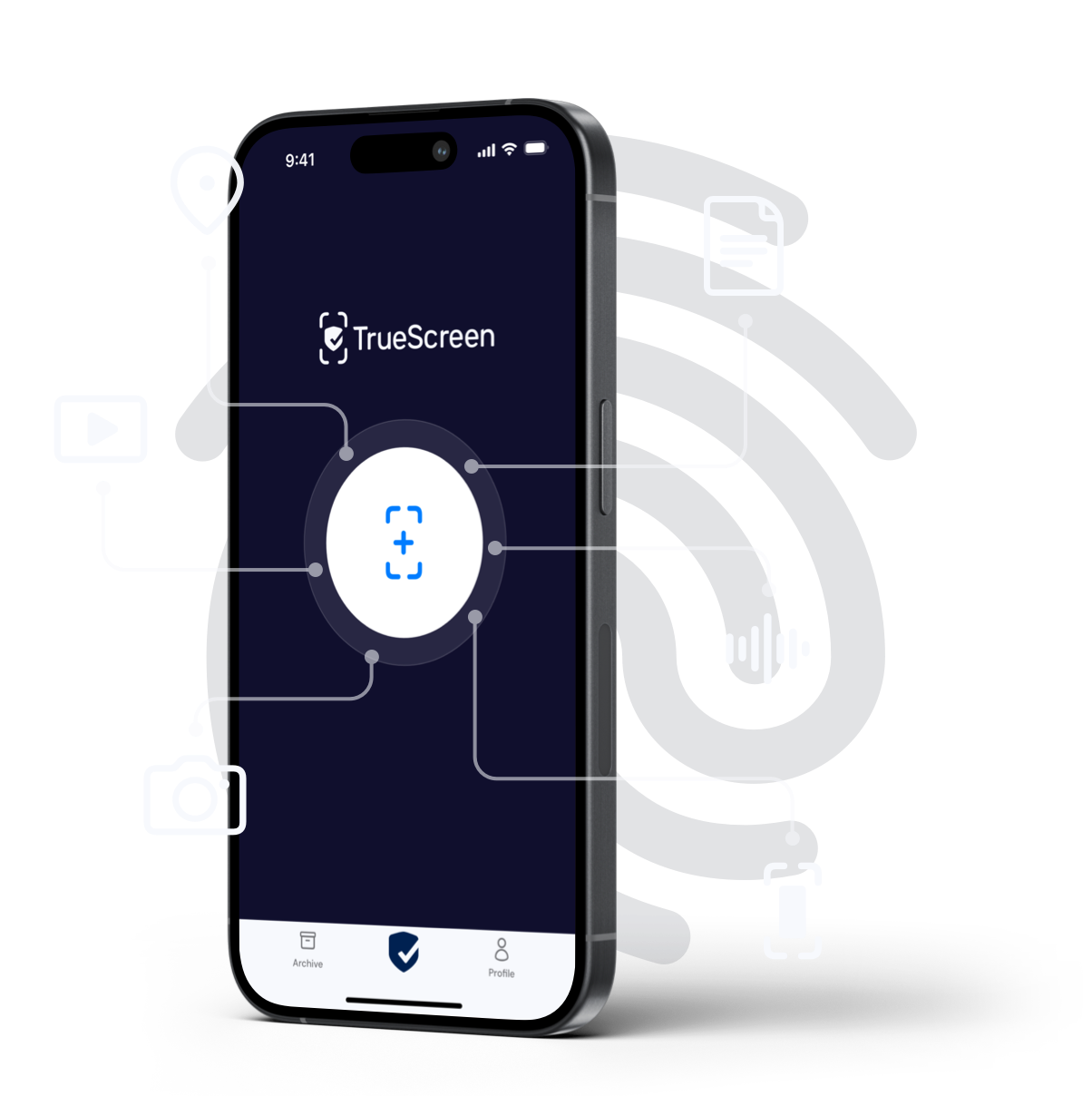
Verifiable provenance evidence is digital evidence acquired at the time and place where the fact occurs, sealed with a cryptographic hash and a qualified timestamp, and accompanied by a report documenting its origin and chain of custody. It is not a photo archive and it is not a smart label: it is the individual piece of proof made defensible. TrueScreen works at exactly this level, applying forensic methodology to the acquisition of photos, videos, documents and web pages, and integrating through API the electronic seal and qualified timestamp issued by a Qualified Trust Service Provider. The result is that the image of a batch ready for shipping, or the report of a plant inspection, is born in a form that withstands challenge.
Capturing field evidence at source
The decisive moment is capture, not storage. A quality manager photographing a lot in a warehouse, a technician documenting the temperature of a chill room, an operator filming a load onto a truck: with the TrueScreen mobile app the image is sealed at the instant of the shot, together with contextual data and detected position. There is no intermediate step in which the file could be swapped or edited, which removes the most common objection in litigation, namely that the photo might be from another day or another place.
Digital seal and integrity over time
The digital seal fixes the fingerprint of the content at a given instant. From then on any change, even a single pixel or character, produces a different fingerprint and becomes detectable by anyone running the check, without needing access to the producer's systems. This is what turns the digital chain of custody into something demonstrable rather than declared, and what makes it possible to certify a photo with legal value years after it was taken.
Transport documents, inspections and retention
The same principles apply to paperwork. A transport document, an analysis report, a supplier conformity certificate can all be sealed at issue or on receipt, so that a batch file is consistent from beginning to end. When that file has to be shared with a foreign customer, a control body or a lawyer, the certified data room stores documents in a tamper-evident environment and logs every access, download and share. For companies that already run supply chain systems, certification APIs seal the evidence produced by existing processes automatically, without asking operators to change how they work.
A concrete case: a protected designation dairy receives a claim from a foreign distributor alleging that a consignment does not meet the product specification. If the outbound batch photos, the transport document and the quality control report were certified at source, the producer responds with a dated, verifiable file instead of a reconstruction assembled after the fact. The discussion moves from who is right to what the documented facts say, and it usually ends sooner.

How to make supply chain evidence verifiable
There is no need to certify everything. There is a need to certify the points where, if something goes wrong, the burden of proof lands on the company.
The first step is an honest map of the critical moments: raw material intake, processing, intermediate checks, packaging, dispatch from the plant, delivery. For each one the question is "if a customer or an authority challenges this step tomorrow, what do I show?". Wherever the answer is a photo on somebody's phone, there is an exposed point.
The second step is deciding who captures and with which tool. Field operators need a single gesture, a shot or a recording, not another procedure. Systems that already produce documents can be connected directly, so certification becomes an automatic consequence of the process.
The third step concerns retention and sharing. Certified evidence that nobody can retrieve when it is needed is worth as much as evidence that does not exist. It pays to establish from the outset where a batch file lives, who can access it and how it is delivered to a third party, because when a dispute lands the timelines are short.
Who uses certified supply chain evidence and why
The value of defensible evidence does not stay in the legal department. It changes how several corporate functions work, each for a different reason.
| Corporate function | Typical situation | Benefit of certified evidence |
|---|---|---|
| Quality and production | Batch checks, non conformities, recalls | Reports and photos with certain dates, immediate batch reconstruction |
| Legal | Origin challenges, imitations, fraudulent returns | Evidence file already assembled, defensible without later expert reports |
| Export and sales | Documentary requests from buyers and foreign retail chains | Third party verifiable documentation, shorter response times |
| Protection consortia | Designation defence, market surveillance | Consistent proof of compliance with the product specification |
| Compliance and certification | Third party audits, second party audits | Coherent documentary trail that cannot be altered |
The connection with Digital Provenance is direct: the food supply chain is one of the contexts where the origin of a piece of data matters as much as the data itself. The same approach supports brand protection through digital evidence when a trademark or a product image is used without entitlement, and more broadly the industry and quality sector.
Proving the real beats chasing the fake
Chasing imitations product by product and market by market is a fight a producer cannot win alone: counterfeiters move faster, change names and resurface elsewhere. Building a body of evidence that makes the authenticity of your own product demonstrable changes the ground the contest is fought on. It is not about recognising the fake, it is about guaranteeing the real, using evidence a third party can verify without taking anybody's word for it.
For a consortium or an exporting producer, that means arriving at a dispute with a file already prepared rather than a reconstruction. It means answering a buyer who asks for origin guarantees with documents that verify themselves. And over time it means turning traceability from a compliance obligation into a commercial argument.