The right to authenticity: positive proof of the true beyond deepfake detection
In 2026, synthetic images and video circulate at a scale we have never seen before. During breaking news, election cycles and armed conflicts, a fabricated clip can reach millions of people before anyone manages to debunk it, and increasingly even AI detection tools certify manufactured content as authentic. This is the complication that dismantles the last defence we believed was solid: if the very systems meant to expose the fake get it wrong, how do we rebuild trust when unmasking falsehood has become a race we cannot win? The answer is not to chase the lie more effectively. It is to invert the logic entirely. The right to authenticity is exactly this: the ability to hold positive proof of the true, created at the precise moment a piece of content comes into existence, instead of pursuing its falsity after it has already gone viral.
For years, digital trust worked the other way around. Content was treated as genuine until proven otherwise, and the job of the verifier was to find the flaw, the artefact, the badly stitched seam. That world no longer exists. Today the production of the fake is cheaper, faster and more convincing than its verification, and this imbalance is not temporary. It is structural.
AI visual disinformation changed scale in 2026
AI-generated visual disinformation reached, in 2026, a diffusion that is qualitatively different from previous years, not only in volume but in perceptual credibility. Europol's analysis of the deepfake challenge documents how synthetic content has moved from technological curiosity to an ordinary component of disinformation flows, with circulation peaks during news events, election periods and international crises. The deepest consequence is not the single fake video. It is the erosion of perceptual trust: when any image could be synthetic, we stop believing even what is genuine.
The Reuters Institute, in its Digital News Report, has recorded for years a growing public concern about the ability to tell real content apart from manipulated content. It is the signal that the problem has stopped being technical and has become civic. It no longer concerns only newsrooms or forensic investigators, but anyone who receives a message, watches a video or forwards a screenshot. The shared perception of what is real, the silent assumption on which public debate and justice both rest, is beginning to crack.
Why deepfake detection cannot win
Deepfake detection cannot win because it is reactive by nature: it intervenes downstream, once the fabricated content has already been produced and put into circulation. Every detector is trained on the artefacts of existing generative models, but every new model is built precisely to remove those artefacts. It is a chase in which the party generating always has the last move, and the party detecting follows with a structural step of delay.
This asymmetry is not a problem of resources or computing power that the next update will solve. The logic of detection itself is fragile: it assumes the fake leaves traces, while the stated goal of every new generation of generative models is to leave none. We have explored elsewhere the limits of deepfake detection, but the essential point is simple. A system that can only say "this looks fake", with a margin of error that grows with every new version of the models, will never be able to ground stable trust. And when the detector errs in both directions, branding the true as false and the false as true, the damage to collective trust is worse still than having no controls at all.
The right to authenticity: from negative proof of the fake to positive proof of the true
The right to authenticity is the possibility, for a person or an organisation, to demonstrate that their own content is genuine through proof created at the source, rather than through the attempt to disprove every possible imitation. It reverses the burden: instead of asking the world to prove that something is false, it lets whoever created the content demonstrate in a verifiable way that it is true. It is the shift from negative proof of the fake to positive proof of the true, and it connects directly to the broader civic idea of a right to truth, the right of people and communities to access facts that can be established.
The difference between the two paradigms is sharp, and it is worth putting in a table.
| Approach | Negative proof of the fake (reactive detection) | Positive proof of the true (proactive certification) |
|---|---|---|
| What it proves | That a piece of content looks manipulated | That a piece of content is authentic and intact from its origin |
| When it acts | After publication, downstream | At the moment the content is captured |
| Scalability | Low: every new model defeats the detector | High: authenticity does not depend on the model generating the fake |
| Who it protects | The verifier, after the fact and with uncertainty | Whoever creates the content, and whoever later receives it |
Seen this way, proactive certification does not fight deepfakes on their own ground. It simply makes them irrelevant: if I can prove that my content is authentic, I do not need to demonstrate that the imitations are false. This is the heart of the paradigm of authenticity at the source, and it helps dissolve what we have called elsewhere the authenticity paradox in the AI era, whereby the more sophisticated verification tools become, the less we manage to trust what we see.
How authenticity is certified at the moment content is created
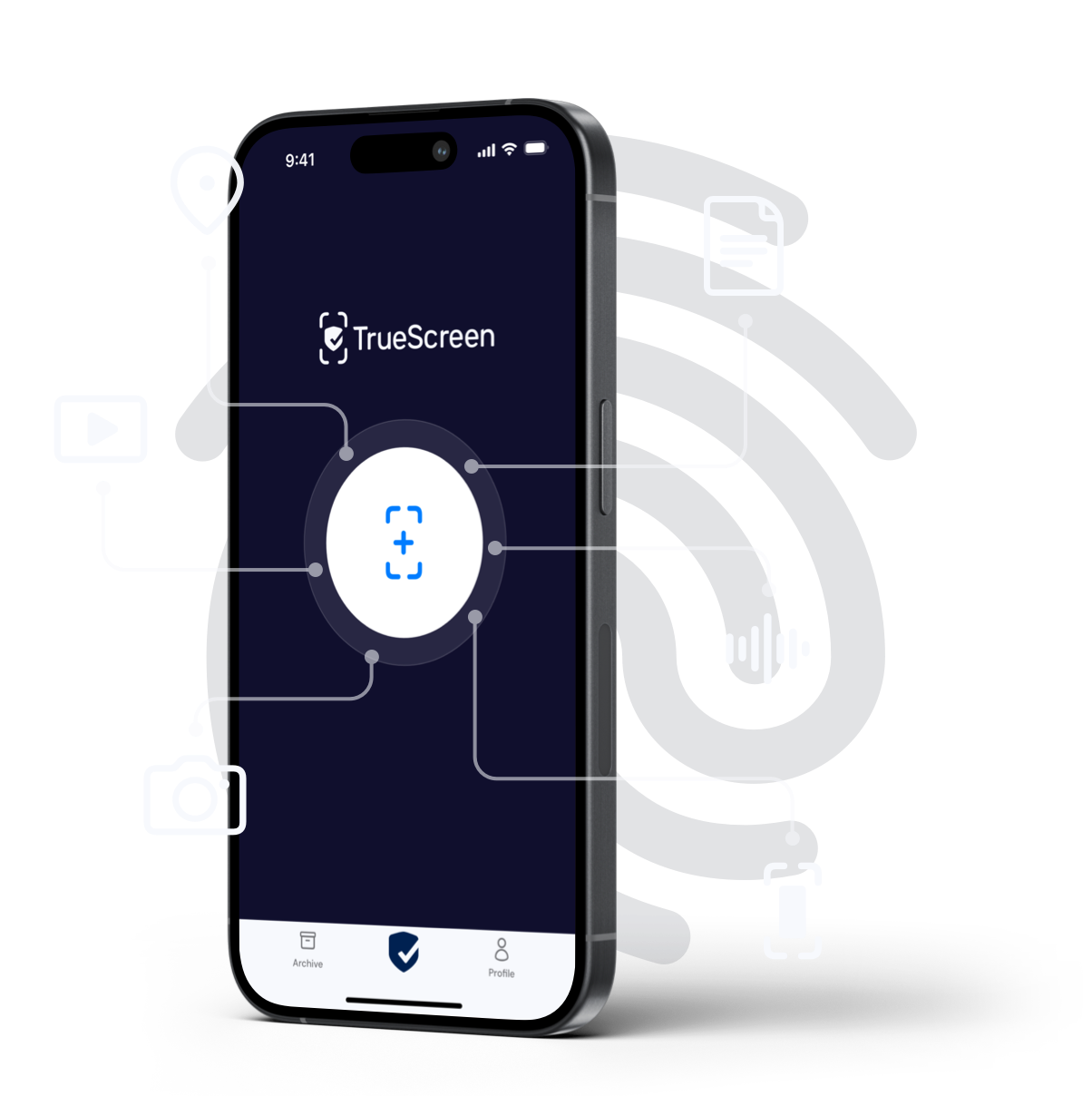
TrueScreen certifies photos, video, audio, email and web pages at the source with a forensic methodology, sealing each piece of content with a hash and a qualified timestamp at the moment of capture. It is not a detector that inspects a file after it circulates online. It is a methodology that intervenes at the origin, when the content is captured, and fixes its exact state at that instant in a verifiable way.
The mechanism is simpler than it sounds. At the moment of capture, the content is reduced to a unique digital fingerprint, its hash: any later modification, even of a single bit, would produce a completely different fingerprint and would therefore be immediately detectable. That fingerprint is bound to a qualified timestamp, which anchors the content to a precise moment in time. For the legal component, TrueScreen integrates via API the electronic seal and the qualified timestamp of a third-party qualified trust service provider, so that the proof is born with probative value, without the platform substituting itself for the qualified party that applies the seal.
A concrete example makes it clear. A journalist documents an event in the field, or a citizen records a significant episode on their phone. If they capture the content through a source-level certification methodology, they obtain material that is already sealed and enforceable: if a retouched version of the same facts starts to circulate online, they do not need to prove that it is false, because they already hold proof that theirs is authentic and dates back to that precise moment. This is the reversal in action, and it is also the most direct way to guarantee data authenticity and to offer protection that does not depend on how quickly a manipulation can be debunked. Anyone who wants to see how this translates into a working service can explore the TrueScreen platform.
A common ground of truth for citizens, media and institutions
The greatest value of the right to authenticity is not technological, it is civic. If every relevant piece of content can be born already certified, citizens, media and institutions return to sharing a common ground of truth: an establishable starting point on which to build debate, reporting and legal process. It is not about deciding who is right, but about guaranteeing that the facts we start from can be verified by everyone.
This does not eliminate deepfakes, and that is not the goal. They will keep existing, and they will probably become indistinguishable to the naked eye. But they will lose their corrosive power the moment a structural alternative exists: not a judge deciding case by case what is true, but a widespread infrastructure that lets anyone prove the authenticity of what they actually created or witnessed. The regulatory framework is moving in the same direction: the EU AI Act introduces transparency obligations for synthetic content, a sign that verifiable provenance is becoming a requirement, not an optional extra. Trust in the future of information is not defended by chasing every new forgery, but by building the true so that it speaks for itself.
FAQ: the right to authenticity
What is the right to authenticity?
What is the difference between detecting a deepfake and certifying authenticity at the source?
How can a person prove that a piece of content is authentic?
TrueScreen editorial team
Published on · Updated on
This section is edited by the TrueScreen editorial team, which brings together expertise in digital forensics, the law of digital evidence and regulatory compliance. Every article is checked against primary sources: legislation, published rulings, technical standards and official documentation, always cited in the text.


