
Construction draw inspections: legally valid photo reports for faster disbursements
Every construction loan in the United States moves on the strength of a photo. A borrower sends a draw request, a third-party inspector visits the jobsite, takes images of the work in place, and a lender releases funds based on what those images show. That process funds roughly USD 150 billion of commercial and multifamily starts each year, with each project triggering between 8 and 15 draw events before completion (California Mortgage Association).
The photo itself has quietly become the weakest link. A smartphone JPEG carries EXIF metadata that anyone can overwrite in seconds, GPS coordinates that free apps can spoof, and timestamps that sit under the user's thumb. The 2024 Travelers Institute fraud survey found that 22% of claims professionals had seen altered photos in the prior twelve months, and 40% had seen altered documents (Travelers Institute). Construction lending feels the same pressure in its own vocabulary: recycled images, phantom work, inflated completion percentages. When a dispute lands on a loan officer's desk, a generic JPEG is not a document. It is an argument.
This article walks through how construction draw inspections can produce photo reports that hold up under dispute, block the most common fraud patterns, and let lenders disburse faster. The answer is a combination of forensic acquisition, cryptographic integrity, qualified eIDAS timestamping, and a traceable chain of custody. Get those four right and the image becomes self-authenticating evidence under FRE 902(14).
What draw inspections are and why every photo can stall a disbursement
A construction draw inspection is a verification performed by a neutral third party to confirm that work billed in a draw request has actually been completed before a lender disburses funds. The inspector compares on-site evidence, typically photos, measurements and progress notes, against the billed line items in the schedule of values, and produces a report that becomes part of the loan file and, in commercial deals, part of the title and construction escrow record. Under Fannie Mae's Selling Guide, the construction window caps at nine months and completion is documented through Form 1004D (Fannie Mae Selling Guide). The same logic applies in VA and FHA programs. Because every disbursement of the USD 150 billion that construction lending deploys each year hinges on those images, a construction draw inspection is less a routine site visit than an evidentiary act: the photos it produces are the proof on which capital moves.
The role of photo reports in modern construction lending
Photos are the evidentiary core of a draw report, not illustrations. A line item reading "framing 85% complete" carries no weight on its own. The lender underwrites the disbursement against the images that show framing in place on the correct lot on the correct date. Fannie Mae's Selling Guide requires a visual on-site inspection for completion reporting, typically documented through Form 1004D, with a nine-month maximum construction window (Fannie Mae Selling Guide). VA Pamphlet 26-7 Chapter 14 sets construction inspection requirements for VA-backed loans, and FHA site-built housing rules require either a building permit plus Certificate of Occupancy or three inspections at footing, framing and final, performed by a local authority or an ICC-certified Residential Combination Inspector (VA Benefits).
In every one of these programs, the written narrative depends on the photos. Lose defensibility on the image and the draw file becomes fragile.
The three parties that depend on draw inspections: owner/borrower, inspector, lender
A draw inspection has three constituencies and each one carries a different exposure if the photo report fails.
The owner or borrower, usually the general contractor or the developer, needs the draw to fund payroll, material releases and subcontractor invoices. A single contested draw pushes the entire pay cycle out, creates carrying costs, and can trigger liens downstream.
The inspector, whether independent, ICC-certified or a staff underwriter for the lender, carries professional liability on the integrity of the report. If the photos can be impeached, so can the inspector's judgment, and insurance carriers have begun to tighten E&O language around image-based attestations.
The lender carries capital risk and regulatory exposure. Under Fannie Mae, VA, FHA and most private construction programs, the file has to survive internal audit, QC sampling and, when the loan sells, investor due diligence. If the photo evidence that justified a USD 2 million disbursement turns out to be a recycled image from a different project, the lender is looking at buy-back demands and, increasingly, fraud-reporting obligations.
Why smartphone photos do not hold under dispute
A construction draw inspection photo is legally fragile when the metadata inside the file can be edited by anyone with free software, when the timestamp is set by the device that took the photo rather than by an independent authority, and when no cryptographic seal binds the pixels to a specific moment in time. That description fits almost every smartphone image on the market.

Editable EXIF metadata and unreliable timestamps
EXIF is the data block inside a JPEG that carries creation date, GPS, camera model, lens, and editing history. ExifTool, a freely available utility, rewrites every one of those fields in a single command. Photoshop saves a new EXIF block by default. Forensic examiners can sometimes find "timestomping" traces, but at document-level an altered EXIF passes non-specialist review almost every time (CYFOR). Without an external anchor, the claim that a photo was taken on Tuesday at 10:47 a.m. is exactly as reliable as the phone's system clock, and the user controls the clock.
Recurring draw inspection fraud: recycled photos, false location, phantom work
According to Sekady's analysis of draw-request workflows, the single most common construction draw inspection fraud is "photos from two weeks ago claiming current work," and the pattern repeats across jurisdictions (Sekady). Five moves dominate the casework: recycled photos reused across draws or projects, GPS spoofing that places the device on the correct lot while the person is elsewhere, phantom work billed for line items never executed, duplicate billing submitted to consecutive draws or different lenders, and compromised inspectors paid by the borrower. ACFE's 2024 Report to the Nations attributes 38% of construction fraud cases to billing schemes, second only to corruption at 52%, with median losses of USD 250,000 per case (ACFE 2024 Report to the Nations). All five moves are simple to execute and hard to detect without forensic tooling.
Photo recycling is the most common. A borrower or an inspector reuses images from a previous draw, a prior project, or a public listing. The documented Greg Bingham case in Chicago Heights involved a USD 170,000 refund obtained on a building by depositing photos of damage already used for refunds on four different properties since 2018 (Injustice Watch).
GPS spoofing puts the device in coordinates that match the subject property while the person is physically elsewhere. Fake GPS apps are free on the Play Store. Unless the inspection process cross-checks cell tower data, Wi-Fi BSSID and IP address against the reported GPS, the spoof stays invisible.
Phantom work bills for line items that were never executed. Industrial cases like the Austal accounting fraud settlement (USD 24 million paid to DOJ/SEC in 2024) show how phantom billing scales in public contracts (USNI News). In residential and small commercial draws, the pattern is smaller but frequent. In 2024 a Fort Worth ring left dozens of homes unfinished in a USD 5 million fraud scheme that relied partly on staged draw documentation (CBS Texas).
Duplicate billing submits the same invoice across consecutive draws or to different lenders. ACFE data shows billing schemes at 38% of construction fraud cases, second only to corruption at 52%, with median losses of USD 250,000 per case (ACFE 2024 Report to the Nations).
Compromised inspectors close the list. When the inspector is paid by the borrower or the GC, the conflict of interest is structural, and the only defense is evidence the inspector cannot rewrite after the fact.
Economic impact: delayed draws, disputes, recovery losses
Weak photo evidence costs both sides. The typical draw request to disbursement cycle runs 5-7 business days, with real-world cases stretching to 2-10 days and only digital-first lenders compressing to 48-72 hours (Land Gorilla). Every day of delay is carrying cost for the GC and deployed but unearning capital for the lender. Multiply by the 8-15 draws in a typical project and the cumulative drag on a single build is substantial.
On the fraud side, Business Email Compromise alone generated USD 2.77 billion in losses across 21,442 US incidents in 2024, with construction draw requests and progress payments among the primary targets (FBI IC3 2024 Annual Report). When a draw is paid on fraudulent photos, recovery is rarely complete. The lender writes off the loss or argues with its title insurer over coverage, and the inspector's E&O carrier gets pulled in. Strong evidence captured at the source, through forensic tools like TrueScreen, is structurally cheaper than weak evidence litigated later.
The four requirements of a legally admissible photo report
A draw inspection photo becomes legally admissible when it meets four operational requirements that an outside reviewer can verify independently: forensic acquisition at source with immutable metadata, bit-level integrity backed by a cryptographic hash, a qualified eIDAS timestamp with certified geolocation, and a traceable digital chain of custody. These four properties map directly to the self-authentication pathway of Federal Rule of Evidence 902(14), which admits records copied from an electronic device when certified by a qualified person through digital identification, most commonly a hash value (Cornell Legal Information Institute). They also align with ISO/IEC 27037:2012, the international reference for handling and preservation of digital evidence (ISO). Miss any one of the four and the image can be impeached: smartphone photos miss all four by default, which is why a 30-photo draw package without certification carries the evidentiary weight of a witness statement rather than a document.
Forensic acquisition at source with immutable metadata
Forensic acquisition means the file is created inside a controlled capture environment rather than pulled from the device gallery after the fact. The distinction matters because once a JPEG lives in the camera roll it is indistinguishable from any other file: you can edit it, replace it or swap it. Acquisition at source writes the image directly into an evidentiary container with metadata that cannot be rewritten post-capture.
ISO/IEC 27037:2012 sets the reference framework for identification, collection, acquisition and preservation of potential digital evidence, and introduces the roles of Digital Evidence First Responder and Digital Evidence Specialist (ISO). Applied to a jobsite, it means the person taking the photo is operating inside a process whose output is repeatable and court-defensible, not improvised.
Bit-level integrity with cryptographic hashes
Integrity means a reviewer can prove that the file shown in the report is identical to the file created at capture, down to the last bit. The mechanism is a cryptographic hash, typically SHA-256, computed at the moment of creation and stored alongside the file. Change one pixel and the hash changes, so any alteration becomes detectable.
That is the logic embedded in Federal Rule of Evidence 902(14), which treats records copied from a device as self-authenticating when certified by a qualified person through digital identification, specifically hash values (Cornell Legal Information Institute). Two matching hashes on the original and the copy establish that the files are exact duplicates. The rule is deliberately flexible to admit techniques beyond hash value, but hash value is the anchor. For draw inspections, that means an image with a recorded SHA-256 hash at capture can be verified against any later copy without relying on the inspector's testimony.
Qualified eIDAS timestamping and certified geolocation
A timestamp is only as good as the authority behind it. A device clock is a user preference. A qualified electronic timestamp under Regulation (EU) 910/2014 (eIDAS) is data in electronic form that binds other data to a specific time, issued by a Qualified Trust Service Provider under national supervision, with accuracy of one second and presumption of integrity and time-accuracy under Article 41 (EUR-Lex, Regulation 910/2014). In a US construction context the eIDAS qualified timestamp carries technical weight rather than direct statutory force, but it satisfies the FRE 902(14) requirement of a reliable digital identification and is the same mechanism used by cross-border lenders and insurers for evidentiary purposes.
Geolocation follows parallel logic. A single GPS reading is spoofable. A certified location, captured from multiple independent sources (GPS, cell tower triangulation, Wi-Fi BSSID, server-side IP) and signed by a trust authority, is much harder to fake. When the location data is sealed into the same hash as the image, spoofing one without breaking the other becomes a real problem for the fraudster.
Traceable digital chain of custody
Chain of custody is the paper trail, now digital, that documents every hand the file passes through. NIST SP 800-86 lays out the canonical four-phase framework: collection, examination, analysis, reporting, with documented custody at every step (NIST SP 800-86). Applied to a draw inspection, the chain records who captured the photo, when it was hashed, when the timestamp was applied, who uploaded the report, and when the lender accessed it. Each transition is logged to an immutable record. If the evidence is ever contested, the log answers the question "how did this file get from the jobsite to my loan committee" without relying on memory or correspondence.
How TrueScreen certifies draw inspection photo reports
A draw inspection photo is legally defensible and lender-ready when acquisition, integrity, timestamping and chain of custody are enforced at the moment of capture instead of layered on later through notarization or expert testimony. That is the approach built into TrueScreen, the data authenticity platform that lets inspectors, general contractors and lenders produce draw reports whose photos are self-authenticating under FRE 902(14) and carry evidentiary weight aligned with ISO/IEC 27037 and Regulation 910/2014. With TrueScreen, acquisition happens inside a forensic container, every file is hashed with SHA-256 at creation, each image is sealed with a qualified eIDAS timestamp and cross-verified location data, and the full chain of custody is written to an immutable log that the lender can audit without additional forensic work. The reviewer does not have to trust the inspector or the device: the reviewer trusts the cryptographic proof inside the file.
Field users, whether general contractors or third-party inspectors, work through a mobile inspection app that writes photos and videos into an evidentiary container at capture, never through the native camera roll. When the inspection touches documents or portals, for example permit verifications, plan-check screens, or public records, the Forensic Browser captures the session with the same guarantees. Lender operations teams review and export reports through the Web Portal, and integration with draw management software runs through API, so a certified photo package flows into the lender's construction loan management system without manual re-upload.
The practical effect on a draw event is simple. Instead of receiving 30-50 smartphone photos the underwriter has to trust on face value, the lender receives a self-verifying package: open the file, check the hash, confirm the qualified timestamp, disburse. What used to take 5-7 business days of back-and-forth often collapses to 24-48 hours, and the loan file that lands in QC is already hardened against the most common fraud patterns.
From jobsite to lender: the certified draw inspection workflow
A certified draw inspection follows four steps that mirror the standard process but replace every trust assumption with a verifiable artifact: scheduling against the draw schedule in the schedule of values, forensic capture at the jobsite, generation of a self-contained report, and transmission to the lender with independent verification. Land Gorilla's benchmarks put typical approval at 5-7 business days when photos require manual review, while digital-first lenders with certified evidence compress the cycle to 48-72 hours because the file authenticates itself rather than the reviewer (Land Gorilla). The economic impact accumulates over the 8-15 draws typical of a commercial or multifamily build: every day saved per draw multiplies across the construction loan monitoring cycle, and every photo that carries its own proof eliminates a point where the disbursement can stall. Four steps, no trust gaps, the same evidence at month nine as on day one.
Scheduling the periodic draw inspection
Draw events are triggered by milestones in the schedule of values. A typical residential construction loan splits disbursement across 4-6 draws tied to foundation, framing, rough-in, drywall, and final, while a larger multifamily or commercial loan can run 8-15 draws against a detailed line-item schedule. The inspector receives the draw request, the current pay application and the prior inspection history, and schedules a site visit within the window set by the lender's procedures.
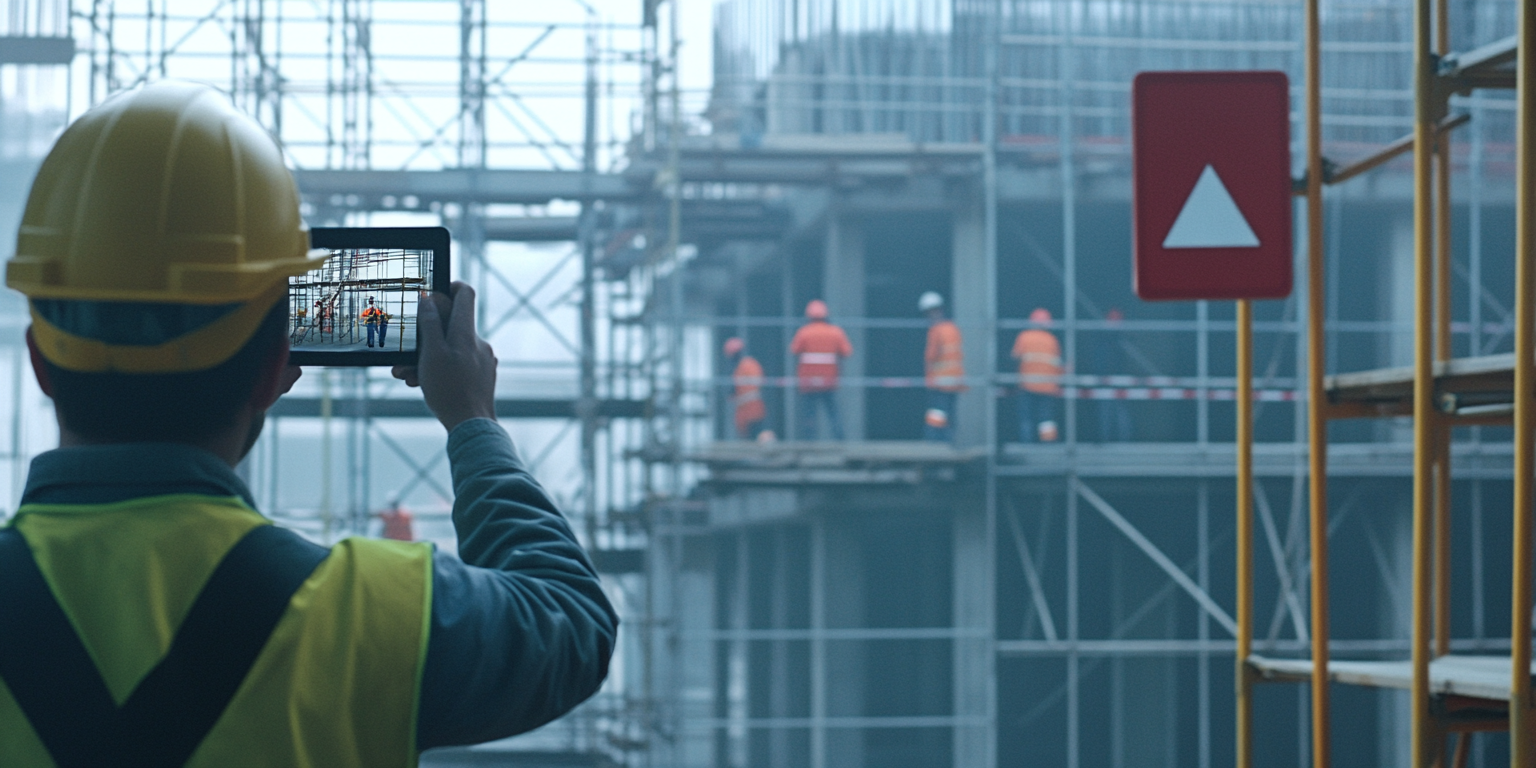
Capturing photos and videos in the field
On site, the inspector documents each billed line item. Instead of the camera app, capture happens inside a forensic acquisition environment that writes the image, the SHA-256 hash, the qualified timestamp and the cross-verified location into a sealed container. Where relevant, video of continuous walk-throughs captures the sequence of rooms or floors in a single file, which is harder to fake than a set of isolated photos.
This is the jobsite layer where construction site safety documentation overlaps with draw evidence. A single capture session can support both functions, which cuts duplicated work for the GC.
Generating the certified draw report
Back in the office or directly from the field, the inspector compiles the report: narrative, measurements, line-item status and the certified photo package. The report is exported as a PDF/A document (ISO 19005, long-term preservation format) with an embedded chain-of-custody log and the full set of hashes and timestamps. The report is a single self-contained artifact. A lender opening it three years later, in the middle of a dispute, sees exactly what the lender opening it in real time saw.
Transmitting the report to the client or lender
The certified report moves to the lender through the TrueScreen Web Portal or through an API integration with the construction loan management system. The lender's reviewer authenticates the file against its hash, validates the eIDAS timestamp, and logs the review in the loan file. If the disbursement goes through, the evidence package is already preserved in the form expected by internal audit, by GSE QC sampling, and, if necessary, by a court.
The same capture pattern supports adjacent evidentiary needs: certified property appraisal for appraiser walk-throughs, property condition report documentation at refinance, and certified site inspections for safety and regulatory purposes.
Legal framework: evidential value of certified photos
A construction photo becomes evidence when a legal framework recognizes it as such. Two frameworks matter for most US lenders, and a third one matters for cross-border portfolios that touch European counterparties.
United States: FRE 901, FRE 902(14), Fannie Mae and VA/FHA requirements
Federal Rule of Evidence 901 sets the general authentication standard: the proponent must produce evidence sufficient to support a finding that the item is what the proponent claims it is (Cornell LII). Authentication can be satisfied by witness testimony, distinctive characteristics, comparison, or evidence about the system or process that produced the record.
FRE 902(14), added in 2017, carved out a specific self-authentication pathway for electronic records: data copied from a device or storage medium is self-authenticating when certified by a qualified person using a digital identification, most commonly a hash value. Matching hashes on the original and the produced copy establish exact duplication. The qualified person is typically an IT specialist or an e-discovery vendor, and the certification substitutes for the live testimony otherwise required under FRE 901. For draw inspections, that means a photo with a documented hash at capture, paired with an appropriate certification, can enter the record without the inspector personally taking the stand every time a draw is contested.
On top of FRE, construction-specific requirements layer in. Fannie Mae's Selling Guide mandates visual on-site inspection for completion via Form 1004D and caps the construction period at nine months. VA Pamphlet 26-7 Chapter 14 structures inspections and draws, typically with 10% held at closing and 10% at final. FHA site-built rules require either permit plus Certificate of Occupancy or three stage inspections by an ICC-certified Residential Combination Inspector. Each framework assumes the inspection output, including photos, is defensible on its face.
International context: eIDAS, ISO 27037, Italy's art. 2712 c.c.
For lenders with international exposure or for US projects with European investors in the capital stack, eIDAS provides the reference standard. A qualified electronic timestamp under Article 41 of Regulation (EU) 910/2014 enjoys a legal presumption of time accuracy and data integrity across all 27 EU member states. A qualified electronic seal under Article 35 does the same for legal persons, establishing that a document was issued by a specific legal entity with integrity and origin presumed. ISO/IEC 27037 provides the technical methodology for evidence handling; it is not law, but it is the framework that auditors and expert witnesses map to.
European construction and real estate cases also apply national codes. In Italy, Article 2712 of the Civil Code treats mechanical reproductions, including photographs, as full proof of the facts and things represented when the opposing party does not specifically deny their conformity. Italian Supreme Court case law has confirmed that screenshots of messages can be produced as documentary evidence (Cass. SS.UU. 11197/2023) and, under Article 2712 of the Italian Civil Code, carry full proof unless their conformity is specifically disclaimed (see, among others, Cass. 19155/2019 and, for WhatsApp screenshots, Cass. 1254/2025). For US lenders this is a jurisdictional citation rather than a live rule, but it shows how hashed and timestamped evidence moves across borders with consistent weight.
Whatever the jurisdiction, the building blocks are identical: acquisition you can document, integrity you can prove, time you can verify, custody you can trace. A draw inspection report that ships all four, as TrueScreen does by default, is hard to impeach anywhere.
FAQ: certified draw inspections
What is a construction draw inspection?
Are smartphone photos valid for construction loan draws?
How much does a draw inspection cost?
How long does a draw request approval take?
What federal rules govern photo admissibility in construction disputes?
What happens when a lender disputes draw photos?
What makes draw photos legally defensible?
TrueScreen editorial team
Published on · Updated on
This section is edited by the TrueScreen editorial team, which brings together expertise in digital forensics, the law of digital evidence and regulatory compliance. Every article is checked against primary sources: legislation, published rulings, technical standards and official documentation, always cited in the text.


