
Updated on
Italian Supreme Court 1269/2025: when WhatsApp messages become inadmissible in criminal proceedings
A prosecutor opens the file. The investigating officer has dropped in a folder of screenshots pulled from the suspect's phone during the search: names, dates, what reads like a confession. Defence counsel raises one procedural point at the preliminary hearing, and the whole stack of WhatsApp messages falls out of the case. That is the practical effect of ruling 1269/2025, Italian Supreme Court, Criminal Division VI, filed on 13 January 2025. For anyone working with whatsapp messages criminal evidence, the Court's position is now explicit: a screenshot taken by judicial police on a seized device, without a motivated seizure decree from the public prosecutor, is affected by pathological inadmissibility and cannot support a conviction.
The criminal division has essentially transposed the logic of ruling 1254/2025 from the civil side. A chat sitting on a smartphone is not a generic digital file; it is correspondence, protected by Article 15 of the Italian Constitution and Article 8 ECHR. The Court leans on Constitutional Court decision 170/2023, which treats instant messaging conversations as the modern equivalent of a sealed letter. The consequence is blunt: investigators cannot shortcut the statutory seizure procedure by photographing the screen, and appeal courts now have to run a resistance test before any conviction based partly on those images can stand.
This insight is part of our guide: Certifying WhatsApp chats with legal value
WhatsApp messages in criminal proceedings: what Italy's Supreme Court ruled in 1269/2025
Criminal Division VI drew a clean line: once a smartphone is seized, the messages inside it remain correspondence, and any acquisition method that skips the prosecutor's motivated decree is inadmissible. There is no carve-out for urgency or technical convenience. The ruling closes the loophole that had allowed screenshots to be treated as a neutral documentary shortcut.
The case: the smartphone as container, messages as correspondence
The defendant's phone had been lawfully seized during an operation. Judicial police officers, on their own initiative, opened the device and photographed the WhatsApp threads they thought relevant. Those images were filed by the prosecution as documentary evidence. The Supreme Court held that seizing the physical device does not, on its own, authorise the autonomous extraction of the correspondence inside it. Container and content are separate legal objects. Seizing a locked drawer does not remove the need for the further authority required to open and read the letters in it.
The Court built on Constitutional Court 170/2023, which had already placed digital instant messaging under the same protection as traditional sealed correspondence (full text on the Constitutional Court website). The only qualifying factor is whether the communication is still current: a chat you can still open inside a live application is correspondence, not an archived document. A detailed academic commentary on 1269/2025 was published in the Giurisprudenza Penale law review (Ballesi, 2025).
The principle of law set by Criminal Division VI
The rule the Court set down has two parts and one consequence. Judicial police cannot autonomously acquire WhatsApp messages by screenshot on a seized device. The admissible route is a motivated decree from the public prosecutor ordering forensic extraction, with adequate defence guarantees during the operation. If an inadmissible acquisition ends up in the file anyway, the reviewing court has to run a resistance test and check whether the remaining lawful evidence is, on its own, enough to sustain the conviction.
Criminal Division IV reaffirmed the same line months later in ruling 31878/2025, filed in September 2025, which restated the nature of WhatsApp messages as correspondence and the pathological consequences of bypassing the prosecutor's decree. A commentary on that follow-up ruling is available on Diritto di Internet. Two rulings in the same year from two different sections of the criminal division is a settled position, not an outlier.
Why screenshots alone fail: acquisition and chain of custody
A screenshot is a picture of a screen at a single moment. It carries no independent metadata about when it was taken, by whom, on which device, or whether the underlying chat was altered between capture and presentation. In a criminal case, where the standard is beyond reasonable doubt, that gap is fatal. The reasoning in 1269/2025 is not only about privacy. It is also about reliability and the right of the defence to test the evidence.
Device seizure vs forensic copy
Italian criminal procedure draws a hard line between seizing a device and analysing what is on it. The first is a physical act that protects the evidence from tampering. The second is an intrusive operation that requires a motivated decree and, ordinarily, a bit-by-bit forensic copy with hash verification, so prosecution and defence end up working on the same verifiable dataset. A screenshot skips every step in between. It loses the context around the message, any deleted-message indicators, the timestamps as stored on the device, and the cryptographic fingerprint of the source. A defence expert cannot reproduce or falsify an image.
Defence guarantees and the resistance test
The second layer of the reasoning is adversarial. A proper forensic extraction lets the defence attend, verify the hash, analyse the same copy, and challenge the prosecution's reading. A screenshot taken in a patrol room offers none of that. When an appeal court finds that inadmissible chats slipped into the file, 1269/2025 obliges it to re-run the evaluation without them. If the remaining evidence does not independently support the verdict, the conviction falls. A screenshot can no longer be written off as a minor supporting element that survives even when tainted.
How to acquire WhatsApp messages with probative value in criminal proceedings
The ruling does not apply the same way to everyone in the proceeding. Investigators have to go through the seizure decree and the forensic copy. Victims, civil parties, defence counsel, and party-appointed experts are in a different position: they already have lawful access to the messages, either because they are a party to the conversation or because the chat sits on their own device. For them the question is not how to acquire the evidence, but how to preserve it, so that when it is produced in court it survives any challenge on authenticity and chain of custody.
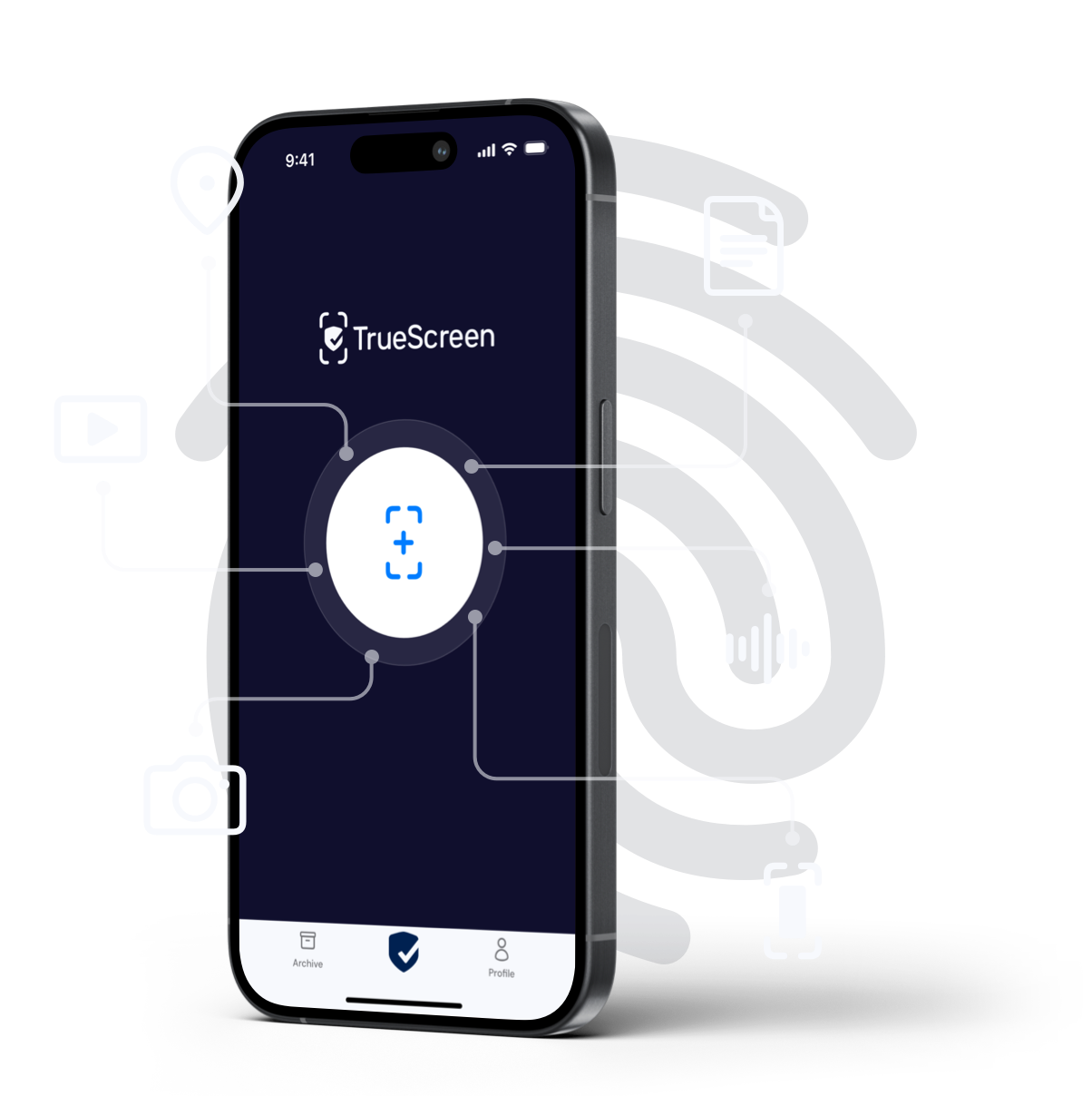
Three complementary solutions cover the acquisition, depending on the device at hand. The main solution on desktop is the TrueScreen Forensic Browser, an application for macOS and Windows that acquires WhatsApp Web while recording the entire browsing session in a controlled forensic environment. The Web Notarization extension for Chrome and Edge lets you quickly certify any content during normal browsing, while the TrueScreen app for iOS and Android certifies the conversation directly from the smartphone. All of them feed the same certification workflow, with SHA-256 hashing, qualified timestamping and electronic seal.
This is what certifying WhatsApp chats with legal value is meant to solve. TrueScreen lets a private party certify a chat that is already lawfully theirs, before they file it, with a chain of custody that can be documented against the kind of scrutiny the Supreme Court now expects. It is not a tool for judicial police, who have to follow the statutory seizure procedure. It is a tool for the party who would otherwise walk into court with an unauthenticated screenshot and lose the argument before the merits are even discussed.
TrueScreen App and Web Portal for certified acquisition
Using the TrueScreen App or the Web Portal, the user captures the conversation directly from the source interface. The capture is sealed with a QTSP-grade cryptographic seal, a qualified timestamp compliant with eIDAS Regulation 910/2014 and RFC 3161, and a digital signature that binds the acquisition to an identified author. The whole operation is logged in an attestation database. What comes out is a court-ready package that documents when the content was acquired, by whom, and proves it has not been touched since. The approach is the same one set out in our overview of digital evidence, chain of custody and certification.

Criminal 1269/2025 vs Civil 1254/2025: two sides of the same coin
The two rulings share a premise but diverge on consequences. Both classify WhatsApp messages as correspondence rather than ordinary documents, and both demand more than a screenshot to establish probative value. The civil ruling, which we covered in our analysis of the 1254/2025 civil decision on WhatsApp screenshots, is about the party's burden of proving authenticity. The criminal ruling is about the state's duty to follow procedural safeguards when pulling evidence from a seized device. Same premise, different addressee.
| Dimension | Civil 1254/2025 | Criminal 1269/2025 |
|---|---|---|
| Who produces the chat | Private party | Judicial police on seized device |
| Core issue | Authenticity and integrity | Pathological inadmissibility without a decree |
| Remedy | Certified forensic acquisition before filing | Prosecutor's motivated decree plus forensic copy |
| Consequence if ignored | Evidence carries little weight | Resistance test; possible annulment |
FAQ: WhatsApp messages as evidence in criminal proceedings
What's the difference between the 1254/2025 civil ruling and the 1269/2025 criminal ruling?
Is a WhatsApp screenshot always inadmissible in criminal proceedings?
Do investigators have to seize the phone to acquire chats?
How can a victim certify a chat before producing it in court?
TrueScreen editorial team
This section is edited by the TrueScreen editorial team, which brings together expertise in digital forensics, the law of digital evidence and regulatory compliance. Every article is checked against primary sources: legislation, published rulings, technical standards and official documentation, always cited in the text.


