
Updated on
WhatsApp Messages as Evidence in Divorce and Child Custody Cases
Family courts across multiple jurisdictions are seeing a sharp rise in WhatsApp-based evidence. In the United States, the American Academy of Matrimonial Lawyers reported that over 97% of divorce attorneys have seen an increase in digital evidence from smartphones in family law proceedings. WhatsApp messages documenting infidelity, financial agreements, or parenting failures now sit at the center of many divorce and custody disputes. But producing those messages in court presents a specific legal and technical problem: under Federal Rule of Evidence 901(a), the proponent must produce evidence sufficient to support a finding that the item is what the proponent claims it is. A screenshot saved on a phone, with no metadata, no cryptographic hash, and no chain of custody documentation, can be challenged and excluded with a straightforward authentication objection.
Can WhatsApp messages be used as evidence in divorce?
Yes. WhatsApp messages are admissible as evidence in divorce and child custody proceedings in most jurisdictions, provided they can be authenticated. Courts require proof that messages are genuine, unaltered, and properly preserved. Forensic certification at the point of capture, with cryptographic hashing, qualified timestamps, and digital signatures, is the most reliable method to meet these authentication requirements.
There is a way to prevent that. Forensic certification of WhatsApp chats at the source, with digital signature and qualified timestamp, turns volatile conversations into court-ready evidence with full probative value in family proceedings.
This insight is part of our guide: How to Certify WhatsApp Chats: Legal Value for Digital Conversations
When WhatsApp messages become evidence in family proceedings
WhatsApp messages qualify as electronically stored information (ESI) under the Federal Rules of Evidence. Courts in the US, UK, India, and across the EU have admitted WhatsApp conversations in divorce and custody cases when they meet authentication requirements. These messages enter family court files for two reasons above all: proving marital infidelity and documenting parenting conduct relevant to custody.
Marital infidelity: messages and media as circumstantial proof
In contested divorce proceedings, WhatsApp chats can document an extramarital relationship: text messages, photographs, voice notes, shared media. The probative value goes beyond written words. Images, audio messages, and attached documents form a composite picture that the judge evaluates under the applicable standard of proof. But the strength of each element depends on its technical integrity. If the file was saved without any guarantee of authenticity, the entire evidentiary picture weakens.
Child custody: conversations documenting parental conduct
Custody disputes raise different evidentiary needs. Here, WhatsApp messages serve to demonstrate neglect, parental alienation, failure to comply with visitation agreements, or offensive communications in front of minors.
Recent case law from multiple countries shows the weight courts assign to these conversations. In February 2026, the Chhattisgarh High Court in India ruled that WhatsApp chats are admissible in family court proceedings. The Madhya Pradesh High Court went further, holding that even WhatsApp conversations obtained without the other party's consent may be admissible under Section 14 of the Family Courts Act when they are relevant to child welfare. In the UK, the Family Procedure Rules 2010 allow digital evidence including messaging records, as long as the evidence is properly authenticated and its provenance documented.
The risk: evidence challenged and excluded by the court
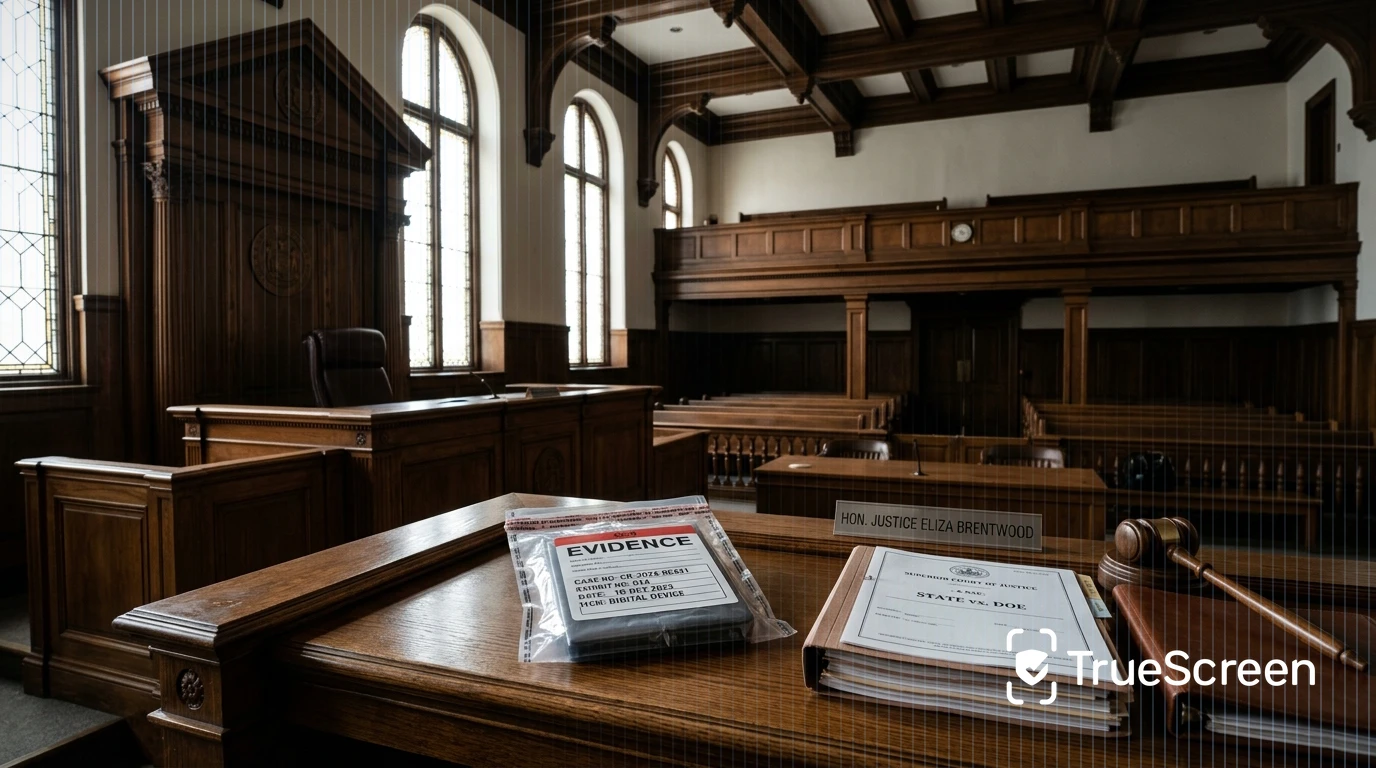
Producing WhatsApp messages in court without forensic acquisition exposes litigants to a real risk of exclusion. The same legal frameworks that recognize the evidentiary value of messages also define the grounds for throwing them out. And the authentication bar is lower than many family law attorneys assume.
Tools like TrueScreen, Data Authenticity Platform, address this vulnerability by certifying messages at the point of capture with forensic methodology.
FRE 901: authentication requirements for WhatsApp evidence
Under Rule 901(b) of the Federal Rules of Evidence, authenticating digital communications requires evidence that the messages are genuine and unaltered. A witness testifying that both spouses had access to each other's phones is not, on its own, enough to authenticate a WhatsApp exchange. The opposing party can challenge authenticity by arguing the messages were fabricated, taken out of context, or acquired without integrity safeguards. Without verifiable metadata, an integrity hash, and a documented chain of custody, the court may order a forensic examination, at an average cost of $2,000 to $5,000 and with delays that stretch proceedings by months. Or the judge may simply exclude the evidence from the record, stripping one side of a central element of their case.
Why a screenshot alone fails forensic examination
A screenshot is a static image. It carries no information about the acquisition device, no cryptographic hash guaranteeing integrity, no proof of when it was captured. A court-appointed forensic expert asked to verify a screenshot submitted as evidence can only note the absence of anything to verify. Multiple courts have held that transcriptions or screenshots of WhatsApp conversations are insufficient without corroborating evidence from the original device.
The privacy risk: wiretapping laws and admissibility limits
There is another risk that litigants producing WhatsApp messages often miss. Accessing messages on a spouse's phone without consent may violate wiretapping and electronic surveillance statutes. In the US, the Electronic Communications Privacy Act (18 U.S.C. 2511) prohibits unauthorized interception of electronic communications. Under the EU's GDPR, processing another person's private messages without a lawful basis raises data protection concerns. Even when messages are authentic, a civil court may declare them inadmissible if obtained in violation of privacy law. Forensic certification performed from one's own device, documenting only conversations the certifying party legitimately took part in, eliminates this risk entirely.
| Criterion | Manual screenshot | Forensic certification |
|---|---|---|
| Cryptographic hash | Absent | Generated automatically at acquisition |
| Timestamp | File date (editable) | Qualified timestamp from QTSP |
| Chain of custody | Not documentable | Tracked and verifiable |
| Device metadata | Partial or absent | Complete (model, OS, network, GPS) |
| Resistance to authentication challenge | Low: any specific objection can invalidate it | High: opposing party must prove fabrication |
| Need for court-ordered forensic examination | Likely (average cost: $2,000-$5,000) | Avoided: certification replaces expert examination |
When WhatsApp messages disappear: deleted chats and recovery
WhatsApp messages can be deleted by either party at any time, with no notification to the other side. The "Delete for Everyone" feature removes messages from both devices within a limited window, and individual deletion leaves no trace on the sender's device. Recovery from the device itself is not guaranteed: it depends on encryption settings, device type, operating system version, and the time elapsed since deletion. Forensic recovery tools exist, but their success rate varies widely and the process is expensive.
Cloud backups on Google Drive or iCloud may retain messages for a period, but these backups are not forensically verifiable. They lack cryptographic hashes, qualified timestamps, and chain of custody documentation. A backup file presented in court can be challenged on the same authentication grounds as a screenshot: there is no independent proof that the content has not been altered between backup and production.
Courts can issue preservation orders requiring parties to retain digital evidence, but enforcement after deletion is difficult and often impossible. Spoliation sanctions, including adverse inference instructions, may follow, but they do not restore the lost evidence. The structural solution is to certify messages forensically before they can be deleted, creating a tamper-proof record that exists independently of the device. This is where proactive forensic certification changes the equation. Platforms such as TrueScreen create a permanent, cryptographically sealed record at the point of capture, making subsequent deletion irrelevant to the evidentiary record.

Common mistakes when using WhatsApp as divorce evidence
Family law attorneys and their clients make predictable errors when preparing WhatsApp evidence for court. The American Academy of Matrimonial Lawyers has documented the growing role of digital evidence in family proceedings, yet the methods used to collect and present that evidence remain alarmingly informal. Each of the following mistakes can lead to evidence exclusion, sanctions, or worse outcomes at trial. Understanding them is the first step toward building a case that withstands scrutiny.
Relying on screenshots alone
A screenshot carries no metadata, no cryptographic hash, and no chain of custody. It is a static image that could have been created, edited, or fabricated using widely available tools. Courts are increasingly aware of this limitation. When the opposing party raises an authentication challenge under FRE 901, a screenshot without corroborating forensic evidence often fails to meet the threshold. The result: months of litigation hinging on evidence the judge refuses to consider.
Exporting partial conversations
Cherry-picking favorable messages is one of the most common errors in digital evidence presentation. Opposing counsel will argue selective presentation and request the complete conversation. Courts want full context: the messages before and after the excerpt, the timestamps, the participants. Forensic acquisition captures the entire conversation as displayed on the device, with every message in sequence and all metadata intact, removing the selective presentation objection entirely.
Waiting too long to preserve evidence
The American Academy of Matrimonial Lawyers reports that 97% of divorce attorneys have seen an increase in digital evidence cases. Yet many clients wait until trial preparation to think about evidence preservation, by which time critical messages may be lost. Messages can be deleted, devices can be damaged or replaced, and cloud backups can expire. The duty to preserve evidence begins when litigation is reasonably foreseeable, not when the complaint is filed. Spoliation sanctions can include adverse inference instructions, monetary penalties, or even case-dispositive rulings. Organizations and individuals use TrueScreen to certify WhatsApp conversations proactively, creating court-ready evidence before any dispute arises.
Accessing your spouse's device without consent
Accessing a spouse's phone to capture WhatsApp messages without consent can violate the Electronic Communications Privacy Act in the US, GDPR provisions in the EU, and equivalent privacy statutes in other jurisdictions. The consequences extend beyond inadmissibility: unauthorized access to electronic communications can result in criminal liability. The correct approach is to certify conversations from your own device only, documenting the messages you legitimately participated in.
Beyond text: voice messages, photos, and media as WhatsApp evidence
WhatsApp conversations in divorce proceedings extend well beyond written messages. Voice notes, photographs, videos, shared documents, and live location data each carry distinct evidentiary weight and present unique authentication challenges. Courts evaluating the totality of a marital relationship or parental conduct increasingly consider these media types alongside text messages. The critical question for each format is the same: can the evidence be authenticated as genuine, unaltered, and reliably timestamped?
Voice messages and audio recordings
Voice messages are increasingly decisive in family proceedings because they capture tone, emotion, and verbal admissions that text cannot convey. Threats, promises regarding custody arrangements, or admissions of infidelity carry stronger probative weight when heard in the speaker's own voice. Each WhatsApp voice message contains metadata including duration and timestamp, creating a timeline of verbal exchanges that attorneys can present chronologically to establish patterns of behavior.
However, authentication challenges for voice evidence are intensifying. A 2023 study published on arXiv demonstrated that AI-generated voice clones can deceive human listeners in over 50% of cases. This reality makes forensic acquisition even more critical for voice messages than for text: the certification must prove the voice note was captured directly from the WhatsApp interface, on a specific device, at a verifiable moment in time. Unlike text messages, voice messages cannot be "screenshotted," making traditional preservation methods entirely inadequate. TrueScreen's screen recording certification captures voice messages, video playback, and live location sharing in real-time, sealing each frame with forensic methodology.
Photos, videos, and shared documents
Media shared within WhatsApp conversations frequently serves as critical evidence in divorce and custody disputes: photographs documenting infidelity, videos of parental misconduct, or financial documents shared between spouses. These files carry embedded metadata including EXIF data with timestamps and, in some cases, geolocation coordinates that can place a person at a specific location at a specific time.
A significant technical limitation applies: WhatsApp compresses images and videos upon upload and strips most EXIF metadata in the process. According to WhatsApp's own documentation, photos sent through the platform are compressed to reduce file size, removing original camera metadata. This means the raw file metadata cannot be relied upon for authentication in court. Forensic acquisition preserves the media exactly as displayed within the conversation interface, with a certified timestamp proving when it was shared and viewed. This approach is particularly relevant in financial disclosure disputes where shared documents, such as bank statements, property valuations, or business records, may later be denied or claimed as fabricated by the opposing party.
Location sharing and real-time tracking
WhatsApp offers both static location sharing and live location tracking (lasting up to 8 hours). In custody disputes, location data can document that a parent was not where they claimed to be during scheduled parenting time. In infidelity cases, shared locations can corroborate or contradict testimony about whereabouts on specific dates and times.
The evidentiary challenge is that location data in WhatsApp is ephemeral: live location sharing expires automatically, and the shared location pin carries no persistent metadata once the sharing session ends. A 2023 study in Forensic Science International: Digital Investigation confirmed that WhatsApp location artifacts are among the most volatile forms of digital evidence on mobile devices. Forensic capture at the exact moment of sharing, with device GPS coordinates independently recorded, is the only reliable method to preserve this evidence for court proceedings.
Jurisdiction-specific rules for WhatsApp evidence in divorce
The admissibility of WhatsApp messages in family proceedings varies meaningfully across jurisdictions. While the global trend moves toward accepting digital evidence with proper authentication, the specific rules, standards of proof, and procedural requirements differ in ways that affect how evidence must be prepared. Attorneys handling cross-border custody disputes or international divorces must understand these differences to avoid evidence exclusion in the applicable forum.
United States: Federal Rules of Evidence and state variations
In the US, FRE 901(b)(1) allows authentication through testimony of a witness with knowledge, while FRE 901(b)(4) permits authentication based on distinctive characteristics such as phone numbers, writing style, and contextual references within the messages. State courts add further layers of complexity. California's Evidence Code Section 1401 requires independent proof of authenticity beyond the content of the writing itself. Texas courts have developed case law requiring circumstantial evidence linking messages to the alleged sender. New York family courts apply a flexible but scrutinizing approach to digital evidence authentication, with judges increasingly requesting technical corroboration.
The landmark case Lorraine v. Markel American Insurance Co. (2007) established a comprehensive five-part framework for authenticating electronic evidence that many state courts continue to follow nearly two decades later. The clear trend across US jurisdictions is toward raising the authentication bar, moving from simple witness testimony ("I recognize those messages") toward requiring forensic proof of integrity and documented chain of custody.
European Union: eIDAS, GDPR, and qualified electronic evidence
The eIDAS Regulation (EU No 910/2014) provides the legal framework for qualified electronic seals and timestamps across all 27 EU member states. Evidence bearing a qualified electronic seal from an authorized trust service provider enjoys a legal presumption of integrity and correct origin under Article 35. This presumption applies uniformly from Lisbon to Helsinki, making eIDAS-certified evidence fully portable across borders within the EU without additional authentication requirements.
This is precisely the framework that TrueScreen operates within: every certification carries a qualified electronic seal and timestamp issued by an EU-authorized trust service provider.
A practical tension exists between evidence preservation and GDPR Article 17 (right to erasure). A party may request deletion of personal data, including chat messages, while the other party needs to preserve that data as evidence. Forensic certification creates a separate legal basis for retention under GDPR Article 6(1)(f), legitimate interest, by transforming the data into certified evidence with a documented legal purpose. National procedural differences remain: German courts require strict chain of custody documentation under the Zivilprozessordnung, while French courts accept a lower threshold of "commencement de preuve par ecrit" (beginning of proof in writing) for digital evidence in family matters.
United Kingdom: Family Procedure Rules and Practice Directions
The UK Family Procedure Rules 2010, Part 22, govern the presentation of evidence in family proceedings. Practice Direction 27A establishes that formal rules of evidence do not apply in many family proceedings, giving judges wider discretion in what they admit. However, this flexibility does not eliminate the need for authentication: judges still evaluate the reliability and provenance of digital evidence before assigning it weight in their decisions.
UK courts have addressed WhatsApp evidence in family contexts in cases including Re B (A Child) and related proceedings where messaging evidence documented parental conduct relevant to welfare assessments. The Judiciary of England and Wales has issued guidance recognizing the growing role of digital communications in family disputes. Post-Brexit, the UK maintains eIDAS-equivalent standards for electronic trust services through the Electronic Communications Act 2000 and subsequent regulations, meaning evidence certified under the eIDAS framework retains full recognition in UK proceedings.
India and emerging markets: landmark rulings
India has produced some of the most significant recent case law on WhatsApp evidence in family proceedings. In February 2026, the Chhattisgarh High Court ruled that WhatsApp chats are admissible in family courts, establishing a direct precedent for digital messaging evidence in domestic disputes. The Madhya Pradesh High Court went further, ruling that even WhatsApp conversations obtained without the other party's consent may be admissible under Section 14 of the Family Courts Act when the messages are relevant to child welfare determinations.
Under the Indian Evidence Act Section 65B, electronic evidence requires a certificate of authenticity from the person responsible for the device or system on which the data was stored. The Supreme Court of India in Arjun Panditrao Khotkar v. Kailash Kushanrao Gorantyal (2020) made Section 65B certification mandatory for the admissibility of electronic records, closing a loophole that had previously allowed uncertified digital evidence. These rulings signal a global convergence: digital evidence is admissible, but authentication requirements are tightening everywhere, making forensic certification the universal safeguard for family law practitioners.
How to certify WhatsApp chats for family court with TrueScreen
TrueScreen, Data Authenticity Platform, allows attorneys and litigants to acquire WhatsApp chats with guaranteed probative value from the moment of capture. The platform applies a complete forensic methodology: controlled acquisition at the source, verification of content integrity and authenticity, then certification with a seal from a Qualified Trust Service Provider (QTSP), a qualified timestamp, and a digital signature. Every message, image, or attachment gets locked with a SHA-256 cryptographic hash. Any alteration after that point is immediately detectable. Because the evidence is born with forensic guarantees equivalent to a technical expert examination, the authentication problem disappears at the origin. No court-appointed forensic analysis needed, at a fraction of the cost. For a family law attorney filing WhatsApp conversations in a divorce or custody case, this means producing certified digital evidence the opposing party cannot invalidate with a simple objection.
Three complementary solutions cover the acquisition, depending on the device at hand. The main solution on desktop is the TrueScreen Forensic Browser, an application for macOS and Windows that acquires WhatsApp Web while recording the entire browsing session in a controlled forensic environment. The Web Notarization extension for Chrome and Edge lets you quickly certify any content during normal browsing, while the TrueScreen app for iOS and Android certifies the conversation directly from the smartphone. All of them feed the same certification workflow, with SHA-256 hashing, qualified timestamping and electronic seal.
Forensic acquisition from smartphone
The acquisition happens directly on the smartphone through the TrueScreen app. A screen recording captures the navigation within the WhatsApp conversation: text, images, voice messages, attached documents. The capture runs in real time, on the content as it appears on the device, with no room for prior alteration. Device metadata, geolocation, and network information are recorded simultaneously.
Digital signature, qualified timestamp, and hash
The verification phase generates a cryptographic hash that makes any later modification detectable. Then the certification phase applies a digital seal from a QTSP and a qualified timestamp attesting the exact moment of capture. Attorneys and litigants can file these WhatsApp messages with full probative value, no court-ordered forensic analysis, and at a cost far below a traditional expert examination.
The guide on certifying WhatsApp chats with legal value walks through the complete process.
FAQ: WhatsApp evidence in divorce and custody
Can WhatsApp messages be used as evidence in a divorce case?
Yes. Courts in multiple jurisdictions recognize WhatsApp messages as admissible electronic evidence in divorce proceedings, as long as they meet authentication requirements. Under US Federal Rules of Evidence (Rule 901), the proponent must show the messages are genuine and unaltered. Screenshots alone face authentication challenges. Forensic certification with cryptographic hash, qualified timestamp, and digital signature makes admissibility far more robust.
How should WhatsApp messages be presented in court?
The content needs to be authenticated with proof of integrity, authenticity, and a verifiable timestamp. The most reliable approach is forensic acquisition with tools that generate a cryptographic hash, qualified timestamp, and digital signature at the source. TrueScreen certifies any digital content at the point of capture, removing the need for both authentication challenges and court-ordered forensic examinations.
Is a WhatsApp screenshot sufficient as court evidence?
No. A screenshot is a static image with no verifiable metadata, no integrity hash, and no certified timestamp. The opposing party can challenge its authenticity under applicable evidence rules, and a forensic examiner has nothing to work with when asked to verify it. Certified digital evidence for litigation requires forensic acquisition tools.
Can deleted WhatsApp messages be recovered for divorce proceedings?
How do courts authenticate WhatsApp messages?
Can my spouse access my WhatsApp without permission?
How long should I preserve WhatsApp messages for a divorce case?
How much does forensic WhatsApp certification cost compared to expert testimony?
Are WhatsApp voice messages admissible as divorce evidence?
Do different countries have different rules for WhatsApp evidence in divorce?
TrueScreen editorial team
This section is edited by the TrueScreen editorial team, which brings together expertise in digital forensics, the law of digital evidence and regulatory compliance. Every article is checked against primary sources: legislation, published rulings, technical standards and official documentation, always cited in the text.


