Document Forgery in the Age of AI: Risks, Real Cases and How to Protect Yourself
Every day, organizations across financial services, insurance, healthcare and government process thousands of digital documents: invoices, certificates, identity credentials, bank statements. Document forgery detection has always mattered to compliance teams, but until recently, producing a convincing fake required specialized skills, professional software and serious effort. Generative AI has wiped out that barrier. Anyone with access to a large language model can now produce a visually flawless forged document in minutes, no design or technical expertise needed. According to Inscribe's 2026 Document Fraud Report, 1 in every 16 documents analyzed is fraudulent, and AI-generated fraud has grown 5x in just eight months.
The problem goes beyond better-looking fakes. Verification systems are becoming obsolete faster than anyone can update them. Each new generative model produces more realistic output, and detectors trained on previous models simply stop working. For risk managers, compliance officers and fraud analysts, the question is uncomfortable but unavoidable: how do you protect document workflows when reactive detection can no longer keep pace?
The answer is structural. Chasing fakes is a losing strategy by definition: the cost of forgery drops while the cost of detection rises. The only scalable defense is to flip the paradigm and certify authentic documents at the source, so the distinction between real and fake becomes irrelevant.
How has generative AI transformed document forgery?
Two years ago, altering an invoice convincingly took hours of Photoshop work. Today, a text prompt is enough. AI has removed the technical barrier that once separated amateur fraudsters from professionals, and the numbers back this up: according to the World Economic Forum, 72% of global leaders now consider AI-driven fraud one of the top current threats. Document fraud is not a future risk. It is an operational problem that organizations deal with every single day.
AI-powered document forgery is growing at an exponential rate across industries. Inscribe's 2026 Report found that 6% of all documents analyzed are fraudulent, with template-manipulated documents jumping from 1 in 14 to 1 in 5 within a single year. Fully AI-generated fraud still accounts for less than 5% of the total, but it has grown 5x in eight months. Deloitte estimates that GenAI fraud losses in the United States will climb from $12.3 billion in 2023 to $40 billion by 2027, a compound annual growth rate of 32%. Current defensive systems are not keeping up, and the expansion curve is still in its early stages.
From basic photo editing to fully AI-generated documents
Until 2022, digital document forgery relied on two techniques: image manipulation with photo-editing software and PDF modification through specialized editors. Both required time, skill, and an original document to start from. A trained analyst could spot the fake by examining metadata, font inconsistencies, or editing traces left in the file.
Generative models have broken that chain. A user with zero technical skills can describe the characteristics of a passport, an invoice, or a medical certificate to a chatbot and get back a completely new document, without any original to work from. A researcher at HYPR showed exactly this: a synthetic passport created with GPT-4o in under five minutes, visually indistinguishable from a genuine one, complete with photo, stamps and coherent personal data. HYPR's assessment was blunt: "Photo-based KYC is done. Game over." We have gone from altering existing documents to generating them from scratch.
Which documents are forged most often?
AI document fraud hits three categories hardest. Bank statements and invoices are the most vulnerable: according to Inscribe, 85.6% of fraud leaders identify them as the document type most susceptible to manipulation. Fake invoices in the supply chain cause direct financial losses through payments redirected to fraudulent accounts. Certificates (professional credentials, medical reports, academic diplomas) come second: the healthtech sector alone recorded a 384% increase in fraud in Q1 2025, according to Sumsub.
Then there are synthetic identity documents. These are not stolen or altered credentials. They are identities built from scratch by AI, mixing real data points (a valid social security number, an existing address) with fictitious ones (name, photo, date of birth) to produce a person who does not exist but clears verification checks. Sumsub recorded a 311% surge in synthetic identities in Q1 2025. In North America, deepfake fraud grew 1,100% year over year. These numbers point to systematic, industrial-scale exploitation of document verification gaps.
Why is reactive detection no longer enough?
The instinctive response to AI document fraud is to invest in better detection tools. The problem is that this strategy has a structural flaw: every new generative model outperforms the detectors designed for previous models, and the cycle never ends. The cost-benefit ratio favors the forger, not the verifier.
The limitation of reactive detection is structural, not technological. Each new generative AI model produces output that defeats detectors built for its predecessors, and this asymmetry only widens over time. The cost of generating a fake document trends toward zero, while the cost of building and maintaining detection systems keeps climbing. Europol's EU-SOCTA 2025 report flagged generative AI as a driver of new document fraud forms that render traditional controls inadequate. The World Economic Forum confirms: 72% of global leaders consider AI fraud a priority threat. That number alone tells you existing systems are falling behind.
Why does each new model make previous detectors obsolete?
Here is how the cycle works. A detector gets trained to recognize artifacts specific to a particular generative model: pixel patterns, metadata inconsistencies, statistical anomalies in color distribution. A new model launches. Those artifacts change or disappear. The detector stops catching fakes. Updating it always takes longer than it takes fraudsters to switch to the new model.
This asymmetry opens a permanent vulnerability window. For teams running onboarding, KYC/AML compliance, or document verification pipelines, it means that at any point, some percentage of incoming documents could be slipping through. The 32% CAGR projected by Deloitte for GenAI fraud losses maps directly to this dynamic: defensive systems are losing ground.
Deepfake detection tools face the same structural issue. They are trained on outputs of known models, and each AI generation produces content that older detectors were never built to recognize. The gap between what detection can catch and what generative AI can produce keeps widening.
What are the limits of traditional verification tools?
Traditional verification relies on manual visual analysis, metadata checking and database matching. Visual analysis fails first: AI-generated documents do not show the telltale signs of traditional manipulation. No cloning traces, no blurred edges, no compression-level mismatches. The document is generated fresh and looks coherent down to the smallest detail.
Metadata verification helps in some cases. An AI-generated document may lack expected metadata, or carry fabricated metadata. But this only works when there is a known reference to compare against: if the issuing organization does not certify its output at the source, there is no baseline. Database matching works for government-issued identity documents, but breaks down for invoices, professional certificates, or bank statements issued by thousands of different entities across different jurisdictions.
Which AI document frauds have already happened?
AI-powered document fraud is not theory. Cases documented over the past twelve months show that these techniques are already in production, scalable, and generating real financial damage. Two areas have been hit hardest: supply chain fraud through fake invoices and banking fraud through synthetic identities.
Cases from 2024 and 2025 show the operational maturity of AI document fraud across sectors. HYPR documented a synthetic passport created with GPT-4o in under five minutes, visually indistinguishable from a genuine one. Phishing campaigns have used AI-generated fake invoices sent via DocuSign, impersonating brands like Norton and PayPal, to redirect payments to fraudulent accounts. In India, synthetic Aadhaar and PAN identity cards were generated by AI to open fraudulent bank accounts. Sumsub recorded a 311% increase in synthetic identities and a 384% surge in healthtech fraud in Q1 2025. The FBI reported 5,100 complaints and $262 million in losses from account takeover fraud alone.
Fake invoices in the supply chain
The playbook is straightforward and spreading fast. An attacker creates an invoice that copies the format, logo, banking details and structure of a legitimate supplier. They send it to the target company's accounts payable team through channels that look official: emails with lookalike domains, compromised electronic invoicing platforms, or directly through services like DocuSign. GlobalSign has documented campaigns where AI-generated fake invoices impersonated brands like Norton and PayPal, with enough realism to bypass standard manual checks.
The damage does not stop at the fraudulent payment itself. The company usually discovers the fraud weeks later, then has to absorb investigation costs, process overhauls, possible litigation with the actual suppliers, and reputational fallout. For organizations with complex supply chains processing thousands of transactions each month, this becomes a systemic risk: every single invoice is potentially suspicious, payments slow down, and operational costs pile up.
Synthetic identity documents and banking fraud
Synthetic identities are the most sophisticated form of AI document fraud in use today. Unlike traditional identity theft, where a criminal uses a real victim's documents, a synthetic identity is a fabrication. It mixes real elements (a valid social security number, an existing address) with invented ones (name, photo, date of birth) to produce a person who has never existed but passes verification.
In India, synthetic Aadhaar and PAN identity cards generated by AI have been used to open bank accounts, take out loans and activate financial services at scale. The problem is global. In the United States, Sumsub recorded the same pattern with a 311% increase in synthetic identities. Deepfake fraud in North America grew 1,100% year over year. The tools are cheap, easy to access, and already running at industrial scale.
What does the law say about document forgery?
Two EU regulations and complementary U.S. legislation set the legal obligations for organizations that process digital documents. If you run compliance, you need to know where document authentication sits in these frameworks.
| Regulation | Scope | Key provisions for document integrity | Enforcement timeline |
|---|---|---|---|
| eIDAS (EU 910/2014) | EU member states | Qualified electronic seals, legal presumption of integrity, cross-border recognition | In force since 2016; eIDAS 2.0 expected 2026 |
| NIS2 Directive (EU 2022/2555) | 18 sectors across the EU | Data integrity obligations, incident reporting, supply chain security | In force since Oct 2024; first audit cycle by June 2026 |
| ESIGN Act (U.S.) | United States | Legal validity of electronic signatures and records | In force since 2000 |
| Federal Rules of Evidence (U.S.) | U.S. federal courts | Authentication requirements for digital evidence (Rules 901-902) | In force; updated periodically |
eIDAS and qualified electronic seals
The eIDAS Regulation (EU 910/2014) is the legal foundation for document integrity in the European Union. Articles 35 through 40 govern electronic seals and establish a powerful legal presumption: a document bearing a qualified electronic seal is presumed to be intact since the moment of sealing. The burden of proof shifts to whoever claims the document has been altered.
What does this mean for document forgery detection? When a document carries a qualified electronic seal with a trusted timestamp, any alteration after sealing is immediately detectable. The seal does not stop someone from creating a separate fake, but it gives you a definitive way to verify the authenticity of the real one. eIDAS 2.0, which is expected to expand the regulation's scope, will strengthen this framework further for cross-border document authentication.
NIS2 and data integrity obligations
The NIS2 Directive (EU 2022/2555) entered into force on October 18, 2024, and covers 18 sectors across the EU, from healthcare and financial services to energy and transportation. Organizations in scope must implement measures to guarantee the integrity of the information they process, and that includes digital documents. The first audit cycle is expected by June 2026.
What does this mean for compliance? NIS2 makes document authentication part of your data integrity obligation. If you cannot show how you verify the authenticity of documents you receive and process, you risk administrative penalties and direct management liability. The directive does not prescribe specific technologies, but source certification with qualified seals and timestamps gives you a clear, auditable compliance path.
Source certification: how to protect original documents
Source certification flips the entire approach to document forgery on its head. Instead of trying to spot fakes after they exist, you certify authentic documents at the moment of creation, making them verifiable and tamper-proof from day one. If every legitimate document carries built-in proof of its integrity, the question "is this real or fake?" stops mattering. TrueScreen does this through forensic data acquisition at the point of origin, combined with a digital seal, qualified timestamp and forensic metadata that build a verifiable chain of custody. A certified document can be authenticated at any time, no matter how advanced generative models get. That is data authenticity in practice: guarantee the authentic, stop chasing the fake.
Digital seal, timestamp and chain of custody
Forensic certification of a document rests on three technical components. The digital seal binds the document's content to a verified identity, so any later modification is detectable. The qualified timestamp locks in the exact moment when the document was created or acquired, producing court-ready digital evidence. Forensic metadata captures the conditions of acquisition (device, geolocation, technical parameters) and builds a chain of custody that starts at the moment the data is generated.
Compare that to detection. Detection needs constant updates to track new forgery techniques. Source certification does not: it proves that a specific piece of content existed in a specific form at a specific moment. That proof holds no matter how good generative models get. Detection erodes. Certification does not.
This is what digital provenance means in practice: the ability to verify the origin, history and integrity of any digital content through a traceable, tamper-proof record.
The document certification workflow with TrueScreen
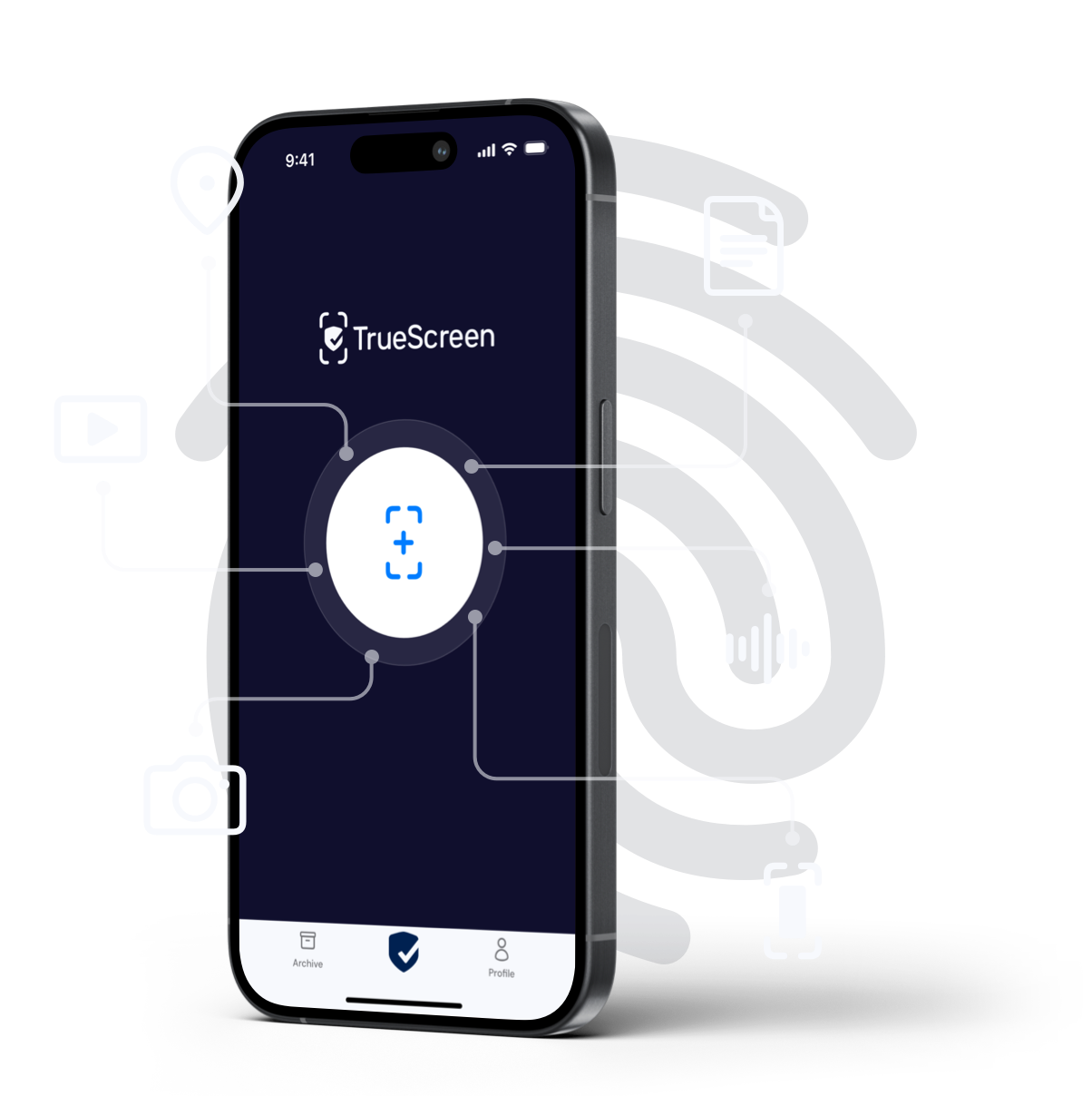
With the TrueScreen platform, source certification plugs into existing business processes without forcing workflow changes. Content is captured directly from the device or system that generates it, and forensic metadata is collected at the same time. The system verifies the integrity of what has been acquired, applies a digital seal and qualified timestamp, and produces a tamper-proof document with full, verifiable digital provenance.
Take a financial institution processing 10,000 documents per month. Under a detection-first approach, every document runs through tools that become less reliable each time a new AI model drops. With source certification, each document arrives pre-certified with a verifiable chain of custody. Verification is instantaneous. Whether you are handling KYC/AML onboarding, insurance claims, or supply chain invoices, certification turns verification from a variable cost that grows over time into a fixed cost that gets cheaper per document as volume scales.
FAQ: Document Forgery and AI
Can AI create fake documents that are indistinguishable from real ones?
How can organizations detect forged documents?
What regulations require organizations to verify document authenticity?
What is the difference between document detection and source certification?
How much does AI document fraud cost businesses?
TrueScreen editorial team
Published on · Updated on
This section is edited by the TrueScreen editorial team, which brings together expertise in digital forensics, the law of digital evidence and regulatory compliance. Every article is checked against primary sources: legislation, published rulings, technical standards and official documentation, always cited in the text.


