Web page certification: how to obtain digital evidence with legal value
Web page certification turns online content into digital evidence with full legal value. Web pages get modified, updated or taken down every day: a defamatory social media post, a fraudulent listing on an e-commerce platform, a contractual clause published on a corporate portal. Anyone who needs to prove what was visible online at a specific moment usually resorts to a screenshot, assuming it will be enough.
The problem is that a screenshot, on its own, carries weak evidentiary weight. Courts in multiple jurisdictions have ruled that digital reproductions are admissible as evidence, but if the opposing party challenges their authenticity, judges can demand additional corroboration. Meanwhile, generative AI makes the creation of fake screenshots increasingly accessible. According to iProov’s 2025 data, only 0.1% of people can correctly distinguish all authentic media from manipulated ones.
Different tools are needed. A forensic certification that captures the page image, yes, but also the full browsing context, with immutable metadata, a qualified timestamp and a digital signature.
Why a screenshot does not guarantee legal value
Digital reproductions and the challenge of authenticity
In most legal systems, digital reproductions such as screenshots can be admitted as evidence. However, their probative strength depends on whether the opposing party contests their authenticity. Under the US Federal Rules of Evidence (Rule 901), electronic evidence must be authenticated before it can be admitted. In the EU, the eIDAS Regulation establishes that electronic documents cannot be denied legal effect solely because they are in electronic form, but their actual evidentiary weight remains subject to national procedural rules.
In practice, a simple screenshot lacks the metadata and chain-of-custody documentation needed to withstand a structured challenge. If the opposing counsel argues that the image was altered, cropped or fabricated, the burden of proving authenticity falls on whoever produced it.
Generative AI and the growing ease of manipulation
The landscape has shifted with generative AI. Creating an image that faithfully reproduces the appearance of a web page, complete with address bar, date and content, now requires minimal skills. Deepfake files grew from 500,000 in 2023 to an estimated 8 million in 2025, a growth rate close to 900%.
Gartner predicts that by 2026, 30% of enterprises will no longer consider standalone identity verification and authentication solutions reliable. Relying on an image without verifiable metadata no longer holds up, technically or legally.
Traditional alternatives and their limitations
Notarized attestation: effective but costly and slow
The most established method for giving evidentiary value to web content is a notarized attestation. A notary accesses the page, certifies its content in an official document and confers full legal force. From a legal standpoint, it works.
The limitations are practical. A notarized attestation can cost from several hundred to over a thousand euros or dollars per session. Response times depend on the professional’s availability. And the process does not scale: an organization that needs to certify dozens of web pages for litigation or compliance cannot go to a notary every time.
Forensic analysis: reliable but not scalable
Forensic acquisition by a technical consultant produces robust results. The expert uses specialized tools to crystallize the content of a page, its metadata and the underlying structure, documenting every step of the chain of custody.
The limitation is the same: specialized skills, significant hourly rates, timelines that stretch. For a single critical case it may be the right choice. For systematic, recurring use, it is not practical.
Certified screenshot services: why they fall short
There are also online services that offer screenshot “certification” by applying a timestamp or digital signature to a captured image. Compared to a manual screenshot they represent a step forward, but they have a structural limitation: they only capture the visible image of the page, without preserving the source code, page resources or browsing context.
If the opposing party challenges the certified screenshot arguing that the image does not reflect the actual page content, there is no way to reconstruct the original. The forensic depth needed to withstand a structured challenge is missing.
How forensic web page certification works
Forensic browser and certified browsing session
Forensic certification of a web page goes beyond a single screenshot. To prove what was published online, a static snapshot is not enough: the entire browsing session needs to be documented. Which pages were visited, in what order, what was visible on screen, what actions the user performed.
The goal is to turn a volatile environment like the web into a verifiable digital asset. The session is recorded from start to finish through a dedicated forensic browser operating in a controlled environment.
The forensic package: video, screenshots, web archive and logs
A complete forensic certification produces a package composed of multiple elements. The session video continuously documents everything the user saw on screen. Certified screenshots capture the specific moments when relevant content was identified. The web archive saves the complete page structure: HTML code, images, graphic resources. Everything needed to reconstruct the page even if the original content is removed.
Then there are the navigation event logs: clicks, page changes, reloads, searches, typed URLs. Together, these elements demonstrate what was published, how the user got there and in what context they found it.
Qualified timestamp and digital signature
The forensic package is sealed with two cryptographic elements. The qualified timestamp, issued by a Qualified Trust Service Provider (QTSP) under eIDAS Regulation (Article 41), binds the data to a precise point in time with a presumption of validity across all EU Member States. The digital signature protects the integrity of the entire package: any subsequent modification would be immediately detectable.
This combination, together with the forensic acquisition methodology, gives the certification evidentiary weight far superior to that of a simple screenshot.

TrueScreen Web Browsing Certification: certify web pages independently
How to start a certified browsing session
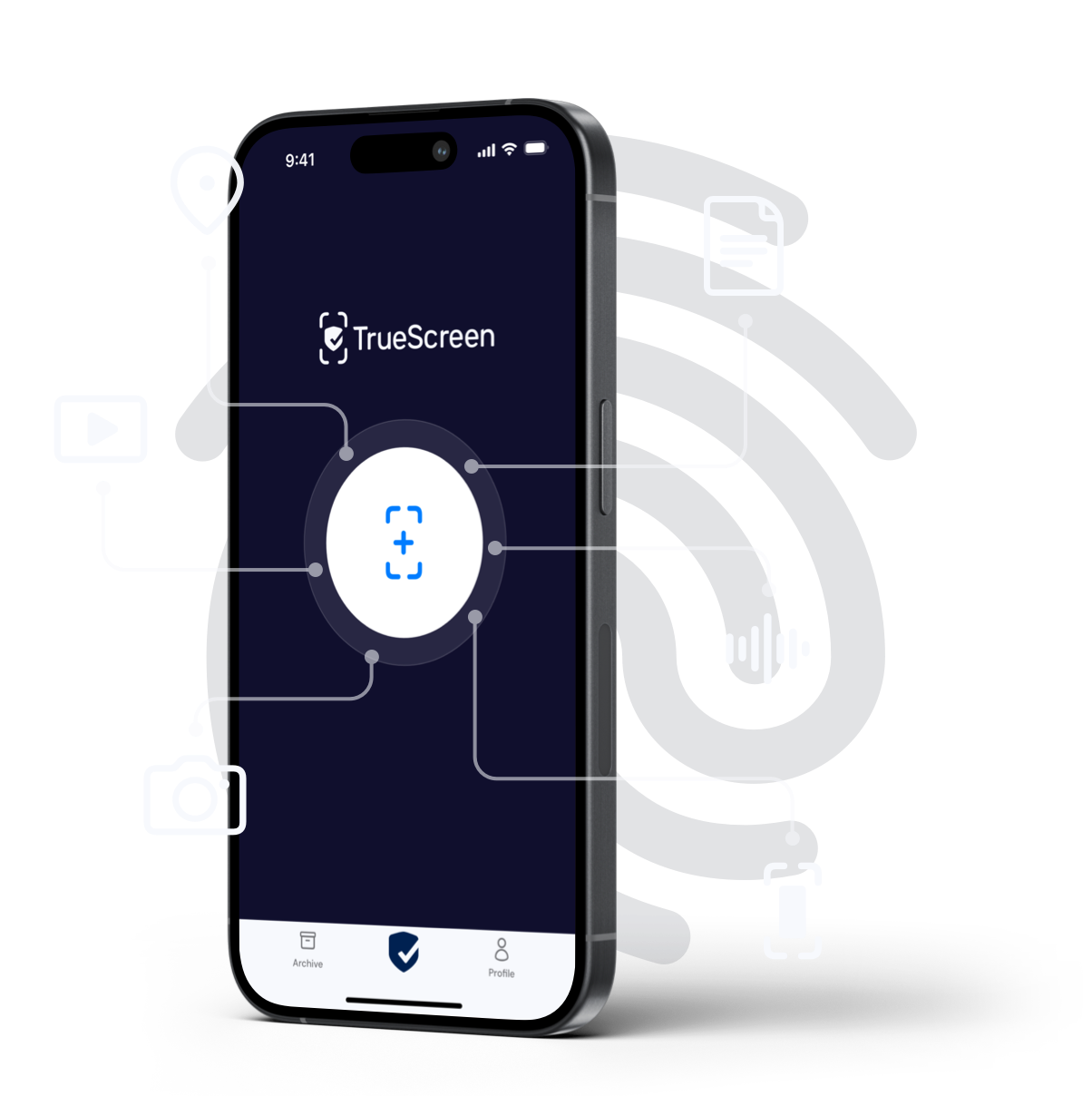
TrueScreen is the Data Authenticity Platform for digital data certification. It includes a patented Web Browsing Certification feature that allows anyone to certify web pages directly from an Android or iOS smartphone, without a notary or forensic expert.
Alongside the Forensic Browser, an application for macOS and Windows that remains the main solution for desktop acquisition, TrueScreen also offers the Web Notarization extension for Chrome and Edge, which lets you quickly certify any content during normal browsing, and the TrueScreen app for iOS and Android, to acquire content from a smartphone: three complementary solutions depending on the device at hand, all feeding the same forensic certification workflow.
The user launches the forensic browser built into the app and starts a certified browsing session. From that moment, the system records a certified video of the screen and documents all interaction events: clicks, forward and back navigation, page reloads, typed URLs, searches.
Multiple captures and context reconstruction
When the user identifies content to preserve, they press the capture button. TrueScreen performs a dual acquisition: a certified screenshot of the visible screen and a complete web archive of the underlying page, with HTML code and resources.
A single session can contain multiple captures. A lawyer collecting evidence of online defamation, for example, can browse through social profiles, websites and different platforms, capturing every relevant piece of content. All captures remain tied to the same session, with shared context, logs and video, demonstrating the chronology and relationships between certified content.
Output: PDF report, JSON, QTSP seal and web archive
At the end, TrueScreen produces a complete forensic package. The PDF report is a readable summary: device used, browsing flow, captures performed, timestamps and technical metadata. The JSON report contains the same information in a structured format, ready for integration with document management systems or case management platforms.
The package also includes the full navigation video, certified screenshots, web archives for each capture and an XML file with the electronic seal and qualified timestamp issued by the QTSP. The entire set is digitally signed, protecting integrity and authenticity over time.
Use cases: defamation, IP protection, fraud, compliance
Web page certification has applications across many fields. In intellectual property protection, it enables documentation of copyright violations, unauthorized use of trademarks or creative content on third-party sites. For attorneys who previously relied on web archives to establish prior online content, understanding the limitations of the Wayback Machine as legal evidence reinforces why real-time certified capture is the stronger approach. In fighting online fraud, it crystallizes scam listings, phishing sites or fake reviews before they are removed.
For law firms, Web Browsing Certification simplifies the collection of digital evidence for civil and criminal litigation, producing evidence with a level of forensic robustness that holds up even against structured challenges. For compliance teams, it is a tool for monitoring and documenting online content relevant to regulatory obligations.