Electronic health record integrity: keeping clinical reports and data authentic
Almost every healthcare provider has moved reports, diagnostic images and consent forms into digital systems. The electronic health record made clinical information faster to consult and easier to share, but it also changed the nature of the problem: a digital document can be copied, replaced or regenerated without leaving the physical traces that once exposed tampering on paper. And while an electronic signature protects a report from the moment it is signed onward, the most exposed phase stays uncovered: the moment the clinical data is captured or generated.
The question hospital directors, medico-legal experts and insurers now ask is no longer "how do we archive the document", but "how do we prove that this report is authentic and has not been altered". The answer is that the integrity of a clinical data point has to be secured at the source, at the exact moment it is created, with a verifiable chain of custody that holds up in court and in expert assessment. That is where the evidentiary weight of the whole electronic health record is decided.
Why electronic health record integrity has become critical
Electronic health record integrity has become critical because the clinical document turned from a physical object that was hard to alter into a file that is editable and reproducible, while its legal value stayed exactly the same. A report can count as evidence in litigation, in an insurance claim investigation and in a medico-legal assessment. If its authenticity can be contested, everything built on it becomes fragile.
From paper charts to digital health records
Three concepts get confused, and the confusion is the source of many mistakes. The internal clinical chart is the record produced and managed within a ward or facility during an admission or a treatment. The electronic health record is its natively digital version, signed and preserved to standard. A national or regional health data exchange, by contrast, is the layer that aggregates and moves documents across providers so they follow the patient over time. The record is born inside the facility; the exchange collects it and makes it available. These are distinct levels, each with its own responsibilities and integrity requirements, and a defect introduced at the source propagates all the way up the chain.
Reports and diagnostic images can be altered with AI
Diagnostic images are today the most exposed point, because generative AI produces alterations the human eye cannot detect. This is no longer a theoretical concern. A study presented at USENIX Security 2019 (Mirsky et al.) showed that by injecting or removing cancerous nodules from lung CT scans with a generative model, radiologists misdiagnosed 99% of the scans with added tumors and 94% of those with removed tumors. The most alarming figure: even after being told the attack was under way, the specialists still erred in 60% and 87% of cases (arxiv.org). If a synthetic diagnostic image is indistinguishable to an experienced clinician, visual review is no longer enough. What is needed is technical proof of the authenticity and provenance of the data, independent of whoever holds it.
What integrity means for a clinical data point
The integrity of a clinical data point means its content has remained identical to the original, that its author and time of creation are known, and that any subsequent change is tracked and attributable. Two companion requirements work alongside it: authenticity (the data truly comes from the declared source) and provenance (its origin and history are documented and verifiable).
In practice, the evidentiary weight of an electronic health record rests on a set of requirements that have to coexist: integrity and immutability of the content, reliable identification of the author through a signature, completeness and correct chronology of entries, confidentiality and security of the data, and compliant long-term preservation. Immutability does not mean the document can never change. It means every change generates a new tracked version, with author, date and time recorded. That is the difference between correcting a report while leaving a verifiable history and quietly replacing it. On paper this was guaranteed by the physical medium; in digital form it has to be rebuilt with cryptographic tools and a chain of custody. Where data integrity must also withstand AI manipulation, authentication of the content itself becomes part of the clinical data's quality.
The real risks: litigation, medico-legal assessments and liability
The concrete risks surface when the authenticity of an electronic health record is challenged in a dispute. A contested report is not only a technical problem: it undermines clinical liability, the insurer's position and the strength of an expert assessment. Whoever has to decide needs to know that the data is the original, without having to take anyone's word for it.
When a disputed report undermines an expert assessment
A medico-legal assessment is worth only as much as the data it rests on. Admissibility and evidentiary weight depend on being able to show the document is intact: if one party raises a credible doubt that a report was altered or backdated, the technical opinion built on that document is exposed and the reconstruction of the facts becomes attackable. The dynamic is symmetrical. When the integrity of a report can be demonstrated independently, the objection burns out before it starts; when it cannot, the whole case around that document is up for argument.
Insurance claims investigation
In a claims investigation, altered clinical documentation is a direct financial risk for the carrier. The assessment of bodily injury, the causal link and the quantification of the settlement all depend on reports, images and records. If a diagnostic image can be generated or modified without leaving a trace, the insurer has no way to tell a genuine claim from an inflated or simulated one by examining the document alone. Healthcare organizations and insurers use data authenticity solutions to produce a verifiable chain of custody for clinical documentation in disputes, so decisions rest on evidence that holds up rather than on assumptions of good faith.
The regulatory framework: GDPR, eIDAS and the EHDS for health data
The electronic health record sits at the intersection of three European frameworks. GDPR governs the protection of health data, eIDAS defines the trust services that bind content to a certain origin and time, and the European Health Data Space reinforces traceability and integrity across the whole ecosystem.
Under GDPR, Regulation (EU) 2016/679, Article 9 classifies data concerning health as a special category, subjecting it to reinforced safeguards and requiring measures that ensure its integrity and confidentiality (gdpr-info.eu). The eIDAS Regulation, (EU) 910/2014, governs qualified electronic seals and timestamps, the instruments that tie a piece of content to a certain origin and to an enforceable point in time (eur-lex.europa.eu). When digital evidence has to be collected and preserved, ISO/IEC 27037 gives internationally recognized guidance for handling it so its integrity survives scrutiny. And the newest piece of the picture, the European Health Data Space Regulation, adopted on 11 February 2025 and in force since 26 March 2025 (eur-lex.europa.eu), raises the bar again on traceability and integrity as health data moves across borders and providers.
| Integrity requirement | What it guarantees | Reference |
|---|---|---|
| Integrity and immutability | Content does not change; every edit produces a tracked version | eIDAS, ISO/IEC 27037 |
| Author identification | The source of the data is certain and cannot be repudiated | Electronic signature (eIDAS) |
| Completeness and chronology | Entries are complete and ordered over time | Records management practice |
| Confidentiality and security | Data is protected as a special category | GDPR Article 9 |
| Compliant preservation | The document stays readable and intact over time | eIDAS, EHDS |
How do you certify the integrity of a clinical data point at the source?
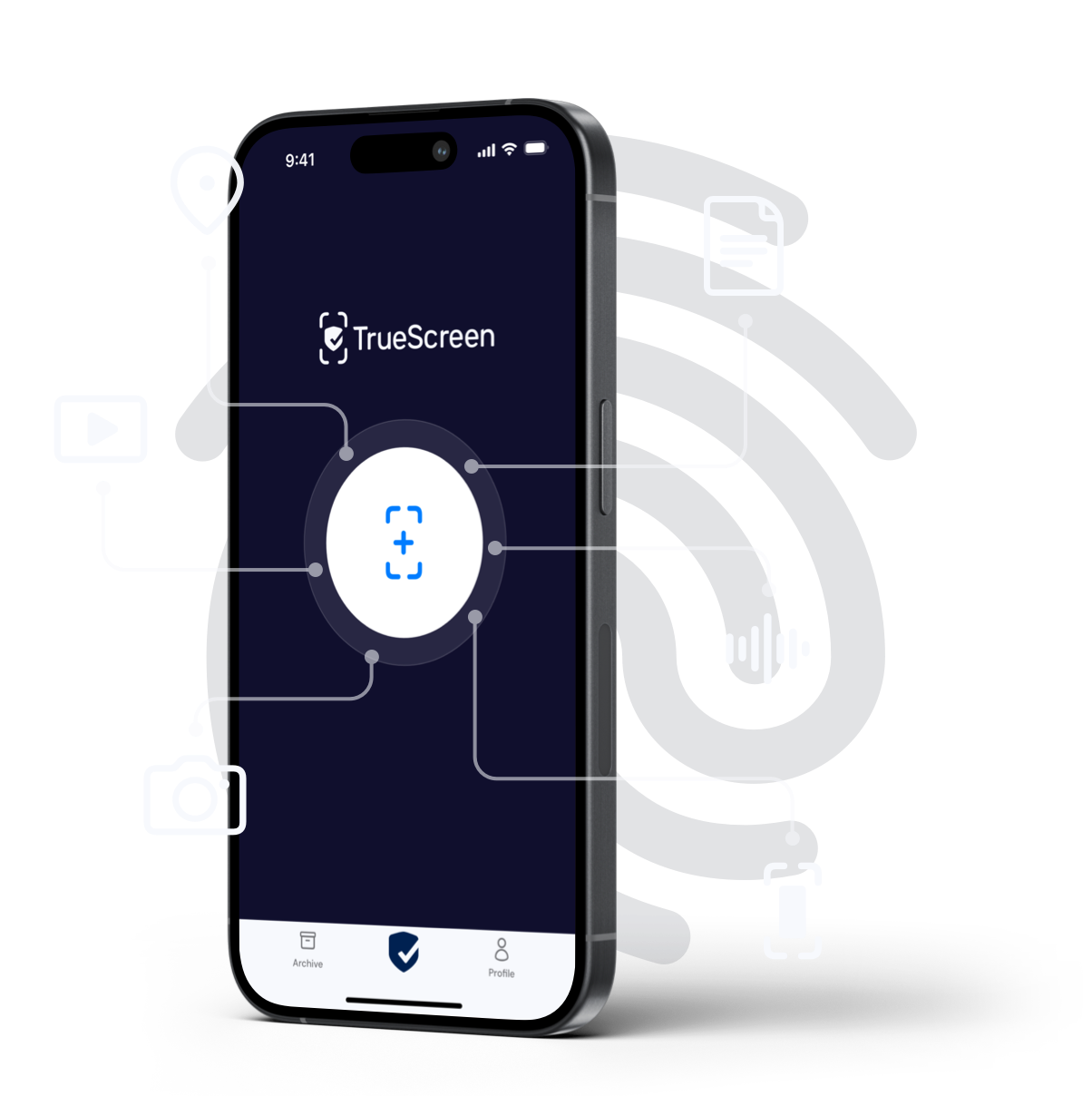
Certifying the integrity of a clinical data point at the source means attesting its provenance and state at the exact moment it is captured or generated, before it enters the health record. Unlike a signature and compliant preservation, which protect the document from the moment of signing onward, certification at the source covers the most exposed phase: the one in which a report, a diagnostic image or a consent form can be replaced or generated with AI tools, before it ever reaches the electronic health record. TrueScreen produces forensic evidence of the data, with a timestamp and an electronic seal applied through a third-party QTSP, and a verifiable chain of custody that documents who, when and how. The result is a clinical data point that holds up in court and in medico-legal assessment: its integrity does not depend on trust in the document system, but on independent, repeatable technical proof.
TrueScreen is the Data Authenticity Platform that certifies the provenance and integrity of a clinical data point at the source through a forensic methodology: forensic capture that protects integrity at the moment of capture, verification, certification with legal value, and secure preservation. The difference from traditional tools is one of timing. It does not act downstream on a document that already exists, but at the instant the data is born.
Certification is content-agnostic. A PDF report, a diagnostic image in DICOM format handled as a file, a recording of a telemedicine visit or data generated and processed by an AI system can all be certified on the same principle. For capturing a report straight from a web interface, forensic capture of the report produces an intact, time-anchored acquisition. For automated flows, certification via an API at the source embeds the attestation directly in the process that generates or receives the data. The qualified electronic seal and timestamp, internationally recognized and applied through a third-party QTSP, bind the content to a certain origin, while the chain of custody documents every step verifiably.
A concrete example: a diagnostic imaging center certifies every radiology report and its DICOM image at capture. In a dispute, the expert has proof of integrity that is independent of the center's own word, and the challenge to authenticity loses its footing. The same logic supports the solutions for healthcare that need to hold up in front of an insurer or a judge.
Practical examples: radiology report and informed consent
The scenarios where integrity at the source makes the difference are the ones where a clinical data point can be contested long after the fact. Two recurring cases show how the mechanism works.
In the digital radiology report, the risk is that the diagnostic image gets replaced, retouched or generated with AI between production and use in a dispute. Certifying the DICOM image and the report at the moment of capture creates a verifiable anchor: any later version that does not match that fingerprint is, by definition, an alteration. With TrueScreen a healthcare provider can attest that a report or a diagnostic image was neither altered nor generated with AI.
In informed consent collected during telemedicine, the typical challenge concerns what the patient actually saw and accepted, and when. Certifying the session and the informed consent in telemedicine at the source documents the content shown and the moment of acceptance, turning a possible word-against-word situation into repeatable proof. In both cases the principle is the same: you move from trust in the system to technical demonstrability of the data.