
Photovoltaic handover inspection with storage: how to certify it with legal value
A photovoltaic system with battery storage is supposed to be handed over once, cleanly, with the site closed behind it. In practice the handover is where the trouble starts. The installer leaves convinced the job was done to a workmanlike standard, the customer signs the handover record, and months later the dispute lands: a scratched module that "was already like that", fire-safety measures in the battery room "that were never carried out", a Declaration of Conformity "never received". From that point on, one party's word weighs exactly as much as the other's, and whoever kept the better proof tends to win.
A photovoltaic system handover inspection with storage is therefore the moment where both parties' liability is decided, and it is almost never documented in a way that holds up. Photos stay on the installer's phone with no certain date. The handover record is a signed sheet anyone can contest. The Declaration of Conformity changes hands and leaves no trace. There is a concrete way out of this: the state of the system at the moment of handover can be locked down with legal value, turning the evidence into something neither side can later rewrite.
This guide sets out what the handover inspection requires under IEC/CEI EN 62446-1, which fire-safety duties the latest fire-brigade guidelines introduce for lithium-ion storage, and how to give defensible proof of both the workmanlike state of the system and the actual handover of documentation.
Why the handover of a photovoltaic system with storage is the most critical moment
The handover inspection is the most critical moment because it draws the line between the installer's responsibility and the customer's, yet it rarely produces objective proof of the system's condition at that precise instant. With a lithium-ion battery the stakes climb higher: beyond the electrical side, specific fire-safety duties come into play, and components whose state has to be documented with care.
The handover record of a photovoltaic system with storage marks the transfer of liability from installer to customer. Without objective, dated proof of the system's state at that moment, a later dispute collapses into one party's word against the other's, with an uncertain outcome before a court or an insurance assessor.
Typical disputes after handover
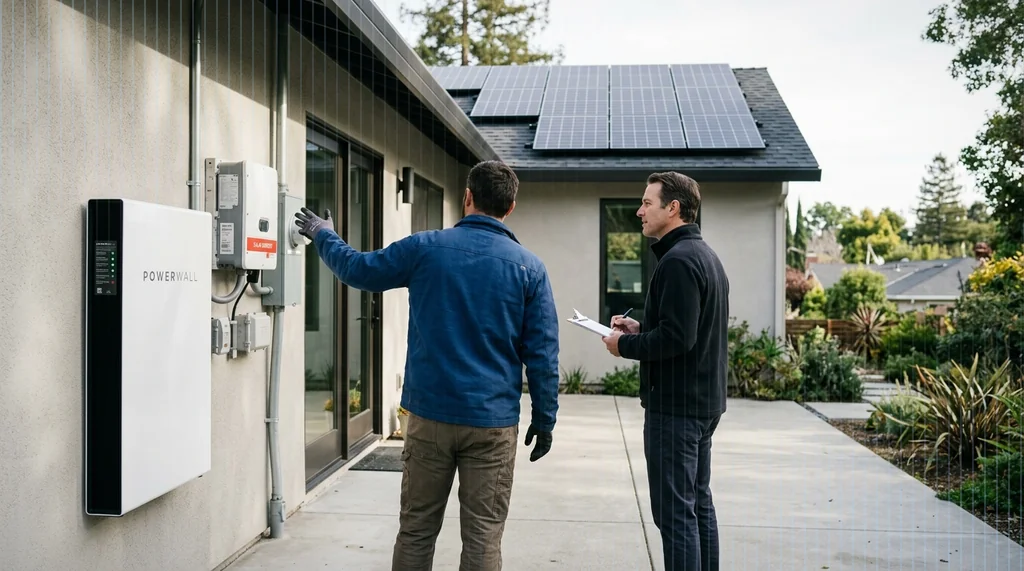
The most frequent disputes circle the same few themes. First, the physical condition of components: modules with micro-cracks or scratched glass, badly seated connectors, mounting structures showing early corrosion. Who caused them? Without a dated photo taken at handover, there is no answer.
Then there are the safety measures in the battery room: missing ventilation, distances not respected, absent signage, thermal detection never installed. The customer claims they were never there, the installer swears they were. And finally the documentation, with the classic Declaration of Conformity "never received", the use manuals not handed over, the battery datasheets that vanished.
In every one of these cases the problem is not technical, it is evidential. What is missing is proof that ties a fact to a date in a way no one can attack.
What installer and customer risk without objective proof
Without objective proof, the installer risks paying for damage they did not cause and being unable to show they handed everything over. A dispute over a damaged module surfacing months later can turn into a replacement claim charged to whoever installed the system, even when the damage happened after handover.
The customer faces the opposite risk: receiving a system with undocumented defects and having no foothold to claim against, because no one photographed anything at commissioning. And in the event of a loss, the insurer will ask for proof of the workmanlike state at the point of entry into service: if that proof does not exist, the payout can fall through. The acceptance inspection protects both parties only when it leaves a defensible trail.
What the handover inspection requires: IEC/CEI EN 62446-1
IEC/CEI EN 62446-1 is the reference standard for inspection, testing and documentation of grid-connected photovoltaic systems: it sets out what to verify at commissioning and which report to hand the customer. At the end of the handover tests the installer produces a verification report covering both visual checks and instrumental measurements, and delivers it to the customer as part of the end-of-works documentation.
One point matters here. The standard (2016 edition with amendment A1:2018) is written for grid-connected systems without storage. For the battery, the fire-safety requirements come from the fire-brigade guidelines covered further down. At commissioning, then, the installer also inspects the battery room visually, while the detailed instrumental measurements stay in the attached technical report.
Visual checks vs instrumental tests
IEC/CEI EN 62446-1 distinguishes two families of controls. Visual checks are the visual inspection of modules, mounting structures, cabling, protections, earthing and labelling. Instrumental tests measure electrical quantities: continuity of protective conductors, insulation resistance, string tests. Detailed thermography belongs to the instrumental tests. The standard also classifies tests into Category 1, applying to all systems, and Category 2, for larger or more complex installations.
| Type of control | What it verifies | Examples under IEC/CEI EN 62446-1 |
|---|---|---|
| Visual checks | Physical state and installation | Modules, mounting structures, cabling, protections, earthing, labelling and signage |
| Instrumental tests Cat. 1 | Basic electrical quantities | Continuity of protective conductors, insulation resistance, string tests |
| Instrumental tests Cat. 2 | Additional verifications | Larger or more complex systems, detailed thermography |
For anyone documenting the handover inspection, the distinction is operational: visual checks get photographed on site at commissioning, while instrumental measurements produce values that go into the attached technical report.
The minimum documentation to hand over
At the end of the works the installing company issues the system Declaration of Conformity, together with its mandatory attachments. The handover is more than a single sheet: it includes the project and wiring diagrams, the report on material types, the certificates and datasheets of the components including the battery, the company references, plus the use and maintenance manuals and the safety documentation.
The Declaration of Conformity is the document the installing company issues at the end of the works, accompanied by mandatory attachments: project and wiring diagrams, report on materials, datasheets of the components including the battery. Together with the use manuals and the safety documentation, it forms the minimum package to hand to the customer.
The weak spot is not producing these documents, but proving they were handed over. A hand delivery with no receipt leaves room for the usual "never received".
Lithium-ion storage: the fire-safety obligations (Italian VVF guidelines DCPREV 14030/2025 and 21021/2024)
Lithium-ion storage introduces specific fire-safety obligations, which the Italian fire brigade (VVF) guidelines made more explicit between late 2024 and 2025. Note DCPREV 14030 of 1 September 2025 sets out guidelines for photovoltaic systems. Circular DCPREV 21021 of 23 December 2024 is the specific reference for risk analysis and fire-safety measures for electrical energy storage systems (BESS), in line with the Ministerial Decree of 7 August 2012.
Note 14030/2025 applies to systems with nominal DC voltage up to 1500 V on civil, industrial, commercial and rural buildings subject to fire-brigade controls. For lithium-ion storage it requires assessing the fire and explosion risk linked to thermal runaway, considering location, ventilation, compartmentation and distances from escape routes.
The thermal runaway risk
Thermal runaway is the failure mechanism most feared in lithium batteries: a single cell overheats and triggers an uncontrolled exothermic chain reaction, with rapid rises in temperature and pressure, possible release of toxic gases such as hydrogen fluoride, and explosion.
Thermal runaway is an uncontrolled exothermic chain reaction that starts from a single overheated cell in a lithium-ion battery and spreads to the neighbouring cells. It produces rapid rises in temperature and pressure, releases toxic gases such as hydrogen fluoride, and carries a risk of explosion: it is the reason the fire-brigade guidelines impose dedicated measures for storage systems.
It is this mechanism that justifies measures a photovoltaic-only system would not need. For whoever hands the system over, it means the state of the battery room has to be documented with the same care given to the electrical side.
Location, REI/EI 30 fire compartmentation, ventilation, distances, signage, thermal detection
The fire-safety measures for the storage system concern both the physical placement of the battery and the protections of the room that houses it. When the batteries sit indoors, for example in a garage or a technical room, they must be placed in ventilated rooms compartmented with fire-resistant materials.
For lithium-ion storage the fire-brigade guidelines require assessing location, ventilation, compartmentation and distances from escape routes. For indoor installations, the batteries must go in ventilated rooms compartmented with fire-resistant materials, with safety signage and early thermal detection devices.
| BESS fire-safety measure | Reference | Purpose |
|---|---|---|
| REI/EI 30 compartmentation | DCPREV 21021/2024, DM 7 August 2012 | Contain a possible fire within the battery room |
| Room ventilation and aeration | DCPREV 14030/2025 | Avoid build-up of heat and gases |
| Safety distances | DCPREV 14030/2025 | Separate from combustible materials, openings, escape routes |
| Safety signage | DCPREV 21021/2024 | Identify the risk and the procedures |
| Early thermal detection | DCPREV 21021/2024 | Catch thermal runaway at its onset |
These are all measures the installer checks at handover and that make sense to photograph: the ventilation grilles, the signage posted, the detector installed, the distances kept.
Inverters and converters: aeration and ventilation
Inverters and DC/DC converters are among the components to document at handover too. Note 14030/2025 requires aeration and adequate ventilation of the places where these devices are installed, so as to avoid heat build-up. In practice, at commissioning you verify that the inverter is positioned in an environment that dissipates heat well and that nothing obstructs the circulation of air.
The weak point: how do you actually prove the state of the system at handover
The real weak point is not the quality of the work but the quality of the proof: in current practice the state of the system at handover is documented by phone photos and a paper record, both easy to contest. A photo with no certain date does not show when it was taken. A signed record proves neither the physical condition of the components nor the actual handover of the documents.
At the end of the handover inspection you reach a paradox: the installer worked to a workmanlike standard, the customer received everything, and yet neither holds proof that would stand before a judge or an insurance assessor. The signature on the record attests to an agreement, not to the state of the premises. The photos prove an image, not a date. And documents handed over by hand leave no trace of the transfer.
What is needed is a way to bind together the images of the system's state, the exact moment they were captured, and the documentation handed over, in a single file that neither party can alter after the fact.
How to certify the handover inspection with legal value
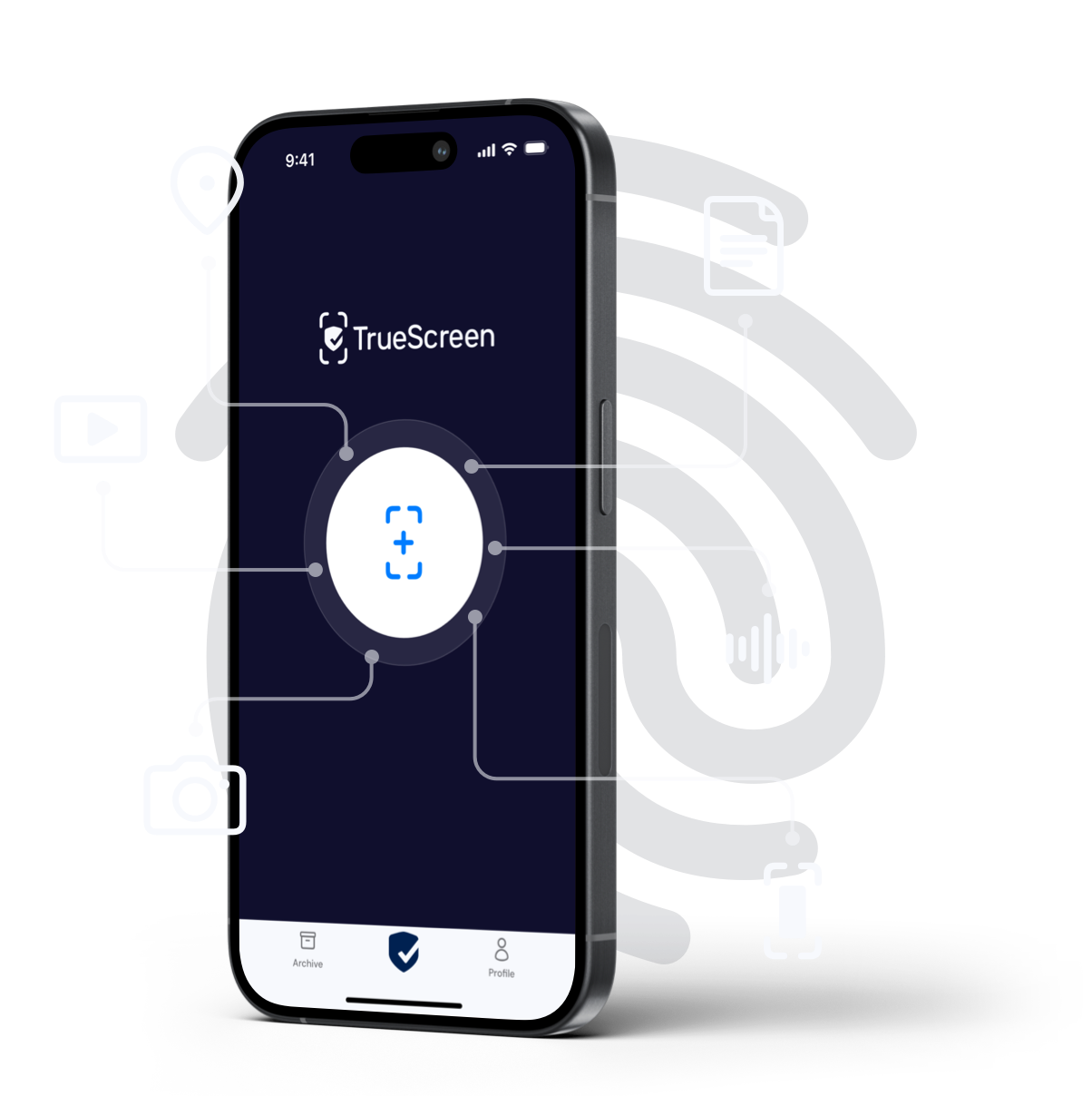
The handover inspection gains legal value when the visual evidence and the documents are captured and certified with forensic methodology at commissioning, obtaining a certain date, verifiable integrity and defensible attribution. That is what TrueScreen does: it captures photos, videos and documents of the inspection, verifies their integrity, and certifies them by integrating the electronic seal and timestamp of qualified third-party QTSPs, with the legal value recognised under the eIDAS framework.
One point has to be stated without ambiguity, because it defines the boundary of the service. TrueScreen certifies the evidence of the inspection, not the technical compliance of the system. The Data Authenticity Platform locks down, beyond dispute, what was photographed and when, and which documents were handed over. It does not replace the professional's commissioning, does not attest that the system meets regulations, and does not issue fire-safety certificates. The technical assessment stays with the installer and the qualified technicians. TrueScreen is not a certification body or a trust service provider: it integrates the seal of qualified third-party QTSPs via API.
Visual evidence immutable at the source
Visual evidence becomes defensible when it is certified at the very instant of capture, not afterwards. With the TrueScreen app the installer photographs or films the state of the modules, the battery room, the signage and the protections, and every file is certified at the source with electronic seal and timestamp: this gives the certain date and the proof of integrity that a photo on a phone can never have. If a module is intact at handover, the certified photograph shows it in a way no one can challenge on date or content.
Delivered documents certified and double signature of installer and customer
The handover of documentation becomes provable when the file is certified and signed by both parties. The Declaration of Conformity, the diagrams, the battery datasheets and the manuals are gathered into a single certified file. With the double signature, installer and customer sign the same document through advanced electronic signature (FEA/AES). From that moment the "never received" no longer holds: there is proof signed by whoever delivers and whoever receives, with a certain date. The digital signature closes the loop between visual evidence and formal acceptance.
Where it is used: App, Web Portal, API and SDK
The same certification process runs across the different TrueScreen tools, depending on how the company works. On site the installer uses the app to capture and certify photos and videos in real time. From the office, the Web Portal handles the files, gathers the documents and gets the parties to sign. For anyone running a site-management or asset-management system, the API and SDK embed certification directly into their own workflow, so every handover automatically generates its certified file with no manual steps.
An example: an EPC handing over twenty residential systems with storage a month can standardise the acceptance. For each site, certified photos of the modules and the battery room, a documentary file signed by installer and customer, and a defensible archive ready in case of a dispute or an insurer's request.
FAQ: photovoltaic handover inspection with storage
Is handover commissioning mandatory for photovoltaic with storage?
Who can do the handover inspection?
Which documents have to be handed over at the end of the works?
What does IEC/CEI EN 62446-1 require for handover?
What are the 2025 fire-safety rules for storage systems?
Are lithium batteries a fire risk?
Does the handover record have legal value?
TrueScreen editorial team
Published on · Updated on
This section is edited by the TrueScreen editorial team, which brings together expertise in digital forensics, the law of digital evidence and regulatory compliance. Every article is checked against primary sources: legislation, published rulings, technical standards and official documentation, always cited in the text.


