What is a Data Authenticity Platform?
Every day, organizations across every sector make operational, legal, and compliance decisions based on digital data: photographs, videos, documents, emails, files of every kind. For decades, the implicit assumption was straightforward: a piece of digital content is authentic until proven otherwise. That assumption no longer holds. In a world where any content can be fabricated, altered, or stripped of context in seconds, the question is no longer whether a piece of data has been manipulated. The question is whether there is a way to guarantee its authenticity at the source. The answer lies in a new kind of infrastructure: a data authenticity platform that certifies data the moment it is captured, before any manipulation can intervene. This is not a marginal improvement to existing verification methods. It is a fundamental shift in how organizations establish trust in the information they depend on.
Why digital data has become unreliable
Beyond deepfakes: a trust crisis across the entire digital ecosystem
When people talk about digital manipulation, the conversation tends to start with deepfake videos. The phenomenon is real: detected cases globally went from roughly 500,000 in 2023 to over 8 million in 2025, a 900% increase according to industry analyses. In 2024, a deepfake fraud attempt occurred every five minutes.
But focusing on deepfakes alone misses the bigger picture. The crisis extends to the full spectrum of digital content: retouched or synthetically generated photographs, documents forged with tools available to anyone, spoofed emails, altered timestamps, shifted GPS coordinates. A photograph submitted as evidence in an insurance claim may have been taken at a different location, on a different date, or may depict a scene that never existed. A contract PDF may carry a forged signature. An email thread presented in litigation may include messages that were never sent. Any piece of information an organization receives, stores, or relies on as evidence may have been tampered with before it even enters the system.
The technical barrier to content manipulation has effectively collapsed. What once required specialized skills and expensive equipment now takes minutes with consumer-grade software or freely available AI tools. This democratization of forgery means that the threat is no longer limited to sophisticated attackers. Anyone with a smartphone and an internet connection can produce convincing fakes.
The outcome is what researchers call the liar's dividend: you no longer need to create a fake to cause damage. The mere possibility that a piece of content could have been manipulated is enough for even authentic data to lose credibility. When everything can be false, nothing is considered true. The liar's dividend works in both directions: fabricated content can be presented as real, and real content can be dismissed as fabricated. For organizations that rely on digital data for decisions with legal, financial, or operational consequences, this ambiguity is corrosive.
The numbers behind the problem: from the WEF to Gartner
Major international institutions confirm the scale of the issue. The World Economic Forum ranked misinformation and disinformation as the number one short-term global risk in the Global Risks Report 2025, placing it in the top 10 across 67 countries. In the 2026 edition, disinformation remains at number two in the two-year outlook, present across every region from North America to Eastern Asia, from Europe to the Middle East.
On the technology front, Gartner placed digital provenance among its Top 10 Strategic Technology Trends for 2026, defining it as the ability to verify the origin, ownership, and integrity of software, data, media, and processes. By 2029, Gartner warns, organizations that fail to invest in digital provenance capabilities will face compliance risks and potential losses amounting to billions.
These are not abstract forecasts. Regulatory authorities in multiple jurisdictions are already tightening requirements around data integrity and evidence admissibility. Insurance companies are tightening fraud controls. Courts are raising the bar on what constitutes reliable digital evidence. The organizations that lack the infrastructure to prove the authenticity of their data will find themselves exposed: to fraud, to litigation, and to regulatory penalties.
The paradigm shift: guarantee the true, don't recognize the false
Detection vs. generation: an asymmetric economy
The instinctive response to digital manipulation is to invest in detection tools: algorithms that analyze content and attempt to determine whether it is authentic or forged. This strategy has a structural flaw. Generation technologies improve at an exponential rate, while detection capabilities advance linearly. Each new generative model outpaces existing detectors, and the race becomes structurally unwinnable.
A detector that correctly identifies 95% of synthetic content today could drop to 80% within months as generative models improve. In a legal or insurance context, a 20% error margin makes any conclusion unusable. No court will accept evidence authenticated by a tool that is wrong one time in five. No insurer will base a million-euro settlement on a probability score.
The economics reinforce the asymmetry. Building a new generative model costs a fraction of what it costs to build a reliable detector, and the generative model can be deployed instantly to millions of users. Detection, by contrast, requires continuous retraining, constant dataset updates, and domain-specific calibration. Organizations that bet on detection as their primary defense are investing in a capability that degrades over time. The cost of staying current rises while the reliability falls.
There is a deeper problem with detection-first approaches. Even when a detector works, its output is probabilistic: "this content has a 92% likelihood of being authentic." Probabilistic answers are insufficient when the stakes involve legal liability, regulatory compliance, or operational decisions with irreversible consequences. What organizations need is not a probability estimate. They need certainty.
From "true until proven false" to "certified at the source"
The alternative to detection is its opposite. Instead of trying to recognize fakes after the fact, you guarantee authenticity at the moment of creation or capture. When data is born certified, with verified metadata, a digital signature, a qualified timestamp, and a complete chain of custody, any subsequent manipulation becomes instantly detectable. The question "is this content authentic?" no longer needs asking: the answer is already embedded in the data itself.
This inversion of the burden of proof is not a technical refinement. It is a change in the operating model. Under the old paradigm, organizations assumed data was trustworthy and investigated only when suspicion arose. Under the new paradigm, no data is considered reliable unless it carries cryptographic proof of its origin, integrity, and provenance. The shift mirrors what happened in physical security decades ago: from relying on guards to spot intruders, to designing buildings where unauthorized access is structurally impossible.
This is the principle on which TrueScreen is built: creating digital trust through an infrastructure that makes data reliable at the source, rather than trying to verify it when it is already too late.
How a Data Authenticity Platform works
Capture, verification, and forensic certification
A data authenticity platform operates on three integrated levels. The first is capture: the digital content (photo, video, audio, document, email, GPS position, screen recording, web browsing session) is acquired through a controlled process that simultaneously records all relevant metadata: device used, geolocation, date and time, technical file parameters, network information, and sensor data. The capture process is designed to prevent tampering at the point of origin: the data is secured before it leaves the device.
The second level is verification: the platform analyzes the captured metadata in real time to confirm consistency between the content and the context of acquisition. Does the GPS position match the claimed location? Are the device identifiers consistent? Do the timestamps align with the server clock? Anomalies are flagged before the data enters the certified workflow, ensuring that only verified content receives certification.
The third level is certification: the verified content is sealed using a forensic methodology that preserves its integrity and authenticity for its entire lifecycle. At the close of the process, a comprehensive technical report documents every step from capture to final certification. This report serves as the evidentiary backbone: a single document that traces the full provenance of the certified content.
Digital signature, qualified timestamp, and chain of custody
The certification rests on three distinct cryptographic elements. The digital signature ensures the content has not been altered after certification: even the modification of a single bit invalidates the signature and makes tampering immediately visible. Unlike simple checksums, a digital signature binds the content to a specific identity and moment in time, creating a non-repudiable record.
The qualified timestamp, issued by an international Qualified Trust Service Provider (QTSP), assigns a legally binding date that is enforceable across jurisdictions. This is not a server timestamp that can be manipulated: it is a cryptographic attestation from a trusted third party, recognized under the eIDAS framework and equivalent international regulations.
The cryptographic hash creates a unique fingerprint of the file: if the file changes, the hash changes with it and the chain of custody is broken. The hash function is one-way: knowing the hash reveals nothing about the content, but any alteration to the content produces a completely different hash. This makes it mathematically impossible to modify certified content without detection.
Combined within a process that conforms to international forensic standards, these three elements produce digital evidence with probative value usable in any legal context.
The technology architecture of TrueScreen
Mobile App, Web Portal, SDK, and API
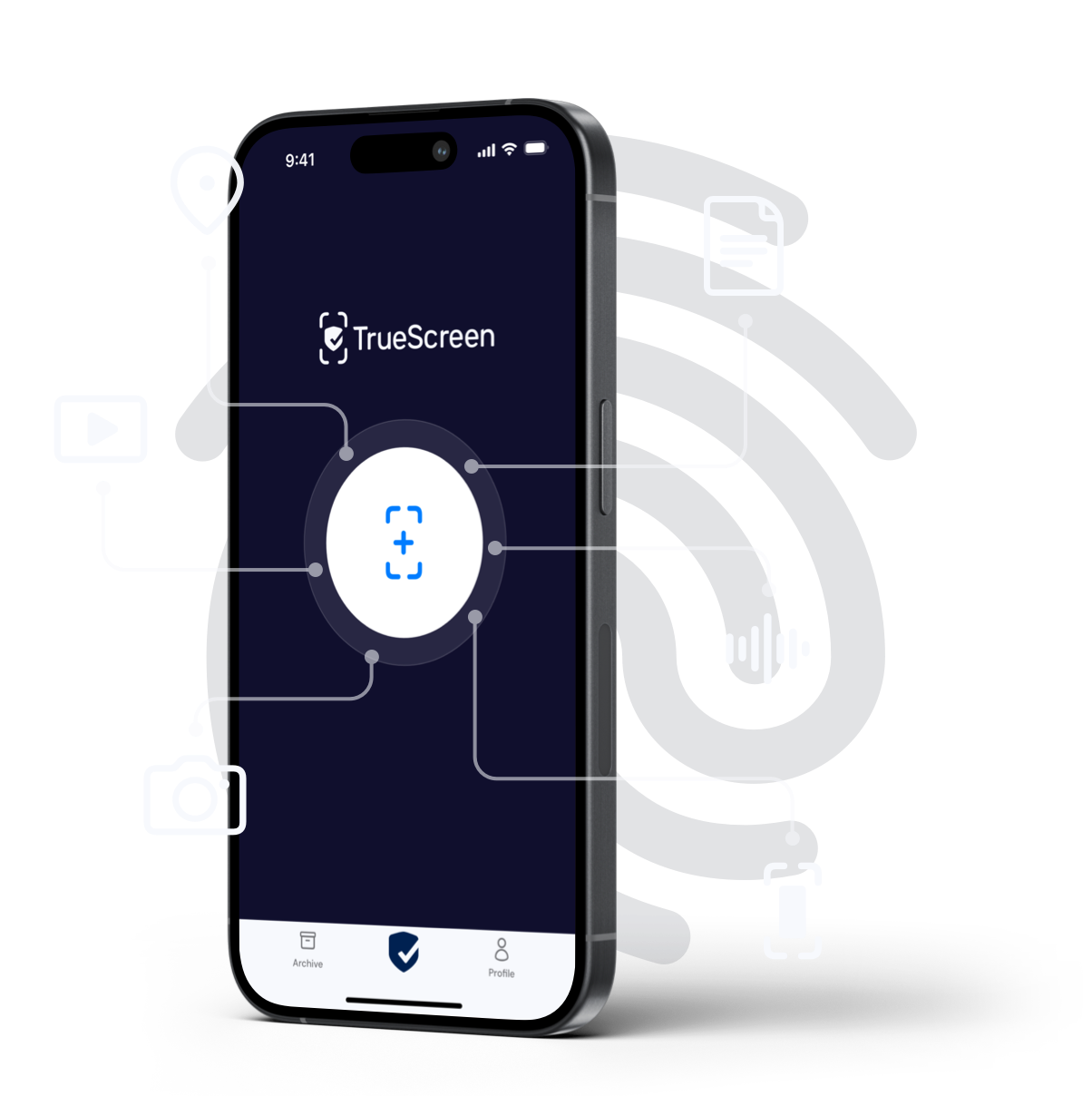
TrueScreen is designed as an end-to-end platform accessible through complementary channels. The Mobile App enables certified capture directly in the field, from the operator's smartphone: an insurance adjuster documenting a claim, an inspector flagging a non-compliance, an attorney gathering evidence for litigation. The app controls the capture process from start to finish, preventing any opportunity for the operator to alter the content before certification.
The Web Portal extends the same capabilities to desktop environments, with tools for managing, archiving, and sharing certified data. Organizations can build repositories of certified evidence, set access controls, and generate reports for internal use or external presentation.
For organizations that need to embed certification into their own systems, SDK and API allow TrueScreen's capabilities to be incorporated into existing applications: enterprise management systems, workflow platforms, ticketing systems, CRMs. A logistics company can certify delivery photographs directly within its fleet management software. A healthcare provider can certify clinical images within its electronic health record system. The technology is available in SaaS mode, with no infrastructure to install.
Whitelabel Technology and Workflow Engine
With the Whitelabel Technology, organizations can offer certification capabilities under their own brand, embedding them into their products and services without end users being aware of an external system. This is particularly relevant for insurance companies, financial institutions, and technology providers that want to offer data certification as a native feature of their platforms.
The Workflow Engine allows custom certification and acquisition processes to be configured: rules, approval flows, mandatory fields, and automations tailored to each business use case. A construction company can define a workflow that requires geolocated photos at specific project milestones. An insurance company can configure a claims workflow that mandates certified photographic evidence before processing. The engine adapts to the process, not the other way around.
European data centers and international patents
The entire infrastructure runs on data centers located in Europe, in compliance with GDPR data residency requirements and European regulations on data protection. The platform is protected by international patents covering its methodology and technological architecture, ensuring that the core innovation remains proprietary and defensible.
Legal value and international compliance
ISO/IEC 27037, ISO/IEC 27001, and the eIDAS framework
TrueScreen's certification methodology is built around the leading international regulatory standards and frameworks. ISO/IEC 27037 sets guidelines for identifying, collecting, acquiring, and preserving digital evidence: TrueScreen applies these guidelines at every stage of the process, from capture to final report generation. This standard is the international reference for digital forensics, and compliance with it is a prerequisite for evidence admissibility in many jurisdictions.
ISO/IEC 27001 certification guarantees that the information security management system meets international requirements for confidentiality, integrity, and availability. The eIDAS regulation (EU Regulation 910/2014) provides the European legal framework for electronic signatures and trust services: the platform uses qualified timestamps and digital signatures recognized throughout the European space and beyond. GDPR compliance ensures that personal data processing meets the principles of lawfulness, data minimization, and protection by design.
The Budapest Convention on Cybercrime provides the principal international treaty framework for electronic evidence, establishing standards for its collection, preservation, and cross-border exchange. UNCITRAL guidelines on electronic commerce and electronic evidence provide additional international frameworks that support the admissibility and probative value of digitally certified evidence. Organizations operating globally can rely on certified evidence that meets the evidentiary requirements of multiple legal systems without needing separate certification processes for each jurisdiction.
The technical report as evidence in proceedings
At the close of every certification, TrueScreen generates a forensic technical report documenting the full chain of custody: device used, GPS coordinates, timestamps, cryptographic hashes, applied digital signature, trust service provider. The report is structured for presentation in judicial, arbitral, and regulatory proceedings as documentation of the authenticity, integrity, and certified date of the content.
The practical impact is measurable. Organizations that adopt forensically certified data report a marked reduction in disputes over the validity of digital evidence. Claims that would previously have been contested on grounds of potential manipulation are resolved faster when supported by certified evidence with a complete chain of custody. The cost of litigation decreases, settlement times shorten, and the evidentiary foundation of organizational decisions becomes substantially stronger.
Who needs a Data Authenticity Platform
Insurance, legal, and construction
Claims managers and fraud investigators in the insurance and claims sector handle thousands of photographic and documentary pieces of evidence every day for assessments, settlements, and disputes. The financial exposure is significant: a single fraudulent claim supported by manipulated photographs can cost hundreds of thousands of euros. Certifying at the source eliminates doubt about manipulation and shortens claim processing times, while providing fraud teams with an objective, cryptographically secured evidentiary base.
Attorneys, legal counsel, and law firms in the legal sector need digital evidence with certain probative value. Forensic certification transforms a screenshot, a video, or an email into evidence usable in court, with a documented chain of custody and an enforceable certified date. In an era where opposing counsel can challenge the authenticity of any digital exhibit, pre-certified evidence eliminates this line of attack entirely.
Project managers, site directors, and HSE managers in real estate and construction document inspections, progress reports, site conditions, and non-conformities. Digital certification replaces fragmented paper-based processes with geolocated, date-stamped, legally valid evidence. When a dispute arises over construction defects or workplace safety compliance, certified documentation provides an unassailable record of conditions at specific points in time.
Industry, public sector, energy, and media
Quality assurance managers and compliance officers in industry and quality certify quality controls, line inspections, and product non-conformities. When regulatory authorities audit a manufacturing process, certified evidence of quality checks carries weight that uncertified photographs and spreadsheets cannot match.
In the public sector, digital transformation requires tools that confer legal value to field-acquired documentation: inspection reports, environmental assessments, technical surveys, urban planning verifications. Certified data gives public officials the evidentiary backbone they need to support administrative decisions and withstand judicial review.
Operations and safety managers in the energy sector document plant inspections, safety checks, and maintenance with evidence that must withstand challenges in administrative and judicial proceedings. Editors, digital trust officers, and investigative journalists in media and institutions need to certify the provenance and integrity of images, video, and communications in a landscape where disinformation erodes the credibility of legitimate information.
Healthcare, investigations, real estate, and fashion
Compliance officers and medical records managers in healthcare and pharma manage clinical documentation, medical device traceability, and trial protocols requiring certified integrity. In pharmaceutical manufacturing, batch documentation must meet strict regulatory requirements: certified evidence provides an immutable record that satisfies auditors and regulators alike.
Private investigators, internal auditors, and fraud examiners depend on field evidence certification for its admissibility in proceedings. Evidence collected without a certified chain of custody is routinely challenged and excluded. Certification at the point of collection eliminates this vulnerability.
Property inspectors and real estate agents document property conditions with certified evidence that prevents disputes over pre-existing damage or contractual conditions. Brand protection managers and IP counsel in fashion and luxury use certification to document counterfeiting, trademark violations, and supply chain anomalies, creating legally valid evidence for enforcement actions across jurisdictions.
The future: digital provenance as a strategic prerequisite
Gartner Top 10 Strategic Technology Trends 2026
Digital provenance is no longer a niche technology for highly regulated sectors. Gartner places it among the strategic technology trends of 2026, alongside agentic AI and domain-specific language models. As organizations and supply chains increasingly depend on third-party software, open-source code, and AI-generated content, verifying the origin and integrity of every digital asset will become an operational requirement, not a choice.
The EU AI Act reinforces this direction, introducing transparency and traceability obligations for AI systems and the content they produce. Under the regulation, providers and deployers of AI systems must implement mechanisms to ensure that AI-generated content is identifiable and traceable. Organizations investing now in a data authenticity infrastructure are not just solving a current problem: they are building a structural advantage for a regulatory environment that will demand verifiable data as standard.
The convergence of regulatory pressure, technological risk, and market expectations points in a single direction. Organizations that can prove the authenticity of their data will operate with greater legal certainty, lower compliance risk, and stronger stakeholder trust. Those that cannot will face increasing exposure to fraud, litigation, and reputational damage.
TrueScreen operates in this space: not as a reactive tool to fight manipulation after the fact, but as proactive infrastructure that makes data authentic, traceable, and legally valid from its origin. Restoring trust in digital information is no longer a vision. In 2026, it is an operational necessity for any organization that manages data on which decisions, processes, and accountability depend.