AI-Generated Insurance Fraud: why evidence certification is the only scalable defense
Every year the insurance industry processes millions of claims based on photographs, medical records, expert assessments, and statements provided by policyholders, adjusters, and intermediaries.
Until now, manipulating a piece of photographic evidence or fabricating an assessment report required specific expertise and considerable time. But that barrier no longer exists. Generative AI has made it trivially easy to produce fake damage photos, fabricated medical certificates, and entirely synthetic identities in seconds, at near-zero cost.
The numbers speak clearly. In the United States, AI-enhanced insurance fraud cases grew from roughly 20,000 in 2022 to over 80,000 in 2025.
In March 2026, a hearing before the U.S. House Financial Services Subcommittee classified AI-driven fraud as a systemic threat to financial services. The Experian 2026 Future of Fraud Forecast reports that consumers lost over $12.5 billion to fraud in 2024, with 60% of companies seeing increased fraud losses year over year.
The question facing the industry is: how can insurers recognize genuine evidence if any digital content can be generated artificially? The answer is not in building ever-more-sophisticated detection tools. It lies in flipping the approach entirely by certifying what is real at the moment of capture.
The growth of AI-generated insurance fraud
Global numbers and trends
Deepfake-based fraud attempts have surged 2,137% over the past three years in the financial services and payments sector, and now account for roughly 6.5% of all identity fraud cases detected. Deepfake files in circulation went from 500,000 in 2023 to over 8 million in 2025.
In the UK, the Association of British Insurers (ABI) confirmed that fraudulent claims exceed £1 billion annually.
Cifas recorded over 118,000 identity fraud cases in the first half of 2025 alone, with synthetic identities contributing a growing share. Across European markets, regulators are flagging digital fraud and counterfeit identities as a rising concern across all lines of business.
The problem cuts across every line. Motor insurers report claims backed by modified accident photos, with AI-generated vehicle damage images now indistinguishable from real ones. But the fraud extends well beyond auto: property, health, liability, and life insurance are all affected.
Emerging AI fraud typologies
Debevoise & Plimpton analyzed the use of AI-generated images in insurance claims in January 2026, mapping the fastest-growing categories.
Document manipulation tops the list. Deepfake technology is used to fabricate technical assessments, medical certificates, and repair estimates, complete with realistic logos and signatures. Allianz and Zurich in the UK have recorded a 300% increase in claims containing AI-generated fraudulent evidence.
Synthetic identity fraud is the second major front. Entirely fictitious identities, built by combining real data with invented information, are used to take out policies and file claims. According to LexisNexis Risk Solutions, up to 5 million consumers in the UK may actually be synthetic creations, and synthetic identities account for up to 85% of identity fraud in the life insurance segment.
Voice and video deepfakes add another layer. Insurance call centers face calls where the policyholder’s voice is cloned in real time to pass knowledge-based authentication checks. Real-time deepfake technology now enables manipulation during video calls, making remote claims verification vulnerable.
The fourth vector is retroactive document manipulation: altering dates, backdating certificates, and artificially aligning supporting documentation to make a fabricated claim appear coherent.
Why detection of fake evidence cannot scale
The arms race between generation and detection
42% of North American insurance carriers report exploitation of AI tools for fraud. The natural response is to invest in more powerful detection. But the detection-based approach has a structural flaw: it is an arms race the defender cannot win.
Every improvement in detection algorithms is quickly outpaced by advances in generation quality. Generative models learn from detection criteria and adapt, creating a cycle where each step forward in detection gets neutralized by the next generation.
The Insurance Council of Australia is building a national AI-powered fraud detection platform expected to launch in 2026, but even the most advanced approaches remain reactive: they chase fraud rather than prevent it.
The asymmetric economics of AI fraud
The economic asymmetry makes things worse. Generating a fake piece of evidence costs fractions of a cent. Detecting that same fake requires investment in infrastructure, continuous model updates, specialized personnel, and verification processes that slow down claim settlement.
For every dollar spent on detection, the fraudster needs a fraction of that to update their tools. In an industry where claims volumes run into the millions and settlement speed is a competitive advantage, this asymmetry makes a detection-only strategy unsustainable over the medium term.
Certifying evidence at the source: a different approach
From “detecting fakes” to “guaranteeing authenticity”
If detection cannot scale, the approach needs to change. Instead of asking “is this evidence fake?”, the focus shifts to ensuring that evidence captured through a controlled process is authentic by construction.
This is the principle behind digital provenance: every piece of digital content acquired through a certified process carries the information that proves its origin, integrity, and chain of custody. The question becomes: not “can I tell real from fake?” but “was this content captured through a process that guarantees its authenticity?”.
In insurance, this means certifying claims evidence (damage photographs, on-site video, assessment documents) at the exact moment of capture. Everything acquired through the certified process is authentic by definition. The rest can go through traditional verification. But within the certified perimeter, evidence-based fraud becomes technically impossible.
How forensic certification of insurance evidence works
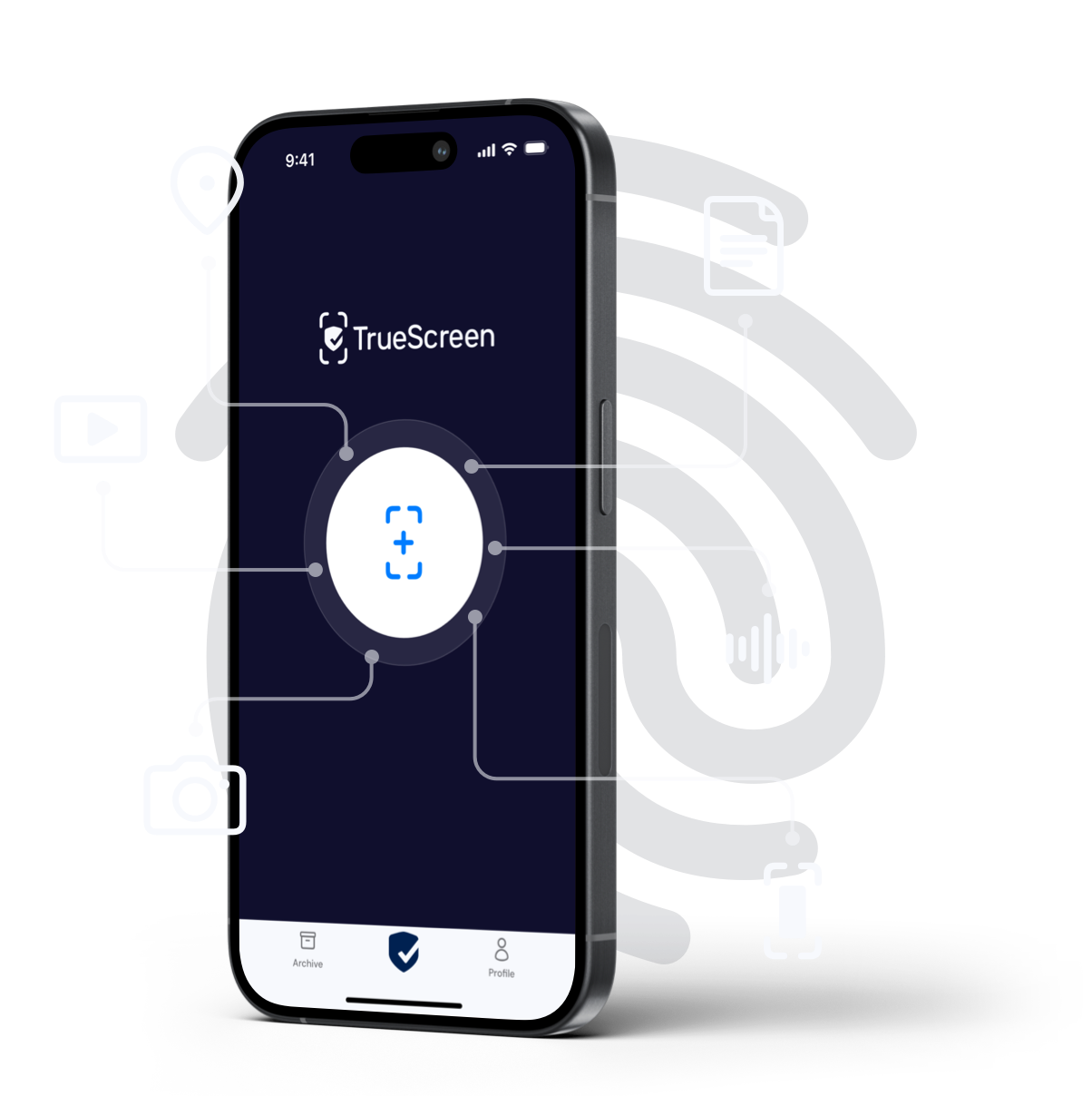
TrueScreen is the Data Authenticity platform that enables insurance companies, adjusters, and policyholders to capture digital evidence with immediate forensic certification. The process complies with ISO/IEC 27037 for digital evidence handling, eIDAS for qualified timestamps, and ISO/IEC 27001 for information security.
Upon capture, each file receives an electronic seal and a qualified timestamp issued by an international Qualified Trust Service Provider (QTSP). Cryptographic hashing ensures that any subsequent modification is immediately detectable.
The certified output package includes the original high-quality file, a forensic PDF report with timestamp and verified GPS coordinates, a JSON report for integration with claims management systems, and an XML file containing the electronic seal and qualified timestamp from the QTSP. Under the eIDAS regulation, qualified timestamps and electronic seals carry a legal presumption of integrity and accuracy across all EU member states.
The claims certification workflow with TrueScreen
Certified capture in the field
The claims certification process integrates directly into existing operational workflows without requiring changes. The adjuster, claims handler, or policyholder opens the TrueScreen app (desktop, iOS, Android) and captures the claim evidence: damage photos, on-site video, supporting documents.
Each file receives full forensic certification at the moment of capture: digital signature, qualified timestamp, verified GPS coordinates, device attestation, and forensic metadata. No post-processing needed: the evidence is certified, tamper-proof, and court-admissible from the moment it is created.
An adjuster documenting property damage gets certified photos and video. A policyholder photographing vehicle damage after an accident produces evidence with immediate legal standing.
In healthcare claims, clinical documentation is captured with the same forensic guarantee. The same applies to underwriting surveys: documenting the condition of assets before risk assumption with certified evidence eliminates disputes over pre-existing damage at the root.
The evidence package: contents and legal standing
Each TrueScreen capture produces four components: the original high-quality file that preserves every detail; the forensic PDF report that documents timestamp, geolocation, and device information in a format that is readable and presentable in any forum; the JSON report feeds directly into claims management systems without manual data entry; the XML file with QTSP seal provides cryptographic proof of integrity and date certainty, with legal presumption of authenticity under eIDAS across all EU member states.
Together, these components form a complete, verifiable chain of custody from field capture to courtroom presentation.
Operational and regulatory impact for insurance companies
Certification ROI: less fraud, fewer disputes, faster settlements
A certified workflow delivers measurable results across multiple dimensions. Evidence captured through TrueScreen cannot be fabricated or manipulated, eliminating evidence-based fraud within the protected perimeter. Authenticity challenges lose their basis when evidence carries legal standing from creation, and companies operating in legal protection insurance can rely on a robust evidence package in court.
On the operational side, automatic certification cuts manual verification time. The adjuster has certified documentation immediately after capture, with no additional steps. On compliance, TrueScreen certifications meet ISO/IEC 27037, ISO/IEC 27001, eIDAS, and GDPR requirements, providing a solid regulatory foundation across EU jurisdictions.
Regulatory compliance and court-admissible evidence
The European regulatory landscape is moving toward stricter requirements for digital evidence. The E-Evidence Regulation, effective from August 18, 2026, establishes uniform rules for the cross-border collection and transmission of authenticated electronic evidence. The eIDAS regulation grants qualified timestamps and electronic seals a legal presumption of integrity and date accuracy.
For insurers operating across the EU, TrueScreen certification provides a direct response to the evolving evidentiary standards. In the insurance sector, this represents the highest level of evidence guarantee currently available.