
Virtual vehicle inspection: how certified photos prevent insurance fraud
Insurers are reshaping the way they assess a claim: instead of dispatching a field adjuster, they ask the policyholder to submit photos of the vehicle from a smartphone. The catch is that these photos, in the absence of source-side certification, are structurally vulnerable to manipulation. According to the insurance industry research, 99% of insurers have already encountered claim documentation altered with AI tools, and 36% of consumers say they would be willing to digitally alter a claim image to obtain a higher payout. Among Gen Z, the figure rises to 55%.
The insurance industry faces a clear strategic choice: keep investing in fraud detection models that chase increasingly sophisticated manipulations, or shift the defense to the moment of acquisition, making fraud structurally impossible. TrueScreen is built around the second strategy: it certifies vehicle photos at the very instant of capture, with a qualified time stamp, geolocation, and a cryptographic fingerprint. Any subsequent edit, including AI-generated alterations, automatically invalidates the certification. Fraud is not detected: it is prevented at the source.
Why traditional virtual inspection is a blind spot for insurers
Virtual vehicle inspection emerged as a response to three converging pressures: cutting field appraisal costs, accelerating claim resolution, and improving the policyholder experience. The model is straightforward: the policyholder receives a link via SMS or email, opens an app or web page, and uploads guided photos of the vehicle. An automated system (often AI-driven) or a remote adjuster evaluates the damage and proposes a settlement.
The efficiency gain is real. The vulnerability is just as real: the submitted photos carry no guarantee of authenticity. They can be:
- downloaded from the internet or pulled from archives of past claims
- taken of a different vehicle than the insured one
- taken at a different moment than the one declared (for example, before the loss event)
- taken at a different location than the one declared
- edited with traditional tools (Photoshop) to exaggerate the damage
- generated or altered with generative AI to produce damage that never existed
The last category changes the game. Two years ago, altering an image required specialized technical skills and left visible traces. Today, free mobile applications let anyone add dents, scratches, and cracks to a photograph in seconds, with results indistinguishable from the original. The Verisk figure of 36% of consumers willing to alter images, and 55% among Gen Z, signals a behavioral shift: tampering with evidence is no longer perceived as a serious crime by the majority of younger consumers.
The four fraud vectors in virtual inspections
A sound anti-fraud design starts by mapping every attack vector. In photographic virtual inspections, there are four.
Vector 1: reused pre-existing photos
The policyholder uploads photos of the vehicle taken before the event (for example, of a vehicle already damaged at purchase, or shot after a previous unreported claim). Without a verifiable time stamp, distinguishing fresh damage from old damage is impossible. The system accepts photos taken months or years before.
Vector 2: photos of other vehicles
The policyholder uploads photos of a similar vehicle (same model and color) found online or shot from other cars. Most virtual inspection systems verify that a vehicle appears in the photo, but cannot verify that it is that specific vehicle.
Vector 3: traditional or AI editing
The policyholder takes real photos of their own vehicle and then edits them to amplify or fabricate damage. Detecting these alterations requires increasingly sophisticated models, in an arms race insurers cannot win: every new detection model is bypassed by the next generation of generative tools.
Vector 4: geographic inconsistency
The policyholder declares the loss occurred in a specific location, but takes the photos somewhere else. Without certified geolocation anchored to the capture, every claim becomes a word-against-word dispute.
Traditional anti-fraud strategies try to address these vectors downstream, through forensic image analysis after the photos are received. The structurally different approach is to block fraud upstream, binding every photo to a verifiable context (time, place, device, file integrity) at the very moment of capture.
What source-side photo certification means
Source-side certification applies a forensic methodology at the moment of acquisition. When the policyholder takes a photo of the vehicle:
- the application generates the image in a controlled environment that prevents manipulation during and after the capture
- GPS position, device orientation, capture time, and other contextual metadata are collected and anchored to the shot
- the image is immediately transformed into a unique cryptographic fingerprint (hash)
- the hash, together with the metadata, receives an official qualified time stamp and digital seal recognized worldwide
- the certified evidence is preserved on secure systems
From this point on, any attempt to modify the image (even a single pixel) alters the hash and invalidates the certification. Recognizing the manipulation is no longer required: the system automatically recognizes the photo is no longer the original. Fraud is not searched for: it is made mathematically impossible.
This is the same logic that governs digital signatures with legal value, applied to the image object from the moment of capture. The principle is called Digital Provenance: every piece of digital information carries with it the proof of its origin, its context, and its integrity throughout its lifecycle.
TrueScreen: fraud-proof virtual inspection
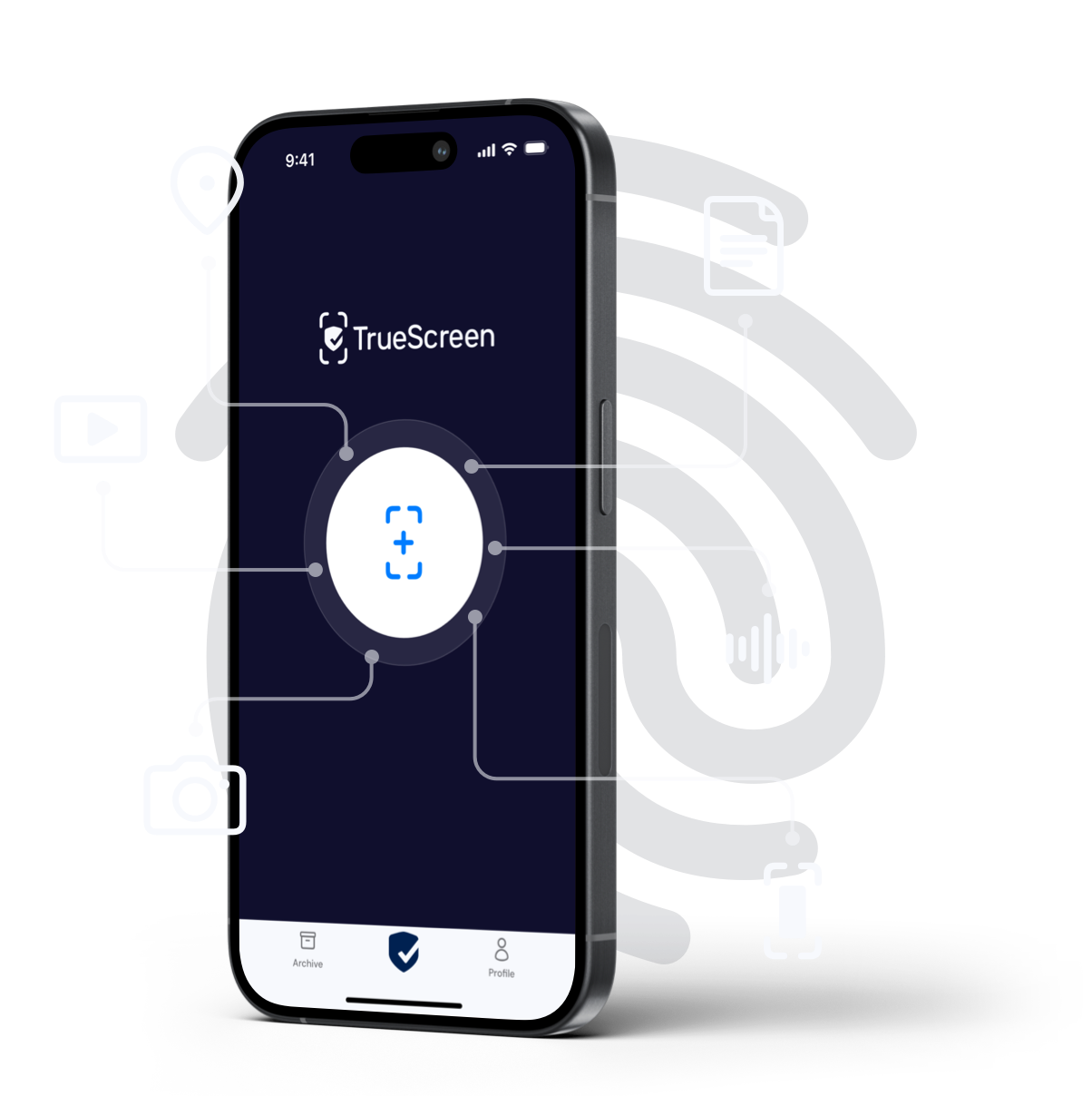
TrueScreen is the platform that certifies the authenticity and legal validity of photos, videos, documents, and other digital data at the moment of acquisition. For virtual vehicle inspections, the integrated flow is the following.
The policyholder receives a secure link from the insurer that opens the TrueScreen app on their smartphone. The app guides the capture of the required photos (left side, right side, front, rear, damage details, license plate, mileage). Each photo is certified in real time with a qualified time stamp, geolocation, and a digital seal applied by a qualified party that TrueScreen integrates via API. The insurer receives a certified package with photos, metadata, and the seal, accompanied by a verification report with legal value.
The distinctive features of the TrueScreen flow for virtual inspections:
- Forensic-grade acquisition: the TrueScreen app prevents the upload of pre-existing photos from the gallery. Capture happens only inside the app, under the control of an environment that protects image integrity during and after acquisition.
- Certified geolocation: the GPS position of the capture is anchored to the image and certified. If the location declared in the claim does not match the capture location, the insurer notices instantly.
- Qualified time stamp: the exact moment of the capture is certified and carries international legal value. Photos taken before the declared event are flagged.
- International digital seal: the seal applied is recognized worldwide and carries probative value in court. A certified photo is uncontestable.
- Resistance to generative AI: any subsequent edit to the image, including with advanced AI tools, automatically invalidates the certification. The insurer does not need to recognize the alteration: the system does it.
The triple benefit for the insurer is clear. First, photographic fraud in claims is structurally eliminated, not through a detection model but because fraud becomes detectable by construction. Second, manual verification costs drop sharply (market estimates put the reduction between 60% and 80% of current spending). Third, claim resolution accelerates: a certified photo requires no additional authenticity review and can directly feed automated damage assessment systems.
When source-side photo certification is a requirement
There are scenarios where certification is not just an efficiency option: it is a regulatory or operational prerequisite.
| Scenario | Why source-side certification matters | Reference standard |
|---|---|---|
| Auto liability claims via online filing | Photos are part of the evidentiary record on which the insurer settles. If contested in court, an uncertified photo carries no probative value | Solvency II, eIDAS |
| Pre-inspection for collision policy | Establishing the vehicle condition at the start of coverage is decisive for any future claim. An uncertified photo can be challenged | Solvency II, eIDAS |
| Corporate fleet management (check-in / check-out) | Establishing responsibility among employees, rental partners, and suppliers without dispute | GDPR, ISO/IEC 27037 |
| Used vehicle sales | The condition of the vehicle at the moment of sale is often disputed. Certification protects both parties | ISO/IEC 27037 |
| Anti-fraud investigations on suspicious claims | Evidence must hold up in court. Photos from generic commercial apps lose probative value | ISO/IEC 27037, Budapest Convention |
Implementation: from pilot to claims process integration
Integrating photo certification into virtual inspections typically follows three stages.
Stage 1: pilot on a specific channel. The insurer identifies a high-fraud-risk channel (for example, low-deductible auto liability claims via online filing) and introduces TrueScreen as a mandatory tool for photographic documentation. Over 60-90 days, the impact is measured on approval rate, average claim cost, settlement time, and detected fraud.
Stage 2: integration into core systems. The TrueScreen API is integrated into the insurer's claims management systems. The certified package (photos + metadata + seal + verification report) flows directly into the claim file. Remote adjusters and automated damage assessment systems receive an input already guaranteed at the source.
Stage 3: extension to all documentary flows. Certification expands beyond photos: claim description videos, audio statements from the policyholder, license plate captures with time stamps, remote video appraisals. Everything that enters the file is certified at origin. The TrueScreen use case library documents similar scenarios in other industries (banking, contact center, real estate, telemedicine).
The investment for the insurer is modest relative to the return: the reduction in photographic fraud and manual verification costs typically pays back the integration within the first quarter of full operation. The competitive advantage is significant in a market where, according to the Insurance Information Institute, fraud is estimated to account for roughly 10% of total premium dollars paid.
The industry shift: from detection to prevention
The 99% figure of insurers already encountering AI-manipulated documentation marks a point of no return. Investing further in detection models brings diminishing returns: every new model is bypassed by the next generation of generative tools, in a race insurers cannot win by fighting downstream. The strategic direction for the industry is the opposite: shift the control upstream, to the moment of acquisition, where data integrity can be guaranteed structurally.
Insurers that adopt this paradigm first will build a durable advantage on three dimensions: more competitive pricing (because structural fraud collapses), faster claim resolution (because the documentation is already verified), stronger reputation (because honest customers are served faster and dishonest ones are filtered out). TrueScreen is the tool that lets this shift happen without rebuilding processes: it integrates into existing flows as a layer of certification, invisible for the legitimate user and impenetrable for anyone trying to alter the evidence.
FAQ: virtual vehicle inspection
What makes a virtual vehicle inspection "fraud-proof"?
How does TrueScreen block AI manipulation of claim photos?
Does the TrueScreen app prevent uploading pre-existing photos from the gallery?
By how much can manual verification costs drop with source-side certification?
Is TrueScreen certification valid in court if disputed?
Can TrueScreen integrate into existing claims management systems?
TrueScreen editorial team
Published on · Updated on
This section is edited by the TrueScreen editorial team, which brings together expertise in digital forensics, the law of digital evidence and regulatory compliance. Every article is checked against primary sources: legislation, published rulings, technical standards and official documentation, always cited in the text.


