
Updated on
B2B formal demand: how to prove emails, registered delivery and screenshots in court
In B2B debt collection the real challenge is not chasing payment: it is proving that the demand was actually received. Formal demand letters only produce legal effect when the creditor can show that the communication entered the debtor's sphere of awareness. Yet most credit managers send chases through ordinary email and then, when the case reaches court, struggle to document delivery. The result is months of additional litigation, defensive objections that shift the burden of proof, and legal fees that erode the recovered amount.
A foundational guide on how to certify an email with legal validity covers the broader picture; this drill-down enters the credit manager's operational flow: which digital evidence tool to choose when the debtor is a small business with no certified mailbox, a foreign company, or a self-employed professional outside national email schemes.
In short: qualified electronic registered delivery services have full legal value but only cover counterparties registered in compatible national systems. Certified emails and certified screenshots, sealed at source with a qualified electronic timestamp and electronic seal, fill the gaps these systems leave open while staying admissible in court under Article 25 of the eIDAS Regulation.
Which channel actually holds up in court: email, certified email, registered post, screenshots
The first mistake credit managers make is treating every channel as equivalent. They are not. The legal basis, proof of receipt, cost per file, and reach across debtor types all change.
| Channel | Legal basis | Proof of receipt | Operational limit |
|---|---|---|---|
| Qualified e-registered delivery | Art. 43 eIDAS | Provider's delivery receipt | Both parties must use a compatible service |
| Ordinary email | Electronic document | Disputable, judge's discretion | Burden of proof on the sender |
| Certified email at source | Art. 25 eIDAS | Hash + qualified timestamp + electronic seal | Requires a source-level certification tool |
| Registered post | Postal regulation | Return receipt | Slow, expensive, manual handling |
| Certified screenshot | Art. 46 eIDAS | Forensic acquisition with seal | Useful for chats, portals, read receipts |
Qualified electronic registered delivery: the safe path when both parties are inside the system
Article 43 of the eIDAS Regulation 910/2014 grants qualified electronic registered delivery services full legal value across the European Union. The European Commission's eIDAS framework lists the trusted providers per Member State. The drawback is reach: both creditor and debtor must hold a compatible mailbox. For foreign suppliers, sole traders, or counterparties outside the system, the channel is unavailable.
Ordinary email: the hidden risk inside the CRM flow
When the chase is sent from the CRM or the credit manager's mailbox, the receivable is exposed. An ordinary email is treated as an electronic document, but its evidentiary weight is freely assessed by the judge and easily disputed. Once the counterparty challenges authenticity, the burden returns to the sender, who must provide technical evidence of dispatch and delivery. Without it, even a clear paper trail can collapse.
Screenshots: filling the gap where email falls short
An increasing share of negotiations closes inside WhatsApp Business, customer portals, or e-commerce admin areas. A screenshot of the chase message or read receipt has evidentiary weight only when captured with a forensic method: page hash, qualified timestamp, electronic seal from a qualified trust service provider. Without these elements, the screenshot is a mechanical reproduction that the counterparty can dispute.
Building a case file the judge can admit without an expert appraisal
The credit manager who wants to shorten litigation works upstream. Court-appointed expert appraisals are ordered when documentary evidence is challenged or technically opaque. Each appraisal adds two or three hearings, expert fees borne by the creditor, accounting provisions that affect the balance sheet. Cases with disputed evidence routinely take many additional months compared with cases supported by source-certified documentation, as European judicial efficiency reports from the EU Justice Scoreboard consistently confirm.
A defensible case file rests on three technical elements:
- Sender identification: signer or sealer certificate, traceable back to the creditor.
- Content integrity: SHA-256 hash computed at the moment of dispatch or capture, replicated in the evidence file.
- Opposable timestamp: qualified electronic timestamp issued by a qualified third-party trust service provider, compliant with Article 42 of the eIDAS Regulation.
When all three are in place, the judge can admit the evidence as full proof without ordering an appraisal. The debtor still has the right to challenge, but must produce counter-evidence at a comparable technical level, a threshold few opposing counsels are willing to cross.
Benefits by business function
| Function | Operational benefit | Indicator |
|---|---|---|
| Credit manager | Tracked chase, automated escalation | DSO reduction, out-of-court recovery rate |
| In-house legal | Case file ready for filing | Case preparation time, in-court objections |
| External law firm | Evidence admitted without appraisal | Success rate on payment orders |
| Finance | Lower provisions on disputed receivables | Bad debt allowance, NPL ratio |
How TrueScreen plugs into the credit manager's flow
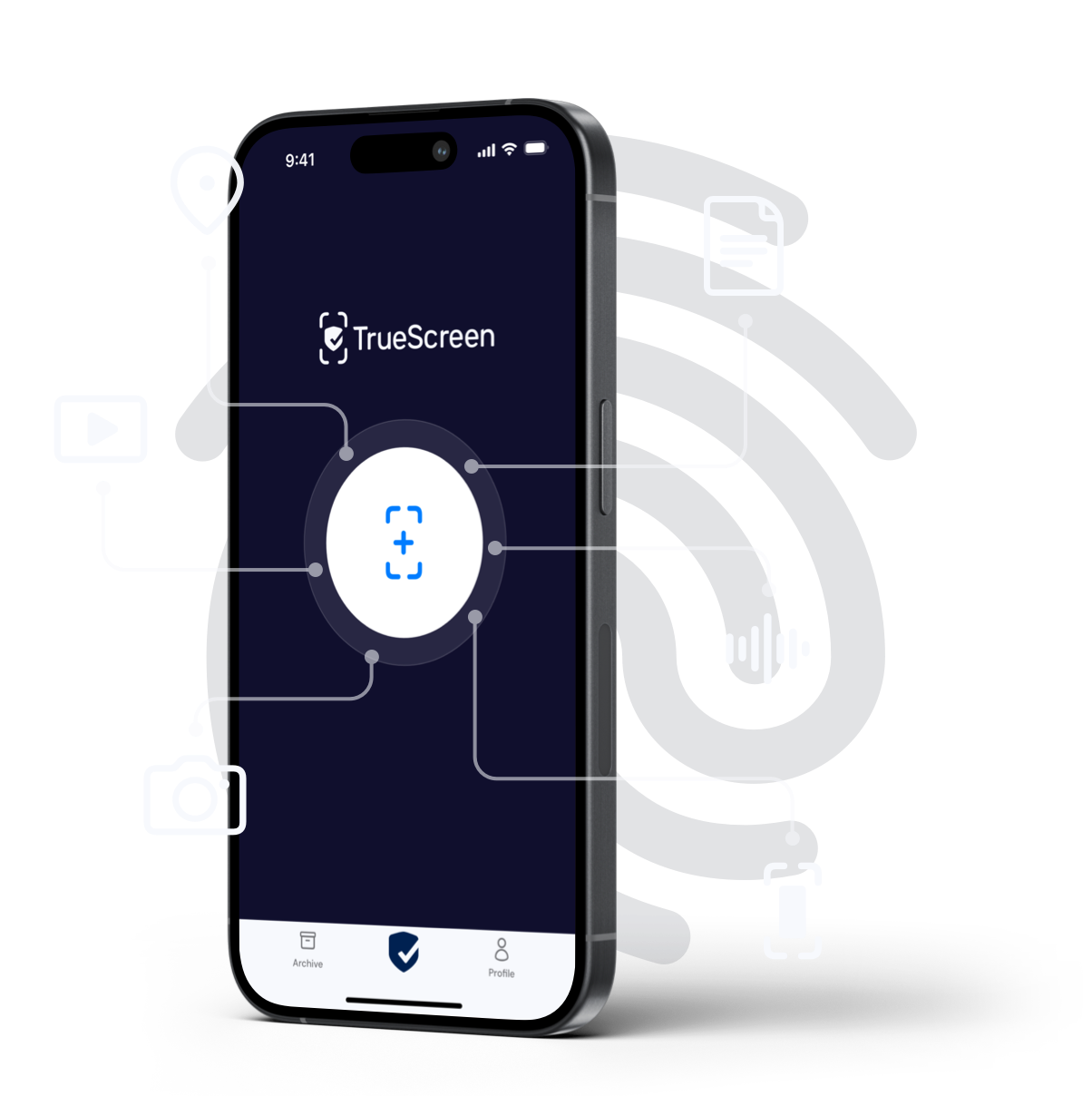
TrueScreen is the platform that captures and certifies chase communications at the source. It works as a certification layer on top of the existing ERP or CRM: the credit manager keeps the same process and adds one certification step that produces an opposable evidence file.
The operational flow is simple. The platform captures the chase email or the screenshot of the chat with the debtor, computes the SHA-256 hash of the content, integrates the qualified electronic timestamp and the electronic seal issued by a qualified third-party trust service provider, and produces a sealed evidence package with an opposable chain of custody. The resulting file is ready for court filing or for attaching to a payment order request.
The added value over qualified registered delivery alone is threefold: coverage of debtors outside compatible mailbox systems, certification of chat content and screenshots, integration with automated chase flows with no manual intervention from the credit manager. Further details on automated source-level certification are available in the dedicated piece on automated enterprise email certification.
Integration with the chase flow
Certification is triggered through API or via the browser extension: every email sent from the company mailbox is mirrored into the TrueScreen system, sealed, and archived against the debtor's case. When the file moves to outside counsel, the dossier is already aligned with the eIDAS Regulation, with timestamps and seals from a qualified trust service provider.
FAQ: B2B formal demand and digital evidence
Is a formal demand sent by ordinary email legally valid?
Are qualified registered delivery and certified email the same thing?
Can a WhatsApp screenshot prove a formal demand?
When does a judge order an expert appraisal on the case file?
Can a payment order be obtained on the basis of a certified email alone, without registered post?
TrueScreen editorial team
This section is edited by the TrueScreen editorial team, which brings together expertise in digital forensics, the law of digital evidence and regulatory compliance. Every article is checked against primary sources: legislation, published rulings, technical standards and official documentation, always cited in the text.


