Screen recording in remote work: how to protect employees and employers with certified digital evidence
Remote work has turned the employee's screen into a workplace in the legal sense of the term. Companies record sessions for operational supervision, training and compliance audits. Workers, on the other side, capture their screens to document demotion, harassment, retaliation, or conduct that is relevant to a protected disclosure. The technical part is trivial. The evidentiary part is not: a screen recording with legal value in the workplace requires a qualified electronic timestamp, a cryptographic hash of the captured stream and a verifiable identity for whoever performed the capture. Without those elements the file remains an unsealed MP4 that the opposing party can dispute.
European data protection authorities have already sanctioned several employers for screen recording practices that lack lawful basis or technical safeguards. Labour courts, in parallel, tend to discount unilateral screen captures when no tamper-evidence mechanism is present. The question is not whether to record: it is how to record so that the resulting file is enforceable both against the worker and against the employer.
This insight is part of our guide: Online Meeting Certification: How to Get Legally Valid Meeting Recordings
When screen recording is lawful in remote work: the three scenarios
The framework is not binary. Article 88 of the GDPR allows member states and collective agreements to define specific rules for processing in the employment context, with safeguards for human dignity, legitimate interests and fundamental rights. The EDPB guidelines on processing personal data through monitoring reinforces transparency and proportionality as cross-border baselines. Three situations recur, each with a different risk profile.
Scheduled recording by the employer
Continuous or recurring sessions on customer support workstations, regulated trading desks, activities involving sensitive data. Lawfulness rests on three pillars: a written notice delivered and acknowledged by the worker, a collective agreement or worker representative consultation, and a declared and proportionate purpose. The recording cannot be reused for purposes other than those stated, and this is where many employers fall in court: the file exists, but the purpose limitation principle was breached during retention or downstream consultation.
Targeted capture for disciplinary investigation
When a specific suspicion of misconduct emerges, the employer can collect targeted evidence. Defensive controls are admitted under most European jurisdictions, but only with strict conditions: a documented suspicion, a circumscribed temporal and functional perimeter, guarantees of immutability over the collected proof. A retrospective capture, produced weeks later, without a verifiable timestamp and without operator traceability, risks being declared unusable by the court.
Defensive recording by the worker
The mirror scenario. A worker who experiences demotion, harassment, retaliation or witnesses conduct relevant to a protected disclosure under the EU Whistleblower Protection Directive 2019/1937 records their own screen to build evidence. The problem is symmetrical: a unilateral capture taken with non-certified tools is challenged by the counterparty as freely editable. Probative value depends entirely on whether a reliable seal was applied at the exact moment of capture.
Why uncertified recordings collapse before regulators and courts
A screen recording is an MP4 or MKV file. Saved to disk, it can be edited with free software without leaving traces visible to the naked eye. File properties (date, author, duration) are mutable. Without a cryptographic mechanism that anchors the content to a verifiable temporal instant, judges treat the recording as informational material, not as evidence. The standards converge: the file must arrive in proceedings sealed at the source, otherwise it is dismissed.
Sanction decisions across European data protection authorities share a recurring pattern: missing prior notice, no consultation with worker representatives, disproportionate scope and duration, retention beyond necessary periods, no way for the worker to know what was recorded and when. Average penalties exceed six figures in euros, with reputational effects on employer branding well beyond the formal decision. On the other side, workers who produce uncertified evidence see their interim measures rejected because the file does not survive the counterparty's denial.
The minimum technical perimeter to overcome these objections is well established: an eIDAS qualified electronic timestamp applied at capture time, a cryptographic hash computed on the stream, traceable identity of the recording author, retention on immutable infrastructure aligned with ISO/IEC 27037 on digital evidence handling. Below that threshold, the file is information. Above it, it is evidence.
How TrueScreen makes screen recording enforceable for both worker and employer
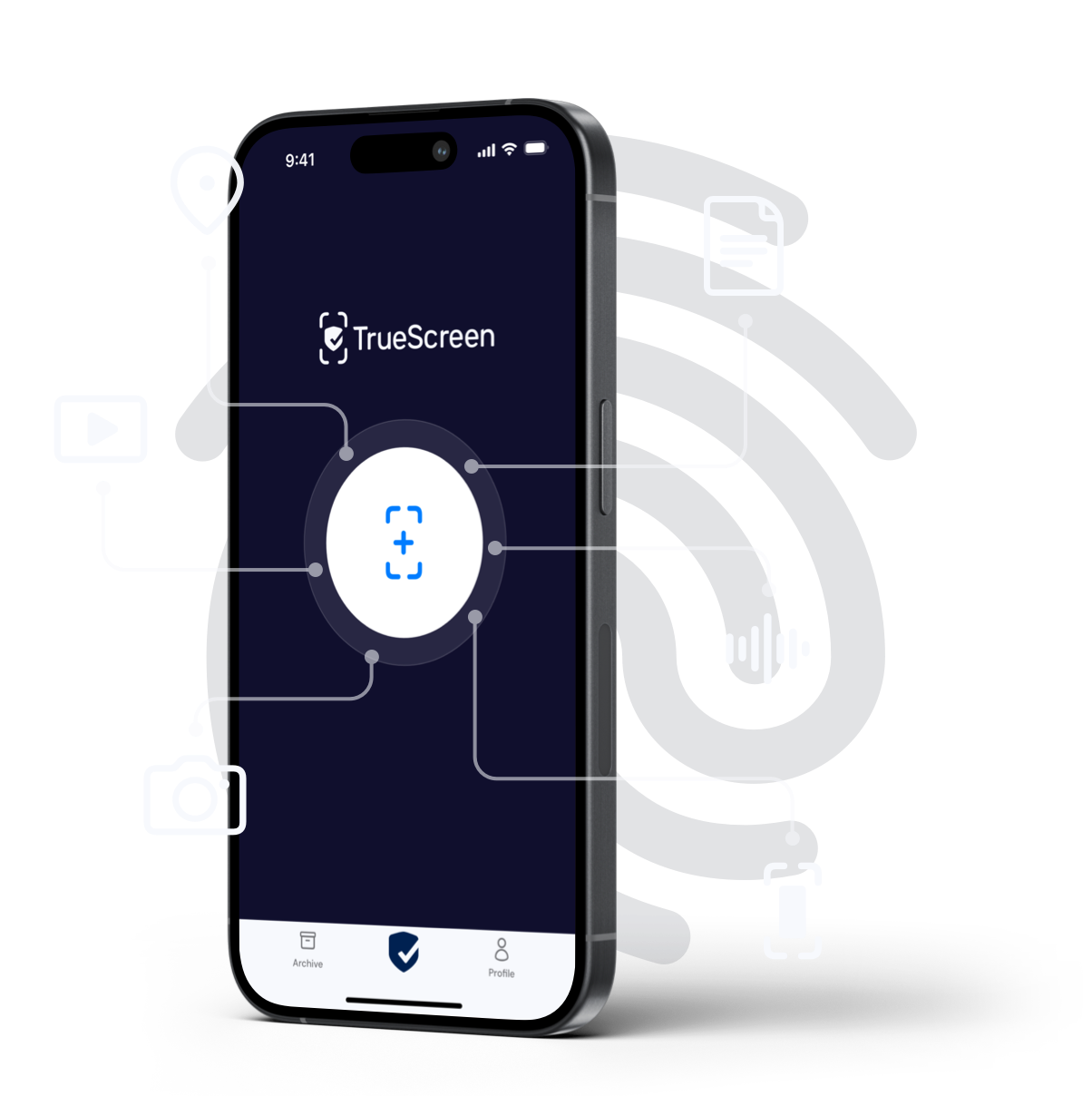
TrueScreen is the data authenticity platform that applies a seal at the source in the exact moment of capture: the screen recording leaves the client already carrying a qualified eIDAS timestamp, a cryptographic hash of the video stream and a reference to the authenticated identity of the operator. When the file reaches the proceeding, it carries built-in evidentiary weight under the eIDAS framework and ISO/IEC 27037. The burden shifts: the party who challenges has to prove tampering, not the party who produces.
Three operational configurations for HR and legal teams
HR can configure scheduled recordings for the functions that require them, with embedded notice and a declared functional perimeter. Internal legal can activate targeted captures for specific disciplinary investigations, with end-to-end traceability of who started the recording and on what grounds. The individual worker, when the situation requires it, can produce defensive captures with the same probative solidity, because the seal is applied by the platform, not by the subject.
In a documented unfair dismissal case, a remote employee filed approximately forty minutes of certified screen recordings, collected over three months, that documented a progressive emptying of contractually assigned duties. The employer could not deny the evidence: qualified timestamps and continuous hash anchoring made any editing technically detectable and legally excluded. The matter closed with a settlement in the worker's favour.
Integration with HR systems (workforce management, ticketing, helpdesk) automates GDPR-compliant retention and ensures recordings are retrievable only within the authorised perimeter. The labour-law framework is not bypassed: it is respected and documented, because every access event on the video remains tracked and verifiable on demand.