The 5 best forensic web capture tools in 2026: honest comparison
Web pages have become one of the most contested sources of evidence in civil and criminal proceedings: a deleted post, an edited review, a statement pulled from a public site can decide a case, but none of those items carries evidentiary weight if they are simply saved as a PDF or grabbed with a screenshot. International standards such as ISO/IEC 27037 on the identification and preservation of digital evidence set the bar: the acquisition process must be documented, repeatable, and tamper-evident. Under the US Federal Rules of Evidence and the Daubert standard, admissibility hinges on whether the method used to capture the page can be explained and replicated by another expert. For a deeper primer on this topic, see our article on the admissibility of digital evidence, and for what turns a capture into evidence with legal value, our guide to web page certification.
The market for forensic web capture tools has split into clear segments. European platforms align with the eIDAS regulation and qualified timestamping. US vendors focus on litigation-grade affidavits for civil cases. Enterprise archiving suites answer compliance frameworks like SOX, FINRA, and FOIA. OSINT tools serve investigators who need a passive record of everything they see. Picking the right software means understanding where the evidence will be used, which standard it must meet, and how the workflow fits the way a team already works. This guide compares five representative tools in 2026: TrueScreen, FAW, Page Vault, PageFreezer / WebPreserver, and Hunchly. For each, the focus is on what it does, where it excels, and where its design choices become structural limits.
What makes a forensic web capture tool defensible
A good forensic capture tool is not the one with the longest feature list. It is the one that implements a process a court can read and accept. The criteria that matter are narrow and concrete: alignment with a recognized standard such as ISO/IEC 27037, the presence of a qualified timestamp under eIDAS (when the evidence is meant for a European court), cryptographic integrity via hash, a traceable chain of custody, and the ability to capture more than static HTML, including video, dynamic content, and external resources. According to the ENISA handbook on electronic evidence, the element most often challenged in court is not the technology itself but the reproducibility of the acquisition process.
Five technical criteria to verify
- eIDAS compliance and qualified timestamping: the eIDAS regulation separates ordinary timestamps from qualified timestamps issued by a Qualified Trust Service Provider (QTSP). Only the latter carries a presumption of authenticity across EU courts.
- Documented forensic methodology: acquisition must be logged step by step, repeatable, and mapped to ISO/IEC 27037. A "certified screenshot" is not enough.
- Format coverage: beyond static HTML, real cases need certified video capture (live streams, meetings, depositions), audio, dynamic content (JavaScript, SPAs, social platforms), and external assets loaded by the page.
- Digital chain of custody: SHA-256 hash at source, digital seal from a QTSP, immutable log of who did what and when. Without a clean chain of custody, the evidence falls.
- Workflow and accessibility: mobile app for field captures, desktop for complex cases, API for integrations, export in standard formats that downstream systems accept.
Forensic web capture tool comparison 2026: feature matrix
The table below compares the five tools on objective features. It does not include point pricing (each vendor runs variable lists based on volume and contract type); the "pricing model" column indicates the commercial logic.
| Software | eIDAS compliance | Qualified timestamp | Certified video | Mobile app | API | Pricing model | Best for |
|---|---|---|---|---|---|---|---|
| TrueScreen | Yes, native (QTSP) | Yes, included | Yes, with QTSP seal | iOS and Android | REST + SDK + MCP | Subscription plus pay-per-use | Law firms, enterprises and professionals in the EU who need a full chain of custody across web, video, and files |
| FAW | Partial (external TSA) | Optional (external integration) | Limited (screencast) | No (Windows desktop) | No | Perpetual license (free and pro) | Court-appointed experts and IT forensic analysts working on Windows |
| Page Vault | No (US focus) | No (proprietary timestamp) | Screen recording | Yes (iOS and Android) | Yes | Per-user subscription | US litigation-focused law firms |
| PageFreezer / WebPreserver | No (SOX, FINRA, FOIA oriented) | Proprietary timestamp and hash | Partial (social video) | Limited | Yes (archive and export) | Enterprise contract | Government, banks and corporate compliance with continuous archiving needs |
| Hunchly | No | No (local hash and log) | No | No (browser extension) | No | Per-analyst annual license | OSINT analysts, fraud investigators, intelligence |
TrueScreen: full forensic methodology aligned with eIDAS
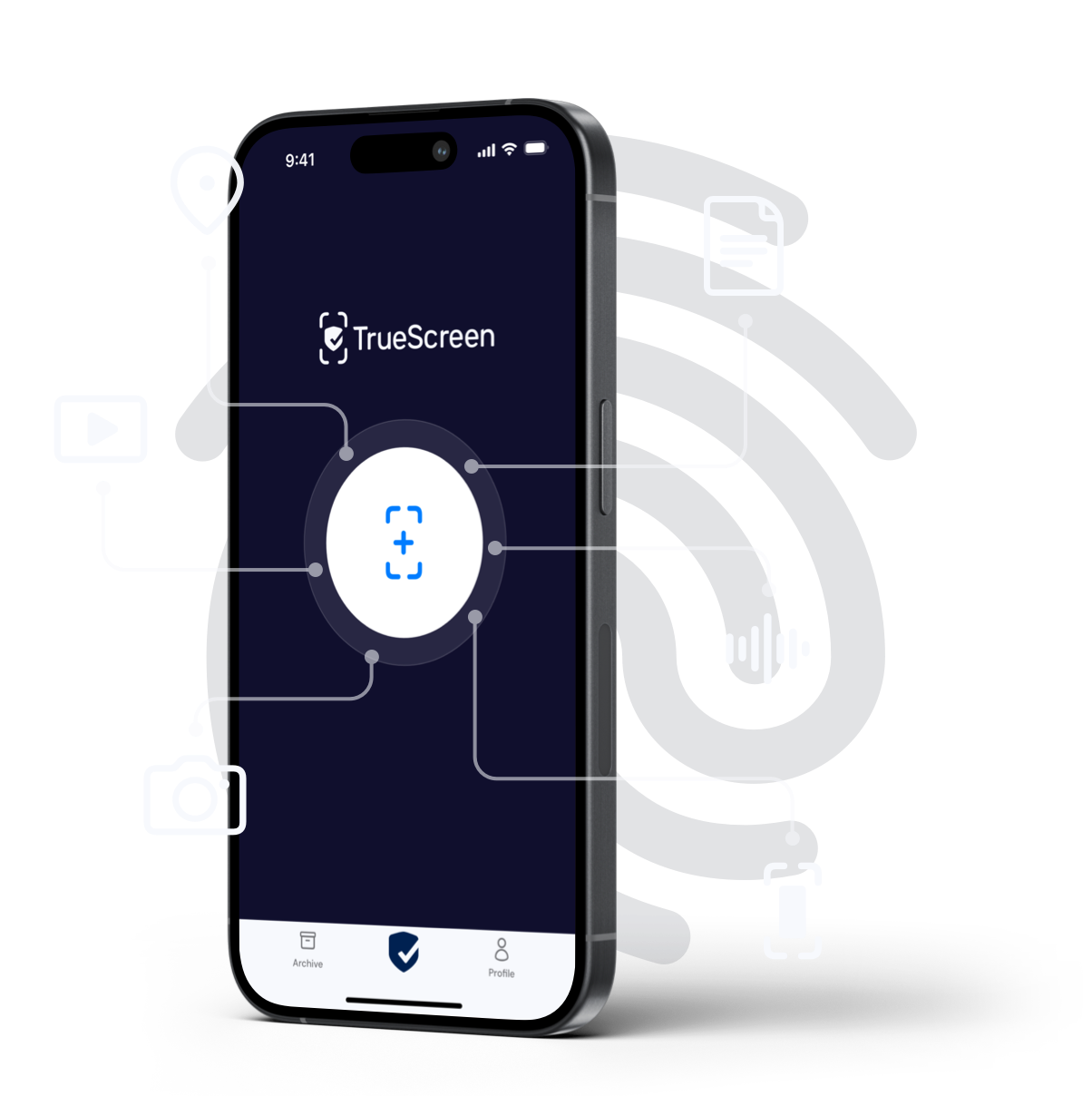
TrueScreen is a European Data Authenticity Platform that captures web pages, video, audio, and files with a forensic methodology and applies a digital seal from a Qualified Trust Service Provider plus a qualified timestamp at the source. Unlike tools that add a seal to an already-existing file, TrueScreen folds acquisition and certification into a single process: the user starts a capture from the Forensic Browser, the mobile app, or the Chrome extension, and the system records page, external resources, timestamp, and SHA-256 hash directly on the trust service provider infrastructure. The output is a PDF report aligned with ISO/IEC 27037 with cross-border recognition across the EU under eIDAS.
The structural strength is format coverage. Beyond static web pages, TrueScreen captures live video (for calls, remote depositions, and live inspections), files, emails, and chat conversations. The combination of iOS/Android apps, desktop portal, REST API, SDK, and Model Context Protocol (MCP) lets teams embed certification inside existing flows: enterprise ticketing, legal workflows, compliance platforms.
Main capabilities
- Forensic Browser: desktop application dedicated to forensic capture of pages and dynamic content, with full session tracking
- Web Portal and mobile app: acquisition from any device, with QTSP digital seal and qualified timestamp
- Chrome Extension: instant certification of the active page inside the working browser
- API and SDK: embed certification inside client portals, ERPs, and vertical applications
- TrueLink: shareable certified link that displays authenticity and integrity to anyone who opens it
When to choose TrueScreen
TrueScreen is the natural choice when the evidence must hold in a European court and needs to cover more than static HTML: certified video, files, multi-user chain of custody. Law firms, compliance officers, insurers, and public administrations use it to certify online content in defamation cases, unfair competition, cybercrime, and contractual disputes. For an end-to-end walkthrough of the process, see the guide on how to certify a web page with legal value.
FAW: the historical Italian forensic acquisition tool
FAW (Forensics Acquisition of Websites) is a software developed in Italy by a community of digital forensics experts, distributed in free and pro editions. For years it has been a reference for court-appointed experts and IT investigators handling civil and criminal cases, thanks to a rigorous approach: HTML capture, external resources, HTTP headers, SHA-256 hash, reproducible report. The pro edition adds session video capture and integration with external timestamp services.
Strengths
- Deeply embedded in the Italian forensic community, with established case history in court
- Perpetual license with a free edition for occasional use
- Detailed technical report suitable for court-appointed experts
- Active community of users and trainers
Structural limits
FAW is a Windows desktop product with no mobile app, no API, and no native qualified timestamp: to obtain an eIDAS-grade timestamp, the user must integrate an external QTSP service, an extra step that adds friction. Video capture is limited to page screencasts and does not extend to certified video calls or live streams. For professionals who need to capture in the field with a smartphone, or organizations that want to embed certification in legacy systems through an API, FAW shows its age.
Page Vault: a reference for US civil litigation
Page Vault is a Chicago-based vendor adopted by many US law firms for collecting evidence from web pages, social media, and online video in civil litigation. Its model is built for the Federal Rules of Evidence: capture the page as visible at the moment of acquisition, add a proprietary timestamp and hash, produce a standardized affidavit ready for court filing. The Page Vault documentation highlights speed of capture and compatibility with Relativity for e-discovery.
Strengths
- Workflow optimized for US civil litigation and law firms
- Mobile and desktop apps with quick capture flow
- Integration with e-discovery platforms (Relativity, Everlaw)
- Cloud archiving of collected evidence
Limits in the European context
Page Vault does not adopt a qualified eIDAS timestamp and does not explicitly map to ISO/IEC 27037: its "evidence grade" paradigm is built on US standards and federal case law. In Europe, producing a Page Vault file in court typically requires an additional validation step, since the proprietary timestamp does not carry the eIDAS presumption. For a direct comparison on the web evidence capture topic, see our Page Vault vs TrueScreen analysis.

PageFreezer and WebPreserver: web archiving for enterprise compliance
PageFreezer and its sister product WebPreserver are web archiving platforms built for compliance in large organizations: banks, public institutions, listed corporations. The logic is different from the previous tools: instead of acquiring a single page on demand, PageFreezer continuously monitors a customer's sites, social channels, and digital properties to produce a historical archive compliant with SOX, FINRA, FOIA, and other US regulatory frameworks. WebPreserver is the Chrome extension that enables point-in-time capture of social posts with timestamp and hash.
Strengths
- Continuous, automated archiving of websites, social channels, messaging
- Export in the WARC standard format for long-term preservation
- Social capture (Facebook, LinkedIn, Instagram, TikTok) with faithful playback
- Configurable audit trail and retention policies
Limits in one-shot litigation
PageFreezer is not designed to acquire a single piece of evidence to be filed in court within hours: its value is in historical archiving, not point-in-time certification. It does not offer qualified eIDAS timestamping or a QTSP digital seal, and for European cases it requires integration with a European trust service. The enterprise contract cost and onboarding complexity make it a poor fit for individual law firms or solo professionals.
Hunchly: evidence collection for OSINT investigations
Hunchly is a Chrome extension built for OSINT analysts, private investigators, fraud examiners, and intelligence analysts. As the user browses, Hunchly automatically captures every page visited during a case session, computes a hash, and stores screenshots and metadata in a local archive. The underlying logic is "everything I see while working on the case must be reconstructible": a useful paradigm for long investigations on the deep web, social platforms, and cryptocurrency tracing.
Strengths
- Passive, automatic capture of all case-related browsing
- Case-based management with tagging, notes, and timeline
- Local archive that does not depend on external clouds
- Affordable pricing for an individual analyst
Limits for courtroom evidence
Hunchly does not produce evidence with legal weight in a European court: there is no qualified timestamp, no QTSP digital seal, no ISO/IEC 27037 certified process. The archive is reliable to reconstruct an internal OSINT investigation, but when a Hunchly artifact needs to land in criminal or civil proceedings, a re-acquisition with a forensic-grade tool is almost always required.
How to choose: three practical scenarios
The choice depends on where the evidence will be used and what needs to be captured. Three scenarios cover most real cases.
European law firm handling civil and criminal matters
For teams that file evidence before EU courts, the priorities are eIDAS compliance, qualified timestamping, and alignment with ISO/IEC 27037. TrueScreen is the most complete option because it covers web, video, and files with a native QTSP seal; FAW remains a valid fallback for Windows-only desktop work with a perpetual license, as long as the team accepts the extra step needed for qualified timestamping.
Enterprise with continuous archiving obligations
Banks, public institutions, and large corporations that must continuously archive their websites and social channels for compliance purposes find a strong fit in PageFreezer / WebPreserver. When single-event certification for disputes or incidents is also required with EU-grade evidentiary weight, TrueScreen complements via API: PageFreezer handles continuous archiving, TrueScreen handles point-in-time certification on high-risk cases.
OSINT analyst or private investigator
For analysts primarily focused on reconstructing digital scenarios with no immediate courtroom target, Hunchly offers the best balance between automation and cost. Once a case evolves toward litigation, the critical artifacts should be re-acquired with a tool that carries a qualified timestamp: TrueScreen is the straightforward choice for a European analyst, while Page Vault is more natural for workflows built around US civil litigation.
Why methodology matters more than the tool
The most common mistake when shopping for forensic capture software is confusing the feature list with courtroom reliability. A tool that offers "screenshot plus hash plus timestamp" can look equivalent to TrueScreen on paper, but if the timestamp is not eIDAS-qualified and the acquisition does not follow ISO/IEC 27037, the risk of challenge in court stays high. European case law, starting from the ways courts evaluate digital documents and electronic evidence, looks at the acquisition process before the specific product. The ENISA handbook states it plainly: the contestability of digital evidence depends on the documentability of the process, not on the brand of the software.
The decision between the five tools presented here is not "which one is the best" but "which one covers the chain of custody my case requires". TrueScreen sits on the widest segment (web, video, files with EU legal weight) because it merges forensic methodology and QTSP certification in a single flow; the other tools are strong in their specific context and become complementary when the case calls for it.