
Digital Evidence for Brand Protection: How to Collect Certified Proof of Online IP Violations
What is brand protection online?
Brand protection online is the practice of detecting, documenting, and removing unauthorized uses of a brand on the internet: counterfeit listings, fake social accounts, copycat domains, and trademark abuse. It turns those findings into legally defensible evidence for takedowns, cease-and-desist actions, and litigation, combining monitoring tools with forensic evidence capture.
Your brand manager opens a report on Monday morning and finds the usual mess: 47 counterfeit listings of your apparel line on AliExpress, a cloned Instagram account pushing fake discount codes, and a marketplace seller on Amazon using your registered trademark in product titles. The scanning platform flagged everything. The team grabs screenshots, pastes them into a Word document, and sends the bundle to outside counsel for a cease-and-desist.
Here is the problem most brand teams discover too late: those screenshots will not hold up in court. A standard browser screenshot is trivially editable, has no verifiable timestamp, carries no cryptographic integrity, and was captured on the brand owner’s own machine, which means it fails the independence test any opposing counsel will exploit. When the infringing seller deletes the listing (they always do), you are left with a picture that proves nothing.
The gap between detecting a violation and proving it is where most brand protection online programs quietly leak money. This article walks through how brand protection teams collect certified, court-admissible digital evidence of IP violations, how forensic capture fits next to monitoring vendors like Red Points or BrandShield, and how to build a brand protection online evidence workflow that survives a federal judge reading Federal Rules of Evidence 901.
The evidence gap in brand protection
Brands spend heavily on detection and almost nothing on the quality of the evidence they collect. Scanning, image recognition, seller clustering, AI-driven anomaly detection: the vendor market has matured on the discovery side. On the evidentiary side, most programs still rely on manual screenshots pasted into PDFs.
The scale of the problem is not small. According to the EUIPO and European Commission 2024 report on customs enforcement (EUIPO/Commission IP rights detentions), EU customs seized 112 million counterfeit articles at the border in 2024, a 30% rise on the previous year, with an estimated retail value of EUR 3.8 billion. That figure counts only what customs intercepted at the border. Online marketplaces, social commerce, and direct-to-consumer phishing pages multiply the surface area several times over.
The paradox is structural. Finding a violation online has become easy: a decent brand protection software scans tens of thousands of listings a day. Proving the violation is what remains hard. Content online is volatile. A counterfeit listing lives for a few days, sometimes hours. Sellers rotate storefronts, edit product titles to dodge keyword filters, and delete pages the moment they receive a takedown notice. If you do not preserve the evidence the instant you spot it, with integrity guarantees that survive deletion, you have a lead, not a case.
Digital brand protection that stops at detection is a monitoring expense. Brand protection online that closes the loop with certified evidence becomes an enforcement capability.
Why regular screenshots fail in court
Standard screenshots fail as evidence in brand protection online cases because they lack four legal requirements: integrity, provenance, completeness, and independence. A screenshot can be edited in any browser’s developer tools before capture, retouched in Photoshop after, stripped of metadata, or fabricated from scratch. Nothing about the file proves who captured it, when, from which server, or whether the content was altered in transit. A judge applying authentication rules under Federal Rules of Evidence 901 will rule an unauthenticated screenshot inadmissible, and opposing counsel knows this. The same weakness torpedoes marketplace takedown appeals and customs filings: the reviewing lawyer or officer needs a record that proves when and how the capture happened, not just a .png file produced on the brand owner’s laptop. This is the evidentiary floor that separates monitoring output from enforceable proof. A deeper walkthrough of the typical objections raised against screenshots in court shows how opposing counsel systematically dismantles unauthenticated captures.
The legal position is well established. A review by World Trademark Review on documenting online infringements stresses that printouts and screenshots of websites are routinely treated as hearsay unless properly authenticated, and that courts expect a witness who can attest to when and how the content was captured, what the system state was at the moment of capture, and whether the content could have been altered in transit. Under the U.S. framework, Federal Rules of Evidence 901 and 902 require the proponent of any piece of evidence to produce evidence sufficient to support a finding that the item is what the proponent claims it is. A screenshot with no verifiable timestamp, no hash, no capture log, and no third-party attestation rarely clears that bar.
The cost of thin evidence lands in three places. Trademark and copyright infringement cases get dismissed or settled low because the proof cannot be introduced. Marketplaces deny takedown appeals when the evidence package lacks chain of custody. Customs authorities refuse to act on counterfeit seizure requests that are not backed by court-grade documentation. Meanwhile the counterfeiter keeps selling, because your cease-and-desist carried a screenshot that their lawyer correctly dismissed as unauthenticated.
The problem is not that courts reject digital evidence. It is that they reject unauthenticated digital evidence, and the brand is the party that has to authenticate it.
What constitutes legally valid digital evidence
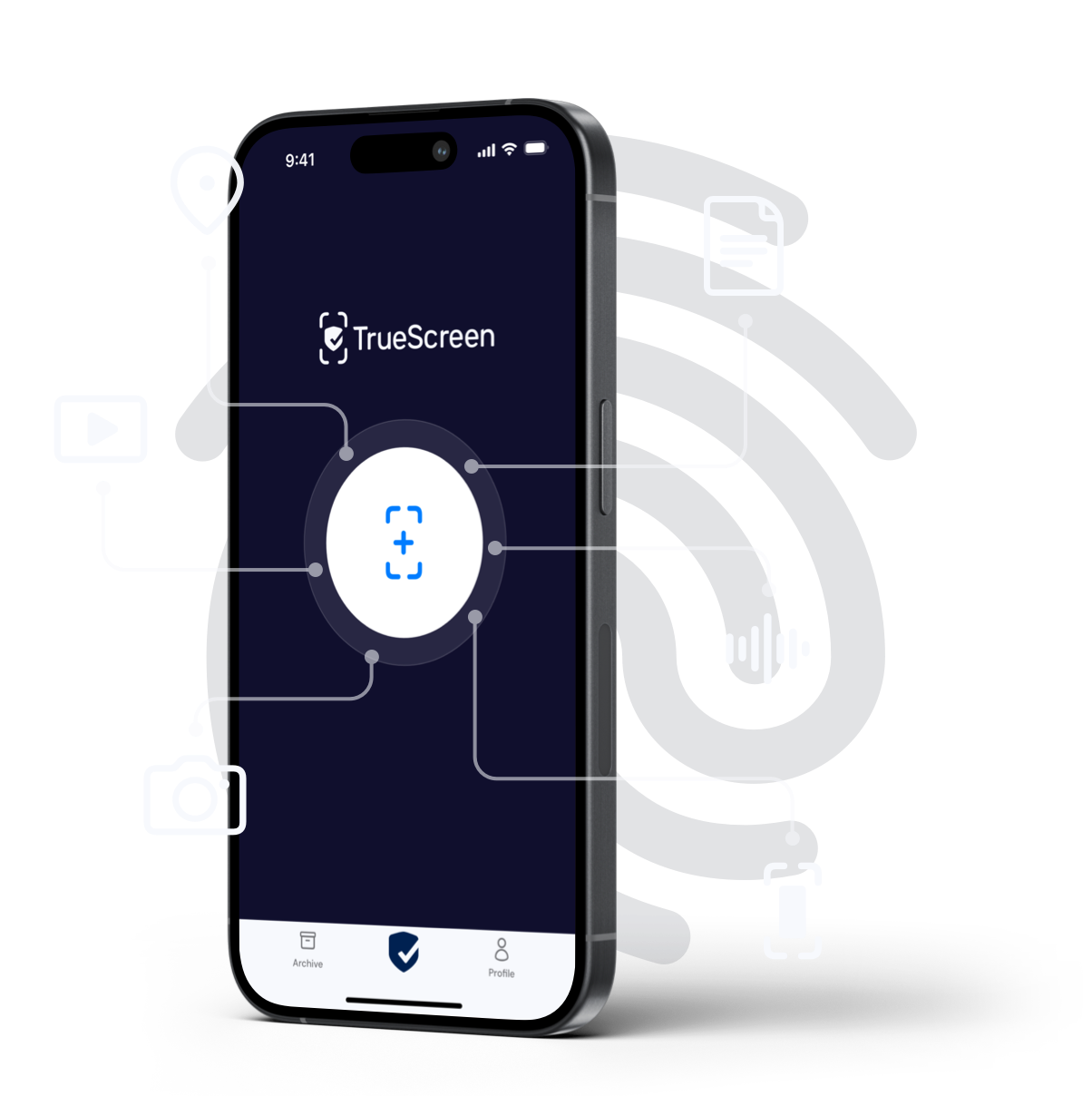
Legally valid digital evidence for brand protection requires four properties: integrity (proof the content was not altered), provenance (proof of who captured it and when), completeness (URL, timestamp, IP, full visual context, source HTML), and independence (capture performed by a neutral third party, not the brand owner’s browser). A standard screenshot satisfies none of these. TrueScreen, the Data Authenticity Platform, captures web pages, marketplace listings, and social media posts through a server-side forensic browser that records the full session, computes a SHA-256 hash, applies an RFC 3161 qualified timestamp, and produces a signed PDF report designed to meet the authentication requirements of Federal Rules of Evidence 901-902 and eIDAS. Brand protection teams use TrueScreen alongside detection platforms like Red Points or BrandShield to convert flagged listings into evidence packages ready for cease-and-desist, marketplace takedown appeals, Schedule A lawsuits, or customs filings.
Each property maps to a concrete technical guarantee. Integrity is carried by the SHA-256 hash and the trusted timestamp: any post-capture edit changes the hash, any attempt to backdate the evidence breaks the RFC 3161 chain. Provenance is carried by an internationally recognized electronic seal issued under eIDAS, which binds the capture to a specific verified operator and server. Completeness means the capture records everything a forensic examiner will want to see later: the URL bar, HTTP headers, rendered DOM, server response, loaded resources, the full-page image including content below the fold, and the capture environment metadata. Independence means the capture happens on a neutral, controlled infrastructure, not on the brand’s own laptop where the chain of custody starts inside the party with an interest in the outcome.
The international standards that govern this space line up consistently. ISO/IEC 27037 defines the handling of digital evidence for identification, collection, acquisition, and preservation. NIST SP 800-86 covers forensic techniques in incident response. In the United States, the Federal Rules of Evidence and eDiscovery practice under the Federal Rules of Civil Procedure shape what gets admitted. In the European Union, eIDAS (Regulation 910/2014, now updated by eIDAS 2) governs trust services, qualified timestamps, and electronic seals. The Budapest Convention on Cybercrime informs cross-border evidence sharing. A practical step-by-step guide to making digital evidence admissible shows how these standards translate into day-to-day capture procedure. Digital evidence collection built against these standards travels across jurisdictions; evidence that is not built against them often does not.

How to build a brand protection evidence strategy
A working evidence strategy sits in four steps: document what you find the moment you find it, capture it with forensic methodology, manage the resulting evidence under a chain of custody, and feed it into the enforcement actions that actually recover money or remove listings.
Step 1. Systematic documentation
The first rule is timing. Capture evidence the instant the violation is identified, before any contact with the infringer, before any takedown request, before any public warning. Once the seller suspects you are watching, the listing disappears. Capture late and you have a memory, not a case.
What to document on every violation: the full URL (including any query parameters that change what the page shows), the rendered page exactly as a buyer would see it, the listed price, the product description, the full image set used by the seller, seller identity and store information, reviews and Q&A sections where relevant, and any shipping-from or fulfillment data the platform exposes. For social media, add the account handle, follower count at the time of capture, and the full thread including replies.
Document repeatedly over time. A single capture proves the listing existed once; periodic captures prove persistence, which matters for damages calculations and for showing the platform was on notice. For recurring infringers, set a weekly cadence so the evidence record spans months by the time you file.
Step 2. Certified acquisition
A certified capture differs from a regular screenshot in ways that matter to a judge. The capture happens on a controlled forensic environment, not the brand team’s laptop. The page is fetched server-side, which means what gets captured is what the seller’s server actually served, not a version manipulated by a local extension or a local proxy. The output is sealed: hash, timestamp, operator identity, environment fingerprint, all bound together in a signed document.
The operational setup that keeps brand protection teams productive combines three surfaces. A Chrome extension for evidence capture lets analysts and paralegals trigger a forensic capture from the browser tab they are already looking at, with no context switch; the capture runs server-side, the trigger sits in the tab. An evidence management portal centralizes the resulting evidence packages, organized by case and violator, with search, tags, and export. An evidence capture API integrates with detection vendors, so that when Red Points, BrandShield, or a custom scraper flags a URL, a forensic capture is triggered automatically and the package lands in the portal without human involvement. This is the integration point that turns anti-counterfeiting technology from an alerting system into an evidence pipeline.
Step 3. Evidence management
Captures on their own do not win cases. Evidence needs to be stored under a chain of custody that a court will recognize, which means access logs, tamper-evident storage, versioning, and export formats that preserve the cryptographic seals when the file leaves the platform.
Organize by case, by violator, and by jurisdiction. A single counterfeiter often runs ten storefronts across five platforms; grouping captures by violator identity (not by storefront) makes it possible to show a pattern. Grouping by jurisdiction matters because the evidentiary burden shifts: a U.S. Schedule A filing wants one package shape, an EU customs AFA another, a Chinese administrative enforcement action a third. Tag captures with the enforcement path you plan to use.
Consider a practical example. An apparel brand finds 47 counterfeit listings on AliExpress flagged by their monitoring vendor. Each listing must be documented before takedown to support a Schedule A lawsuit if AliExpress fails to remove the seller. Using a Chrome extension for evidence capture, a paralegal captures all 47 listings in 30 minutes; each capture includes URL, server-rendered HTML, full-page visual, RFC 3161 timestamp, and SHA-256 hash, packaged as a signed PDF the law firm files with the complaint. The paralegal does not need forensic training; the platform supplies the forensic properties.
Step 4. Enforcement actions
Certified evidence changes the response rate on every enforcement channel. A cease-and-desist that attaches a signed forensic report carries different weight than one that attaches a .png file; infringers who would have ignored the first letter often comply with the second because their counsel recognizes the evidence will hold. Marketplace takedown appeals (Amazon Brand Registry, eBay VeRO, AliExpress IPP) move faster when the evidence package already matches what the platform’s legal team expects to see. Evidence captured from sources that meet court admissibility standards also shortens the back-and-forth with platform legal teams.
Schedule A litigation has become a primary enforcement mechanism for online counterfeiting cases in U.S. federal courts, particularly in the Northern District of Illinois. A recent analysis by JD Supra on Schedule A practice describes the model: a brand files a single complaint naming dozens or hundreds of anonymous online sellers as Doe defendants, obtains a temporary restraining order, and freezes the defendants’ marketplace and payment accounts before they can move funds. The bottleneck in Schedule A is evidence preparation: each defendant on the Schedule A requires a documented capture of the infringing listing sufficient for the court to find likelihood of success on the merits. Forensic capture at scale is what makes a 200-defendant Schedule A economically viable. Customs filings under the EU Anti-Piracy Application (AFA) and the U.S. CBP e-Recordation system use the same evidence, reframed for administrative review.
Copyright infringement online and trademark infringement online respond to the same evidence logic: the better the proof, the shorter the timeline from detection to removal.

Brand protection tools: detection vs evidence
Brand protection online runs on two complementary layers: detection and evidence. Brand protection software and digital evidence platforms solve different problems and belong together in a mature program. Detection tools scan the open and semi-open web to surface potential violations at volume across marketplaces, social networks, domains, and app stores. Evidence platforms take the flagged violations and produce documentation that stands up to legal scrutiny in court, in marketplace legal reviews, and in customs administrative proceedings. Detection answers “what is being infringed and where.” Evidence answers “how do we prove it and act on it.” Treating one as a substitute for the other is where most programs get stuck: monitoring vendors generate alerts that never convert to enforcement, or legal teams chase infringers one by one without the scanning coverage to find them. Both layers are required, and they must be integrated so that flagged URLs flow automatically into forensic capture.
| Tool category | Primary function | Output | Integration model |
|---|---|---|---|
| Detection platforms (Red Points, BrandShield, MarkMonitor, BrandVerity) |
Scanning, alerting, volume analysis, seller clustering | Flags, notifications, dashboards, takedown lists | Monitoring dashboards, analyst review queues |
| Evidence platforms (TrueScreen) |
Forensic capture, legal-grade certification, chain of custody | Signed PDF + SHA-256 hash + RFC 3161 timestamp | API/SDK integrable with detection vendors and case management |
Unlike detection platforms such as Red Points or BrandShield, which monitor and flag potential infringements across marketplaces, social networks, domains, and app stores, TrueScreen operates at the downstream stage: it captures the flagged content with cryptographic integrity and produces the court-admissible record. Detection platforms answer the question “what is being infringed.” Evidence platforms answer the question “how do we prove it and enforce it.” The two layers feed each other: detection volume is wasted without evidence quality, and evidence capacity is wasted without detection coverage. Brands running both report higher takedown compliance rates, faster Schedule A docket preparation, and customs seizure requests that get acted on rather than parked. This is the workflow pattern that separates modern brand enforcement from legacy monitoring contracts.
The procurement mistake to avoid is asking a detection vendor to also produce legal evidence. Some try, through PDF reports generated inside their own platform. Those reports almost never carry a qualified RFC 3161 timestamp, an eIDAS-recognized electronic seal, or an independent capture environment, which means they reintroduce the same admissibility problems as a regular screenshot. Keep the layers separate. Run detection for coverage and analytics, run evidence capture for enforcement.
Closing the loop
Effective brand protection requires both detection and evidence. Teams that stop at detection discover infringement; teams that close the loop with forensic evidence capture remove it, recover damages, and deter repeat offenders. The measurable gains show up in takedown compliance rates, in the proportion of Schedule A defendants against whom a default judgment actually sticks, and in customs filings that produce seizures rather than paper.
If your program is already running a detection platform and struggling with enforcement outcomes, the missing piece is almost always the evidence layer. You can start small: integrate forensic capture on your top ten recurring marketplaces, route detection flags through the capture API, and measure the lift on compliance. For brand, IP, and legal teams weighing this next step, a free trial of TrueScreen and a working demo on your own flagged listings is the fastest way to see whether the evidence quality closes the gap you are feeling on your current takedown rate. For the adjacent question of documenting original creative works before release, read our guide to proof of creation for original works.
FAQ: Digital evidence for brand protection
What is online brand protection?
Are screenshots admissible as evidence in court for trademark infringement?
How do you collect evidence of counterfeit products online?
What evidence do I need for a DMCA takedown or marketplace removal?
What is the difference between brand protection software and digital evidence platforms?
How does Schedule A litigation use online evidence?
What evidence do you need to prove trademark infringement?
What is an example of brand protection enforcement?
TrueScreen editorial team
Published on · Updated on
This section is edited by the TrueScreen editorial team, which brings together expertise in digital forensics, the law of digital evidence and regulatory compliance. Every article is checked against primary sources: legislation, published rulings, technical standards and official documentation, always cited in the text.


