
Article 2712 Italian Civil Code: The Rule Governing Digital Evidence in Italy
Updated on
Article 2712 Italian Civil Code is the provision that decides whether a screenshot, an email, a WhatsApp chat or an audio recording holds up in an Italian courtroom. Written in 1942 for photographs and phonographic recordings, extended by Legislative Decree 82/2005 (article 23-quater) to informatic reproductions, and now interpreted by the Italian Supreme Court as the backbone of digital documentary evidence, article 2712 civil code grants mechanical and digital reproductions the status of full proof of the represented facts, unless the party against whom they are produced disclaims their conformity. That single caveat, the disclaimer, is where most digital evidence cases are won or lost. A plain screenshot can be neutralized by a timely, specific objection. A reproduction acquired under forensic methodology, with cryptographic hash, qualified timestamp and documented chain of custody, cannot. Understanding how the mechanism works, and how to harden it technically, separates indisputable digital evidence from material that will not survive cross-examination.
For foreign counsel operating in Italy, the parallel is straightforward: article 2712 plays the role that Federal Rule of Evidence 902 plays in the United States for self-authenticating records, while eIDAS Regulation 910/2014 provides the European qualified trust services layer and ISO/IEC 27037 supplies the international forensic standard for digital evidence handling. Italian courts are converging around the same principle the rest of the world is converging around: authenticity has to be engineered at the moment of capture, not argued afterwards.
What Article 2712 of the Italian Civil Code Actually Says
Article 2712 of the Italian Civil Code states that photographic, informatic or cinematographic reproductions, phonographic recordings and, in general, any other mechanical representation of facts and things constitute full proof of the facts and things represented, if the party against whom they are produced does not disclaim their conformity to those facts or things.
Two legal concepts carry the entire architecture: "full proof" and "disclaimer." Full proof means the judge is bound to treat what the reproduction shows as a proven fact, without further verification. The disclaimer is the safety valve that lets the opposing party strip the reproduction of that probative weight, demoting it to a mere indication subject to free judicial evaluation.
The Text of the Rule and Its Rationale
The logic behind article 2712 civil code is pragmatic. The 1942 legislator acknowledged that mechanical reproduction, by its nature, offers a degree of fidelity to reality superior to human testimony, and codified that superiority while balancing it against the right of defense through the disclaimer mechanism. The Italian legal community publishes the full text of the rule in the Brocardi civil code collection, which remains the standard reference for practitioners.
Photographic, Digital, Cinematographic and Phonographic Reproductions
The catalogue inside article 2712 lists five categories: photographic reproductions, informatic reproductions, cinematographic reproductions, phonographic recordings, and a residual clause covering every other mechanical representation. "Informatic" was not in the original 1942 text. Legislative Decree 82/2005, article 23-quater, added it to formally include electronic content: files, screenshots, webpages, emails, chats and system logs. Anything born or transiting in digital form falls within the scope of article 2712 italian civil code, provided it represents facts and things and is not a signed document. Signed documents fall under article 2702 (private writings), which is a separate regime with its own authentication rules.
Why Article 2712 Is the Cornerstone of Digital Evidence in Italy
Italian procedural law does not have a dedicated statute for digital reproductions evidence italy, and this is where article 2712 Italian civil code does the heavy lifting. The code of civil procedure is built on twentieth-century categories (private writings, public acts, witness testimony) that do not describe chats, emails or log files natively. Article 2712 fills the gap. Anyone who wants to introduce italian evidence law digital documents into a proceeding has to reckon with this rule, because its logic, and no other, decides whether the material stands or falls. That is why counsel, in-house legal teams and compliance officers treating italian exposure have to read article 2712 Italian civil code case law the way US counsel reads FRE 902: as the gateway rule.
The Disclaimer Mechanism and the Counterparty's Power
Article 2712 Italian civil code runs on a two-level architecture: the reproduction is full proof, but only until the counterparty disclaims it. The disclaimer is not a ritual statement. It is a qualified act, with technical requirements that the Italian Supreme Court (Corte di Cassazione) has sharpened considerably over the past decade.
When a Reproduction Constitutes Full Proof
Absent a timely disclaimer, the informatic reproduction has full probative efficacy: the judge is bound to treat it as an established fact, with no discretion. The same outcome follows when the disclaimer is late, generic or unqualified. Silence or a poorly crafted objection crystallizes the evidence. Italian practitioners describe this as "evidentiary consolidation," and it is a routine tactical trap for defendants who underestimate the procedural deadline.
Cass. 17526/2016 and Cass. 24613/2019, the Italian Supreme Court consolidated the rule that a disclaimer under article 2712 Italian civil code must be clear, specific and explicit. Generic contestation of provenance or authenticity is not enough. The objecting party has to indicate concrete elements of non-correspondence between the represented reality and the contested facts, and to do so within the first hearing or the first defensive filing following the production of the reproduction.
How Conformity Is Disclaimed and What Makes It Effective
An effective disclaimer under mechanical reproductions italian law requires three elements: timeliness, specificity and technical reasoning. Saying "the screenshot is fake" does not work. Counsel has to point, for example, to text manipulation in a specific message, to a metadata date that clashes with other facts on the record, or to the impossibility of the apparent author being on the platform at that moment. The body of article 2712 case law has punished generic disclaimers with inefficacy for years, and that trend has hardened.
The Qualified Disclaimer Principle in Italian Civil Case Law
Italian civil case law (for example Cass. 19155/2019) has stated the qualified disclaimer principle in general terms. To be effective, the disclaimer has to be clear, explicit, timely and supported by concrete elements showing divergence between the content of the reproduction and the real facts. Cass. 1254/2025, dealing with WhatsApp screenshots, confirmed that such messages are usable as documentary evidence under article 2712. The combined effect closes the door on generic defenses: when facing a qualified disclaimer, the judge moves to free evaluation; when facing a generic one, the full proof stands. This is the single most important procedural development in article 2712 Italian civil code interpretation over the last three years.
Consolidated Case Law on Article 2712
The Italian Supreme Court has built, over roughly two decades, an interpretive map of article 2712 Italian civil code that now covers almost every category of digital content. Each new ruling adds a tile, and the direction of travel is unambiguous: informatic reproductions fall squarely within the scope of the rule, provided the producing party accepts the burden of defending them against qualified disclaimers.
The table below summarizes the key rulings.
| Ruling | Category | Principle |
|---|---|---|
| Cass. 1254/2025 | WhatsApp chats, screenshots | WhatsApp messages and SMS usable as documentary evidence, also via screenshots, taking provenance and reliability into account |
| United Sections 11197/2023 | General principle | WhatsApp messages and SMS are documents that can be acquired by simple photographic reproduction |
| Cass. 19155/2019 | Ordinary email falls within art. 2712 as informatic reproduction | |
| Cass. 24613/2019 | Disclaimer standard | Generic contestation is not an effective disclaimer |
| Cass. 11606/2018 | Confirms email probative efficacy absent disclaimer | |
| Cass. 5241/2017 | Audio recordings | Phonographic recording between present parties has full proof |
| Cass. 17526/2016 | Evidentiary standard | Disclaimer requires specific non-correspondence elements |
| Art. 2712 of the Civil Code | Websites and social media | Screenshots of messages carry full proof when the disclaimer is generic, under art. 2712 |
Screenshots and Chats: Cass. 1254/2025
Order Cass. 1254/2025 (full text PDF) concerns WhatsApp messages produced as screenshots in a civil case. The Court held that screenshots of WhatsApp chats constitute informatic reproductions under article 2712 italian civil code and, absent qualified disclaimer, constitute full proof of the represented facts. The order refers to WhatsApp messages and SMS; other messaging apps fall under the same article 2712 rule, but the order does not address them. For an operational reading, our analysis of the Italian Supreme Court ruling 1254/2025 on WhatsApp screenshots as evidence walks through the procedural implications for international counsel.
Emails: Cass. 19155/2019 and Cass. 11606/2018
Emails, even without electronic signature, fall squarely within article 2712 as informatic reproductions. Cass. 11606/2018 and Cass. 19155/2019 clarified that an ordinary email carries full probative value if not disclaimed in a qualified manner, independent of whether any signature layer is present. Certified electronic mail (PEC, the Italian qualified email channel) enjoys additional attestations from the certified operator, but the ordinary email is far from defenseless. Effective contestation demands specific elements: body manipulation, inconsistencies in the SMTP headers, impossible routing paths. A bare "I never sent that email" does not clear the bar set by article 2712 case law. Practitioners who want the evidentiary architecture in detail can consult our work on email certification and the authentication challenge.
Audio Recordings: Cass. 5241/2017 and Phonographic Reproductions
Cass. 5241/2017 confirmed that an audio recording between present parties, made by one of the participants, has full probative efficacy under article 2712 unless disclaimed. Intercepted audio between absent parties follows a separate criminal-law regime. The article 2712 perimeter covers Zoom, Teams and Meet call audio, call center recordings and WhatsApp voice notes. All of these fall under the same rule and all of them can be neutralized by a qualified disclaimer if they were not acquired under forensic methodology. The risk is not theoretical: AI-driven audio manipulation tools are making generic "possible tampering" objections more credible, which in turn raises the threshold of what counts as a qualified disclaimer against a properly acquired recording.
Websites and Social Media
A screenshot of a webpage is also an informatic reproduction under article 2712 Italian civil code. The same logic applies to ephemeral content: stories, reels, removable posts, deleted tweets. The fragility of these items makes the moment of acquisition decisive. Without timely, traceable capture, a deleted post is gone. For the typical courtroom objections to webpage and social screenshots, see our analysis of screenshot court evidence objections and the companion guide on screenshot evidence court admissibility.
Digital Photographs: The Perimeter of Article 2712 in Practice
Digital photographs fall under the original regime of article 2712, with an added complication: EXIF metadata, when present and unaltered, contribute time, location and device corroboration. Italian merit courts treat digital photography as an informatic reproduction with full efficacy unless qualified disclaimer, and they give weight to metadata as corroborating elements. The rise of generative imagery has sharpened the defense strategy of "possible synthetic origin," which again raises the bar for what counts as a qualified disclaimer against a forensically acquired image.
What Makes a Digital Reproduction Uncontestable
Under article 2712 Italian civil code, a digital reproduction becomes hard to disclaim in a qualified way when it combines four engineering elements: a SHA-256 cryptographic hash calculated at the moment of capture, a qualified eIDAS timestamp issued by a qualified trust service provider, a chain of custody conforming to ISO/IEC 27037, and a verifiable provenance attestation identifying who acquired the material, on which device, in which session. These four elements flip the evidentiary geometry: a generic disclaimer no longer works, and a qualified disclaimer has to attack verifiable technical elements instead of asserting vague possibilities of manipulation.
This is the section that matters most in practice. Here is where a reproduction survives cross-examination or collapses.
SHA-256 Cryptographic Hash as Proof of Integrity
In the context of article 2712 Italian civil code, a SHA-256 hash is a unique 256-bit fingerprint computed over the content of a file. Two identical files produce the same hash. A single-bit change produces a completely different hash. Computing the hash at the moment of acquisition and logging it in an independent register freezes the integrity of the file at that instant. If the opposing party claims post-acquisition manipulation, comparing the original hash with the hash of the file in the record closes the question mathematically.
Qualified eIDAS Timestamp and Legal Dating
The qualified timestamp, governed by the eIDAS Regulation 910/2014, is a time attestation issued by a qualified trust service provider (QTSP). Applied to a hash, it certifies that at that instant the file existed with that content, with erga omnes effect across the European Union. The hash plus timestamp combination locks two dimensions: "what" and "when." A qualified disclaimer has to explain how a manipulated content could produce a matching hash and carry a timestamp issued before the alleged manipulation. That is a technical explanation most disclaimants cannot produce.
Chain of Custody and ISO/IEC 27037 Standard
ISO/IEC 27037 defines the international guidelines for identification, collection, acquisition and preservation of digital evidence. Applying it means documenting who acquired, with which tool, in which session, with which intermediate integrity checks. This chain of custody is what separates procedurally robust evidence from a file sitting on a disk somewhere. Without that documentation, hash and timestamp are a dot in empty space.
Provenance Verification: Who, When, from Which Device
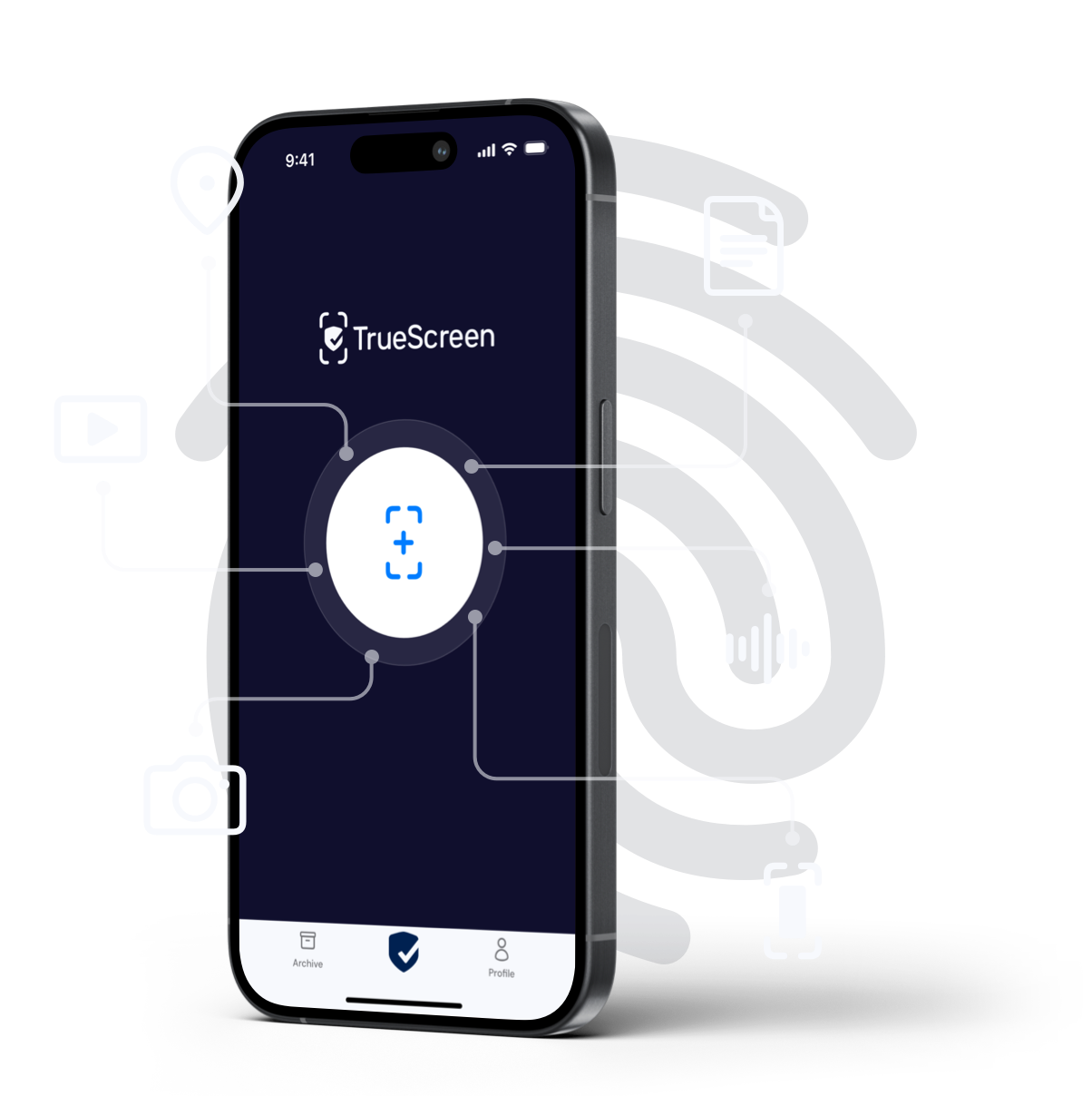
The fourth element is provenance attestation: who performed the acquisition, from which device, with which credentials, on which network session. These coordinates build the complete evidentiary narrative. Not just "this file is unaltered since moment X," but "acquired by Y, on device Z, in session W, authenticated against account Q." To harden a screenshot under article 2712 italian civil code, the reproduction has to be acquired with forensic methodology. That is the approach TrueScreen, the Data Authenticity Platform, operationalizes through its mobile app, web portal and API.
Practical Applications: Certifying Each Type of Reproduction
Every category of digital content has specific disclaimer risks. The table below maps the main classes, the reference rule, the typical disclaimer vectors and the certification path.
| Category | Rule | Disclaimer risks | Certification |
|---|---|---|---|
| WhatsApp chats and messaging | Art. 2712 c.c. | Text manipulation, date alteration, sender identity | certifying WhatsApp chats |
| Email and certified mail | Art. 2712 c.c. + eIDAS | Manipulated headers, altered body, replaced attachments | email as evidence |
| Website and social screenshots | Art. 2712 c.c. | Removed content, DOM manipulation, local cache | screenshot admissibility |
| Digital photographs | Art. 2712 c.c. | Manipulated EXIF, photomontage, synthetic images | photo certification |
| Meeting and video recordings | Art. 2712 c.c. | Audio editing, cuts, participant substitution | meeting recordings |
WhatsApp Chats and Messaging
WhatsApp chats are the most litigated digital category under article 2712 Italian civil code in Italy today. Cass. 1254/2025 confirmed the applicability of article 2712, but the plain screenshot remains vulnerable because it can be altered with trivial tools. Proper certification of WhatsApp chats with legal value requires device-level acquisition with hash, qualified timestamp and chain of custody. The same applies to Telegram, Signal and iMessage. For the implications in family law and custody disputes, see our analysis of WhatsApp evidence in divorce and custody proceedings.
Emails and Certified Mail
Ordinary email and certified mail share the article 2712 Italian civil code regime, with certified mail carrying additional operator attestations. In both cases, resisting a qualified disclaimer requires preserving complete headers, intact attachments and a hash of the full message envelope. The architecture is covered in depth in our analysis of email certification as an authentication challenge.
Website and Social Media Screenshots
A webpage can change in minutes, a post can be removed in seconds. Local screenshots do not suffice. What works is an acquisition that certifies date, content and URL in the same forensic act, with full-page capture and preservation of linked resources. For a deep dive on what defendants actually argue in court, our write-up on screenshot court evidence objections walks through the recurring defense patterns.
Digital Photographs
With the spread of advanced editing tools and synthetic image generation, disclaimer arguments based on "possible manipulation" or "possible synthetic origin" have become more credible on their face. Acquiring the image forensically with hash, qualified timestamp and provenance attestation shifts the argumentative burden back onto the disclaimant. Our practitioner guide on certifying photos with legal value covers the operational workflow.
Meeting and Video Call Recordings
Zoom, Teams and Meet produce recordings that fall under article 2712 italian civil code. The recording exported from the platform does not carry integrity guarantees by itself: it has to be sealed at the moment of acquisition, not after the fact. Our analysis of online meeting certification and its legal value walks through the technical requirements. For readers who want the broader evidentiary framework, the companion pillar on admissibility of digital evidence sits alongside this one.
How TrueScreen Certifies Digital Reproductions Under Article 2712
TrueScreen, the Data Authenticity Platform, certifies WhatsApp chats, emails, screenshots, photographs and recordings by applying the forensic methodology that article 2712 italian civil code implicitly requires. Every acquisition produces an evidentiary package that combines SHA-256 hash, qualified eIDAS timestamp issued by a QTSP, chain of custody conforming to ISO/IEC 27037 and provenance attestation (device, session, account). The result is an informatic reproduction that is hard to disclaim in a qualified way: generic contestation fails, and specific contestation has to confront verifiable technical elements. Law firms, in-house legal teams and compliance officers use TrueScreen to acquire digital evidence with forensic guarantees at the moment of capture, without retroactive expert consultations.
Mobile App for On-the-Go Acquisition
The TrueScreen mobile app captures screenshots, photographs and recordings directly from the mobile device. Each acquisition is sealed locally with a hash and transmitted to the certification infrastructure, which applies the qualified timestamp and registers the chain of custody. Typical use case: capturing a WhatsApp chat before it gets deleted by the counterparty.
Web Portal for Desktop Acquisitions
The TrueScreen web portal handles acquisitions of webpages, websites and desktop content with full-page capture, HTTP header logging and preservation of linked resources. Typical use case: acquiring a defamatory online post or a contested advertisement before it gets modified or taken down.
API for Enterprise Integration
The TrueScreen API integrates certification into existing workflows: case management, CRM, internal messaging platforms. Typical use case: automated certification of every inbound email routed to a case file, creating an article 2712 compliant record from day one.
Mail Certification for Email Evidence
TrueScreen Mail Certification seals ordinary emails with hash and qualified timestamp at the moment of reception, protecting sensitive commercial correspondence with a probative purpose baked in.
Who Carries the Burden of Proof When a Reproduction Is Disclaimed
The burden of proof decides which party bears the consequences when a fact stays uncertain. For digital reproductions, Article 2712 builds a three-stage mechanism, and knowing who has to prove what, and when, often matters more than the content of the reproduction itself.
At the first stage the burden sits with the party filing the document: it must be produced and asserted as conforming to the facts it depicts. As long as nobody objects, the reproduction is full proof and nothing further is needed. At the second stage the burden shifts to the opposing party, which must disclaim it. A generic denial is not enough: Supreme Court case law requires the disclaimer to be clear, specific and timely, and to say in what respect the reproduction departs from the reality it depicts.
The third stage is the one most often missed. Once a disclaimer has been properly framed, the reproduction loses its status as full proof and returns to being circumstantial material that the judge weighs freely. The burden of showing that the file really matches the fact it depicts falls back on the party that produced it, which then has to reconstruct origin and integrity by other means: witness testimony, court-appointed technical expertise, forensic acquisition of the device. Under Supreme Court case law (for example Cass. 19155/2019), the judge can then establish conformity with the original by other means of proof, including presumptions.
This is precisely where a reproduction certified at the source changes the outcome. If the file was acquired with a forensic method, sealed with a cryptographic hash and bound to a qualified electronic timestamp, a generic disclaimer does not hold, because conformity no longer rests on the word of the party that produced the document but on a technical check anyone can repeat, including the opposing party's own expert. The burden of proof stays formally where it was, but it can be discharged with an automated verification instead of an expert report.
FAQ: Article 2712 Italian Civil Code
What does article 2712 of the Italian Civil Code provide?
Which reproductions fall within article 2712 Italian civil code?
What does it mean to disclaim a reproduction under article 2712?
By when must a digital reproduction be disclaimed?
What is the difference between article 2712 and article 2702 of the Italian Civil Code?
What is the difference between article 2712 and article 2719 of the Italian Civil Code?
Can a certified digital reproduction still be disclaimed?
What does a screenshot need to resist disclaimer under article 2712?
TrueScreen editorial team
This section is edited by the TrueScreen editorial team, which brings together expertise in digital forensics, the law of digital evidence and regulatory compliance. Every article is checked against primary sources: legislation, published rulings, technical standards and official documentation, always cited in the text.


