Document dematerialization: from scanning to legally certified digitization
Organizations across Europe are accelerating the shift from paper archives to digital systems, driven by regulatory mandates and the need to reduce storage costs. The Italian National Institute of Statistics (ISTAT) reports that 99% of enterprises with 10 or more employees have adopted at least a basic level of digitization, yet most document scanning initiatives stop at creating simple copies with no legal standing.
The core problem: scanning a paper document into a PDF does not make it a legally valid digital record. Without cryptographic integrity verification and qualified timestamping, that digital copy can be challenged in court and fails to meet regulatory archiving requirements. The gap between simple digitization and certified document dematerialization creates measurable compliance risk for every organization that handles paper-origin records.
Closing this gap requires a specific technical process: each digitized document must be certified for integrity and authenticity at the moment of capture, using cryptographic hashing and a qualified timestamp issued by a Qualified Trust Service Provider (QTSP) under the eIDAS Regulation.
What document dematerialization means
Document dematerialization refers to the regulated process of converting paper documents into legally equivalent digital records through certified digitization. Unlike simple scanning, it requires the application of cryptographic hashing, qualified timestamps, and digital signatures or electronic seals to ensure each digital copy carries full legal and evidentiary value, enabling organizations to dispose of paper originals.
The process goes beyond digitization: dematerialization demands that the digital copy acquire probative value sufficient to replace the physical document in any context, including judicial proceedings. Under the eIDAS 2.0 framework (EU Regulation 2024/1183), a document digitized and archived through a Qualified Trust Service Provider carries legal presumption of integrity across all 27 EU member states. Data authenticity platforms such as TrueScreen enable organizations to apply these certification requirements at the moment of capture, embedding legal validity into the digitization workflow from the start.
Simple digitization versus certified dematerialization
The distinction between digitization and dematerialization is substantive, not semantic. Digitization produces a copy: an image file or PDF with no legal guarantees. Certified dematerialization produces a digital record with legal standing, capable of replacing the paper original in all contexts, including litigation.
| Criterion | Simple digitization | Certified dematerialization |
|---|---|---|
| Process | Scanning or photographing the document | Certified capture with integrity verification |
| Legal value | None: the copy can be challenged | Full: equivalent to the original under eIDAS |
| Integrity guaranteed | No | Yes: cryptographic hash detects any alteration |
| Timestamp | No | Yes: qualified timestamp from a QTSP |
| Archiving | Generic storage on disk or cloud | Qualified electronic archiving (eIDAS 2.0) |
| Disposal of original | Not permitted | Permitted after certified dematerialization |
| Regulatory compliance | None | eIDAS, GDPR, national implementations |
Digital preservation versus substitutive archiving
Digital preservation covers the long-term management of any digital record, ensuring readability, integrity, and retrievability over time. Substitutive archiving (a concept rooted in EU member state implementations of eIDAS) specifically addresses the replacement of paper originals with certified digital copies that carry equivalent legal weight. The two concepts overlap but serve different purposes: preservation is about longevity, substitutive archiving is about legal equivalence.
The regulatory framework: eIDAS 2.0 and qualified electronic archiving
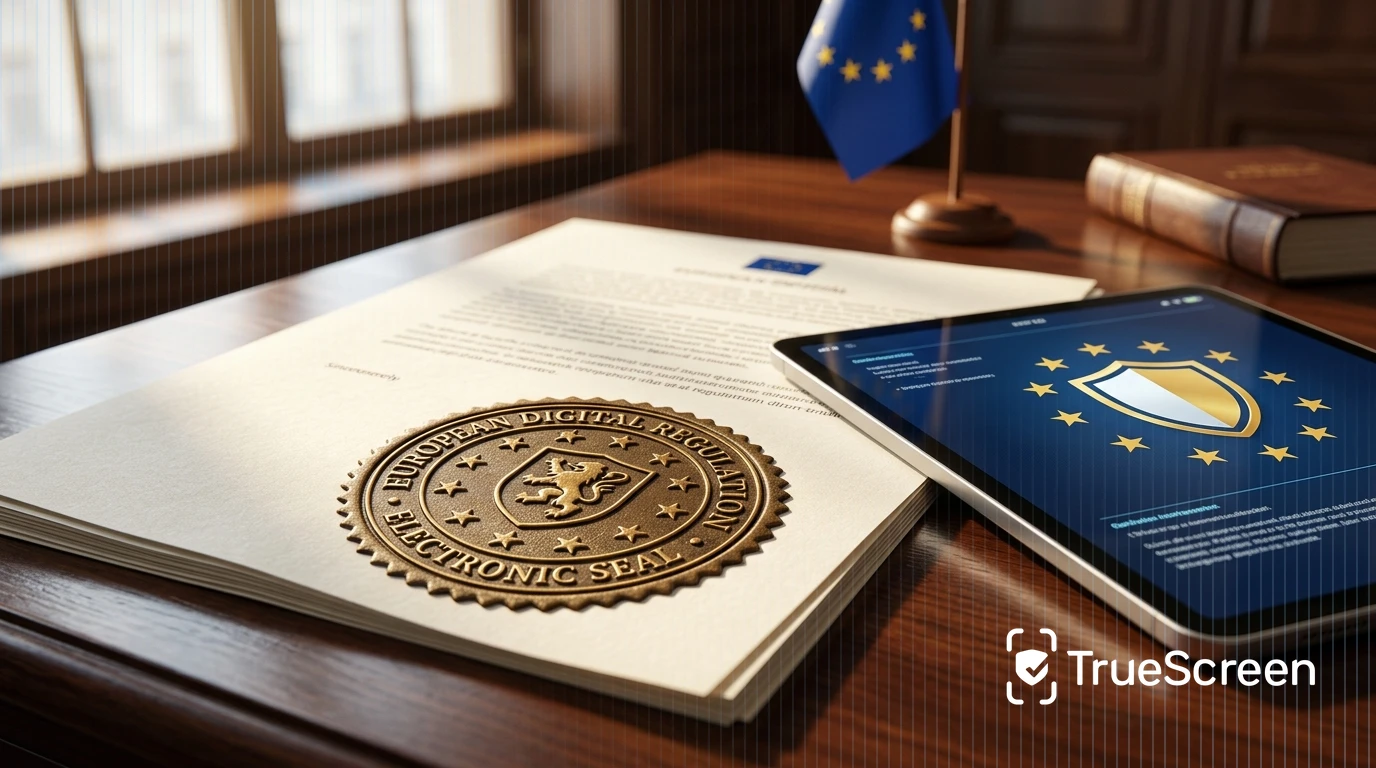
Regulation (EU) 2024/1183 (eIDAS 2.0), which entered into force on 20 May 2024, introduces a significant development for document dematerialization: qualified electronic archiving as a new trust service. This service, provided by Qualified Trust Service Providers (QTSPs), creates a harmonized EU-wide framework for preserving electronic documents over time, covering both born-digital and digitized records.
What eIDAS 2.0 changes for document digitization
eIDAS 2.0 explicitly permits format and media migrations during archiving, provided that the integrity of information is fully preserved and any risk of alteration is eliminated. By May 2025, the European Commission established the reference standards and technical specifications for qualified electronic archiving services, creating for the first time a mechanism for cross-border recognition of the legal value of digitally archived documents.
This represents a paradigm shift: before eIDAS 2.0, document archiving regulations were fragmented across member states. Now, a document certified and archived by a QTSP in one EU country carries legal presumption of integrity across all 27 member states.
ISO standards and international compliance
Beyond eIDAS, the international framework for certified document digitization includes ISO/IEC 27037 (guidelines for identification, collection, acquisition, and preservation of digital evidence), ISO/IEC 27001 (information security management), and the OAIS reference model (ISO 14721) for long-term digital preservation. Organizations operating across jurisdictions need their digitization processes to comply with these standards to ensure that certified copies maintain their legal validity internationally.
Risks of digitization without certification
Digitizing without certifying creates copies with no probative value. The consequences are practical: they materialize in courtrooms, during compliance audits, and in the ongoing costs organizations bear to maintain parallel paper archives. This is why certification at the point of capture, as provided by data authenticity solutions like TrueScreen, represents the critical step that separates useful digitization from legally defensible dematerialization.
Evidentiary challenges
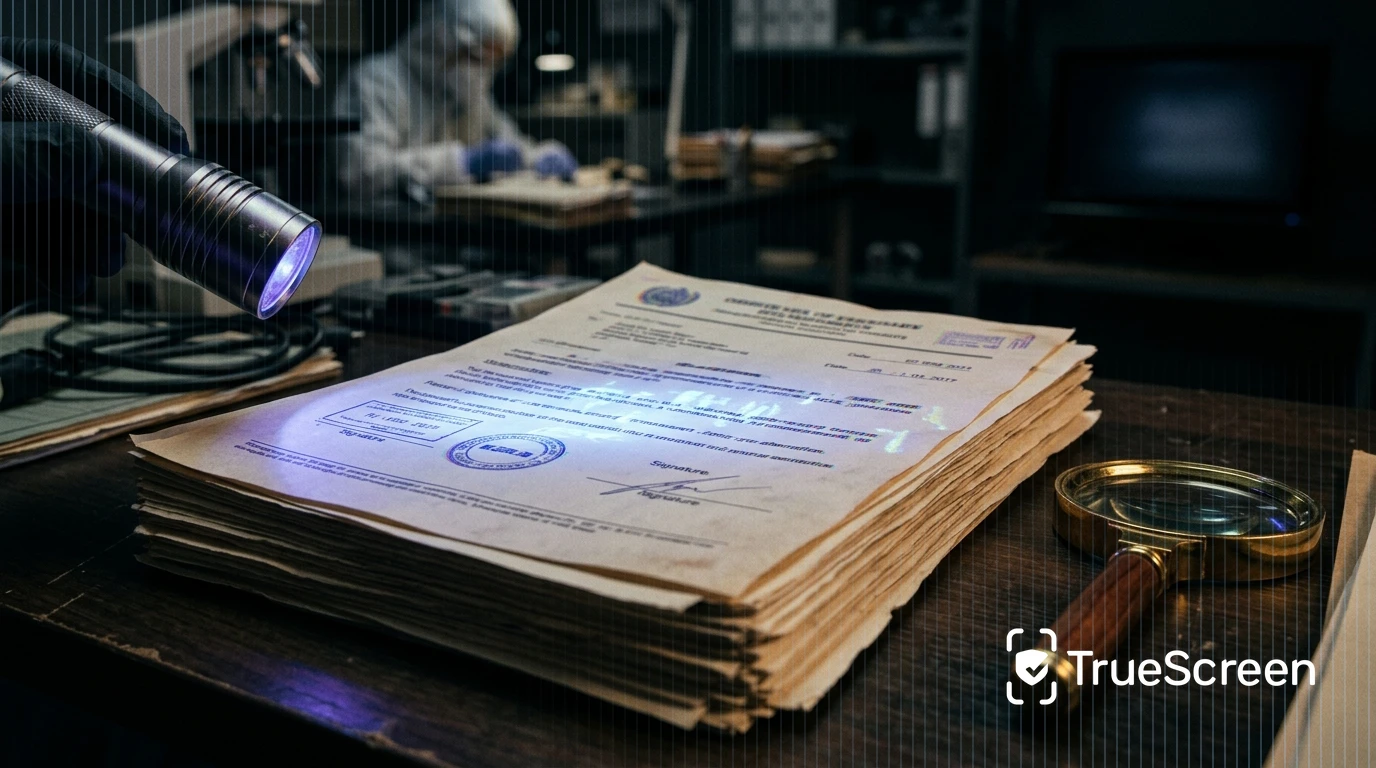
A digital document lacking integrity certification can be challenged by opposing parties in litigation. Under the EU framework and most common law jurisdictions, the party producing a digital copy bears the burden of proving it has not been altered since capture. Without a cryptographic hash and qualified timestamp, there is no technical mechanism to demonstrate that a scanned contract, report, or medical record remains identical to the moment it was digitized. The opposing party simply needs to raise the question of potential alteration to undermine the document's evidentiary weight.
Compliance failures and operational costs
Organizations subject to document retention requirements (financial, healthcare, regulatory) face penalties when digital copies fail to meet the applicable technical standards. Financial regulators across the EU require that digitally stored documents carry digital signatures and qualified timestamps. Healthcare facilities must preserve patient records for legally mandated periods while guaranteeing their integrity throughout. Non-compliance can result in the invalidation of documentation during disputes, loss of fiscal benefits tied to digital transformation, and the obligation to maintain the original paper archive, negating the investment in digitization. Maintaining a verifiable digital chain of custody from the moment of capture is essential to avoid these risks.
What makes a digital copy legally equivalent to the original
A digital copy achieves legal equivalence to its paper original when three technical elements are present simultaneously: a cryptographic hash that certifies content integrity, a qualified timestamp issued by a QTSP that establishes legal date certainty, and a digital signature or qualified electronic seal that confers juridical validity. Under the eIDAS Regulation and ISO/IEC 27037, these elements create a verifiable chain of integrity from the moment of capture through long-term archiving. Missing even one of these components leaves the copy as a simple, contestable reproduction with no probative weight in legal proceedings.
Cryptographic hashing and document integrity
A cryptographic hash algorithm generates a unique digital fingerprint of a file. Any modification to the document, even a single bit, produces an entirely different hash value. Applied at the moment of scanning, the hash certifies that the file content has not been altered since capture. This mechanism underpins all compliant digital preservation systems and serves as the technical integrity guarantee required under eIDAS and ISO/IEC 27037.
Qualified timestamps and legal certainty of date
A qualified timestamp, issued by a QTSP under the eIDAS Regulation, provides legally binding proof of the date and time a document was certified. Unlike a simple file metadata timestamp that can be modified, a qualified timestamp is a cryptographic seal issued by an accredited third party, creating evidence opposable to third parties of the exact moment the document existed in that specific form.
Digital signatures and qualified electronic seals
A digital signature confers legal validity equivalent to a handwritten signature under eIDAS. The qualified electronic seal, also introduced by eIDAS, serves an analogous function for legal entities: it attests to the origin and integrity of associated data without requiring the identification of a specific natural person as signatory. For large-scale dematerialization projects where thousands of documents are processed sequentially, the qualified electronic seal is the most appropriate instrument because it enables automated certification while maintaining full legal validity.
How to certify digitized documents with legal value
TrueScreen, the Data Authenticity Platform, enables organizations to transform document digitization into certified dematerialization with full legal value. The platform integrates forensic-grade data acquisition and certification in a single process: each document is scanned, sealed with a cryptographic hash and qualified timestamp from an international QTSP, and rendered immutable and verifiable. The result is a digital copy that meets eIDAS requirements for qualified electronic archiving, admissible as evidence in court and suitable for replacing the paper original.
Mobile capture and certification
The TrueScreen mobile app includes the Document Scanner Certification feature: a capture mode that transforms a smartphone camera into a certifying scanner. The paper document is photographed, the system verifies image quality, and automatically applies the digital seal and qualified timestamp. The entire process takes seconds on-device, requiring no dedicated infrastructure or specialized technical skills. A law firm dematerializing its historical archive, for instance, can assign the task to staff equipped with smartphones, obtaining certified digital copies without professional scanners or external service providers.
Platform and API integration for enterprise workflows
For organizations processing high document volumes, TrueScreen offers integration through API and web platform. The APIs enable certification to be embedded directly in existing document workflows (ERP, DMS, archiving systems), automating dematerialization without modifying operational processes. A hospital digitizing patient consent forms, for example, can integrate TrueScreen certification into its management system: each scanned document is certified automatically before archiving, ensuring regulatory compliance without additional manual steps.