
Updated on
Recording a Meeting Without Consent: Legality, Limits and GDPR
The legal framework varies by jurisdiction, but the core tension is universal. Most legal systems distinguish between intercepting a conversation as a third party (generally illegal) and recording a conversation you actively participate in (generally permitted, with conditions). The real challenge is not whether you can record, but whether the recording will carry evidentiary weight when it matters. An unprotected file can be challenged, edited, or dismissed. A certified recording, protected by a digital signature and qualified timestamp at the moment of capture, shifts the burden of proof onto the party contesting its authenticity.
For organisations that handle online meeting certification without consent as part of their compliance or legal processes, understanding where the line falls between lawful recording and admissible evidence is essential.
This insight is part of our guide: Certified Online Meeting Recording: Legal Cases
When recording a meeting without consent is lawful
The one-party consent principle
In most common law jurisdictions and across the European Union, a person who participates in a conversation may record it without notifying the other participants. This is commonly referred to as the “one-party consent” rule. The rationale is straightforward: you are not intercepting someone else’s communication; you are documenting your own experience of a conversation you are part of.
The distinction matters because interception laws (such as the U.S. Federal Wiretap Act, 18 U.S.C. § 2511, or the EU’s e-Privacy Directive 2002/58/EC) target third-party surveillance, not participant documentation. A Zoom recording made by an attendee falls into the second category. That said, some U.S. states require all-party consent (California, Illinois, and others), and specific contractual or employment agreements may impose additional restrictions.
In the European context, the eIDAS Regulation (EU No. 910/2014) and the GDPR (EU 2016/679) provide the overarching framework. Recording is not prohibited per se, but the processing of personal data contained in the recording must comply with GDPR requirements, regardless of whether consent to the recording itself was obtained.
Lawful recording vs admissible evidence
Recording a meeting lawfully is one thing. Using that recording as reliable evidence is another. A native screen recording from Zoom or Teams has no cryptographic protection. It can be edited, trimmed, or reassembled without leaving visible traces. In litigation, the opposing party can argue that the file was tampered with after capture, and without certified metadata proving the exact moment of acquisition and the absence of subsequent modifications, the court has no objective basis to assess the file’s integrity.
The recording is not necessarily excluded, but its evidentiary weight decreases significantly. It moves from conclusive proof to circumstantial evidence, subject to the judge’s discretionary assessment. For anyone relying on meeting recordings as part of a legal strategy, this distinction is critical.
GDPR and meeting recordings: obligations and boundaries
Legal basis: legitimate interest vs consent
The GDPR applies fully to video conference recordings because they contain personal data: faces, voices, displayed names, and often shared documents visible on screen.
When the recording is made without the other participants’ consent, the most relevant legal basis is Article 6(1)(f) of the GDPR: the legitimate interest of the data controller. The European Data Protection Board (EDPB) has indicated that legitimate interest can justify processing when it is necessary to establish, exercise, or defend legal claims. A balancing test is required: the interest of the person recording must outweigh the rights and freedoms of the data subjects.
In practice, recording a meeting to protect oneself in an employment dispute, to document a commercial agreement, or to capture evidence of misconduct can be justified under legitimate interest. Recording for surveillance, curiosity, or unauthorised redistribution does not meet the threshold.
Data minimisation and storage limitations
Even with a solid legal basis, the GDPR imposes specific constraints. The data minimisation principle (Article 5(1)(c)) requires that the recording capture only what is necessary for the stated purpose. The storage limitation principle (Article 5(1)(e)) requires that the file be retained only for as long as necessary.
An often-overlooked requirement concerns data security. Article 32 of the GDPR mandates appropriate technical and organisational measures to protect personal data. A recording stored on a local drive without cryptographic safeguards does not satisfy this requirement. Certification at the source, with digital signature and secure preservation, addresses both the evidentiary integrity requirement and the GDPR security obligation simultaneously.
Online meeting certification without consent: protecting evidentiary value
When a recording made without consent enters legal proceedings, the opposing party typically has two lines of attack: challenging the lawfulness of the recording and challenging the authenticity of the content. On lawfulness, the legal position is well established for participant recordings. On authenticity, everything depends on the technical protection of the file.
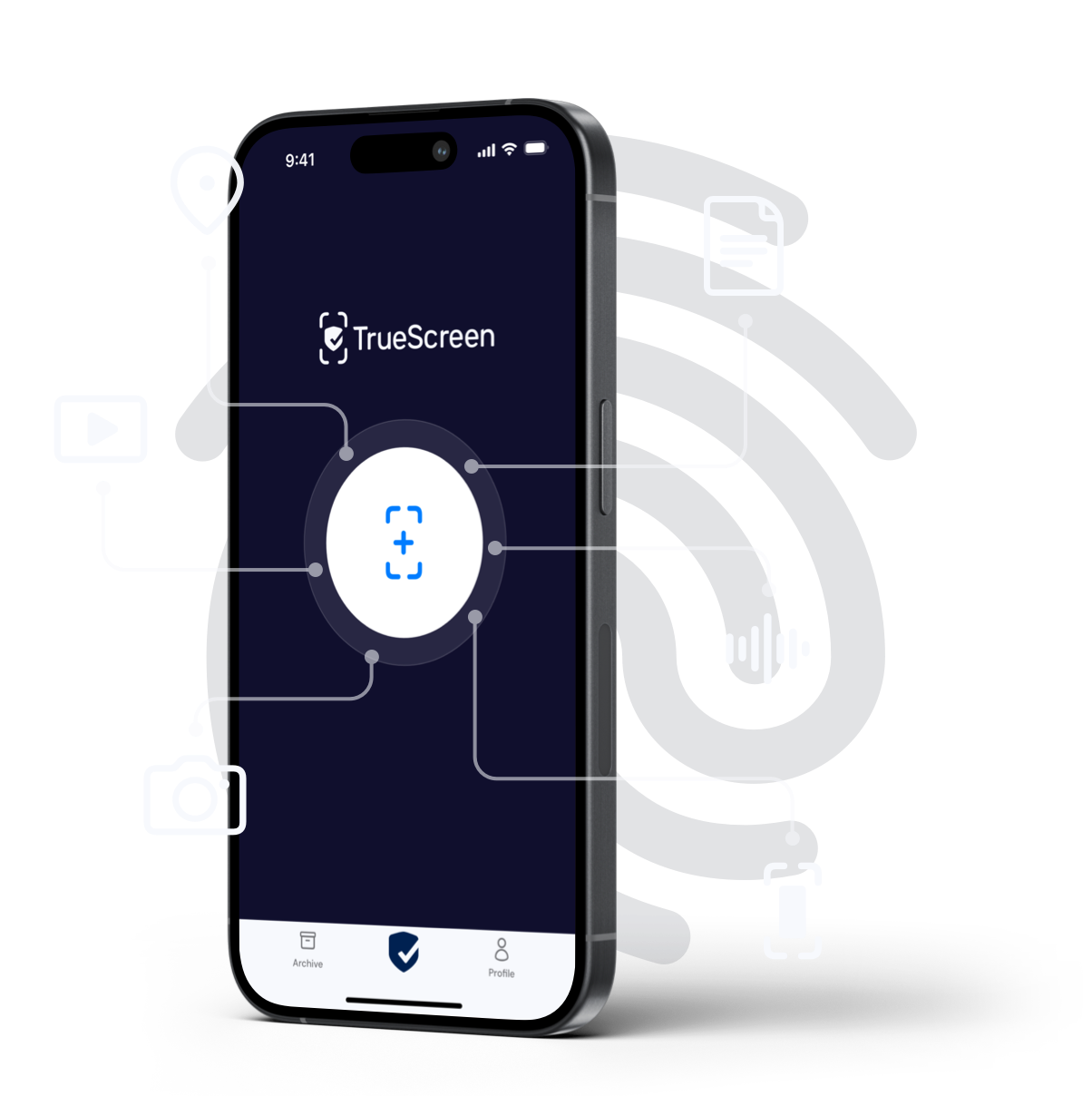
TrueScreen addresses the authenticity challenge at its root. The certified screen recording process applies a digital signature and qualified timestamp at the exact moment of capture. Immutable metadata includes the date, time, cryptographic hash of the content, and the identity of the certifier. Any subsequent modification to the file is detectable, making challenges to the recording’s integrity effectively unsustainable.
From a GDPR perspective, certification also provides precise documentation of when the acquisition occurred and what exactly was recorded: elements that support compliance with the data minimisation principle and the accountability obligation under Article 5(2). The certified file itself constitutes an appropriate technical measure under Article 32.
The international standard ISO/IEC 27037, which defines guidelines for the identification, collection, acquisition, and preservation of digital evidence, requires that evidence be acquired in a manner that preserves its integrity, with complete documentation of the chain of custody. A recording certified at the source satisfies both requirements, strengthening the evidentiary position in civil proceedings, employment disputes, and regulatory investigations alike.

FAQ: Recording meetings without consent
Is it legal to record an online meeting without telling the other participants?
Can a meeting recording made without consent be used as evidence in court?
How does GDPR affect the recording of business video conferences?
TrueScreen editorial team
This section is edited by the TrueScreen editorial team, which brings together expertise in digital forensics, the law of digital evidence and regulatory compliance. Every article is checked against primary sources: legislation, published rulings, technical standards and official documentation, always cited in the text.


