
Updated on
Online Meeting Certification: how to get legally valid meeting recordings
Every day, thousands of business meetings take place on Google Meet, Microsoft Teams, Zoom, and Slack. Many of them get recorded: board resolutions, contract negotiations, disciplinary hearings, remote medical consultations, witness depositions. Organizations hit “Record” assuming the file will serve as reliable evidence of what happened. In the majority of cases, that assumption is wrong.
Platform recordings are editable files. They carry no cryptographic integrity guarantee, no timestamp issued by a qualified third party, and no verifiable chain of custody. Metadata can be altered, segments removed, and with today’s AI tools, participants’ voices can be cloned and words fabricated. An uncertified recording is evidence that holds up only until someone challenges it.
The question organizations should be asking is not “are we recording our meetings?” but “do our recordings have legal standing?” For virtually all business recordings, the answer is no. There is, however, a different approach: certify the meeting at the moment of capture, turning a volatile recording into forensic evidence with full legal value.
Why standard recordings lack legal standing
The false security of the “Record” button
Video conferencing platforms offer built-in recording features. This creates a false sense of security: if the meeting was recorded, we have proof of what was said and decided. In reality, the file produced by these platforms is an audio-video file like any other, lacking the characteristics that would make it usable as evidence in legal proceedings.
Three fundamental elements are missing. First, cryptographic integrity: no video conferencing platform applies a cryptographic hash to the file at creation, so there is no way to prove the content has not been altered after recording. Second, a qualified timestamp: the date and time of the recording are file metadata, editable with any tool. Without a timestamp from a Qualified Trust Service Provider (QTSP), the date carries no legal presumption. Third, chain of custody: from the moment of recording to its presentation as evidence, there is no documentation of who accessed the file, where it was stored, or whether it was copied or modified.
Real-world risk scenarios
Situations where an uncertified recording proves insufficient are more common than most organizations realize. A board member disputes the content of a resolution voted during a remote shareholders’ meeting. An employee contests what was said during a disciplinary hearing held via video call. A counterparty denies the verbal agreements reached during an online negotiation. A witness claims their remote deposition was manipulated.
In each case, the platform recording falls short. Without integrity guarantees, any recording can be challenged and potentially invalidated. And the moment an organization discovers its recordings have no evidentiary value is almost always the worst possible one: when they are needed as proof.
The legal landscape: when digital recordings are admissible
Digital recordings are admissible as evidence to the extent their authenticity is not contested. Under the eIDAS regulation, qualified timestamps and electronic seals carry a legal presumption of integrity and date accuracy across all EU member states. ISO/IEC 27037 sets the guidelines for identification, collection, and preservation of digital evidence.
The E-Evidence Regulation, effective from August 18, 2026, will establish uniform rules for cross-border collection and transmission of authenticated electronic evidence, making source certification of recordings even more relevant for organizations operating across jurisdictions.
Without cryptographic proof of integrity, any recording can be successfully challenged. Recordings backed by a qualified timestamp and cryptographic hashing enjoy a significantly stronger legal standing.
Forensic certification of online meetings with TrueScreen
A dedicated service, not generic screen recording
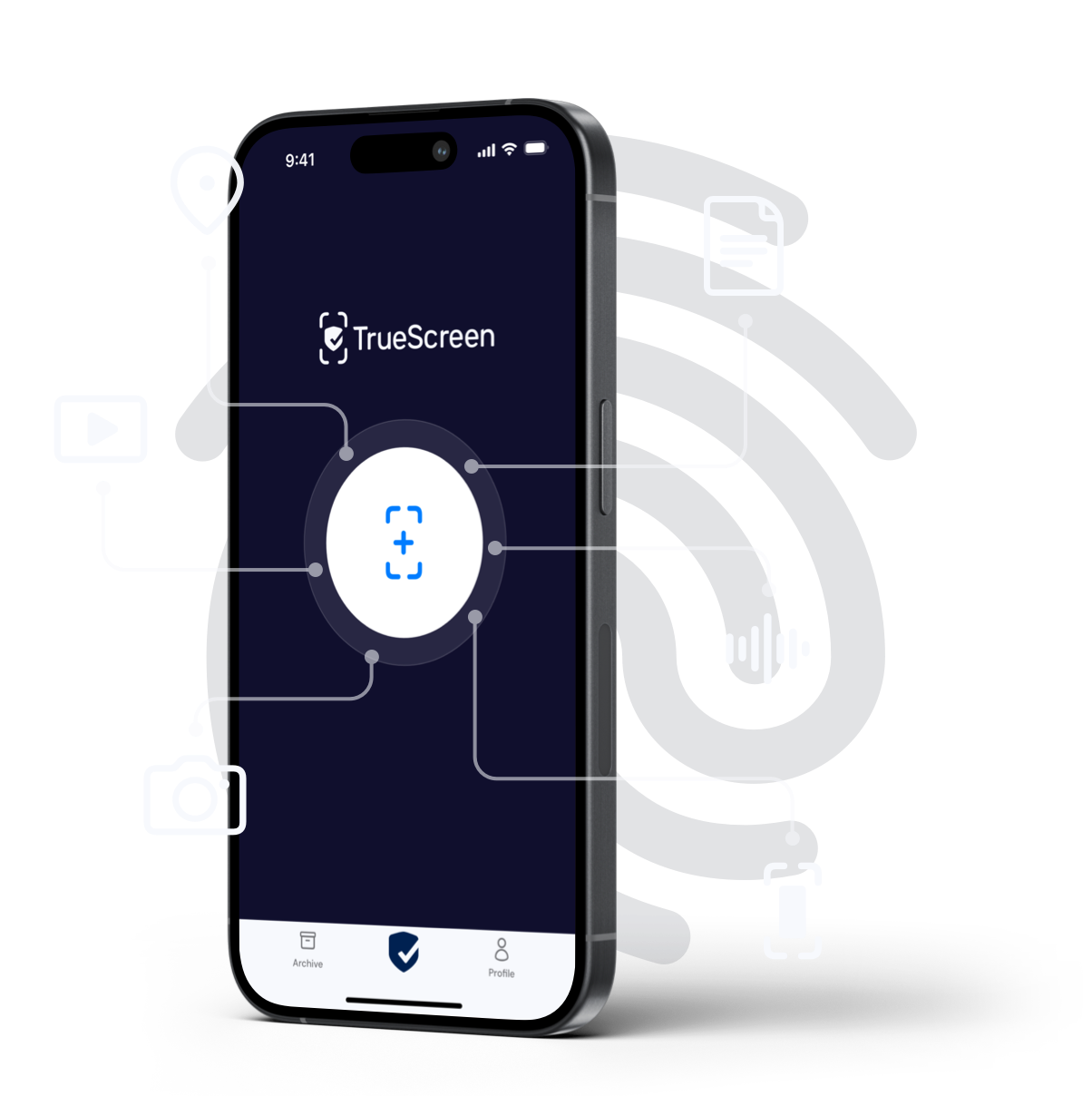
TrueScreen offers a dedicated online meeting certification service, designed to turn video conferences into digital evidence with full legal and forensic value. This is not a generic screen recording feature: it is a forensic acquisition process purpose-built for video conferencing.
The service works with Google Meet, Microsoft Teams, Zoom, and Slack. Only the participant initiating the certification needs TrueScreen installed. All other attendees join the meeting normally, on their preferred platform, without installing anything.
The three-step process
Certifying an online meeting with TrueScreen takes three steps.
1. open the TrueScreen application (available on desktop, iOS, and Android) and select the online meeting certification function.
2. start the meeting on the chosen platform. TrueScreen’s forensic acquisition engine captures the entire session in a controlled environment: video, audio, screen-shared content, and participant interactions.
3. When the meeting ends, TrueScreen automatically generates the complete certification package.
The controlled environment ensures that captured content cannot be altered, edited, or selectively manipulated during or after the session. Cryptographic hashing is applied to the entire package, making any subsequent modification immediately detectable.
What the certified package contains
At the end of the acquisition, TrueScreen produces a certified ZIP package with four components. The original recording in high quality preserves video, audio, and shared content exactly as captured, without any alteration. The forensic PDF report documents timestamps, participant list, session duration, platform details, and operational acquisition logs in a format that is readable and presentable in any forum. The JSON report contains the same data and metadata in machine-readable format, for automated integration into information systems and document workflows. The XML file contains the electronic seal and qualified timestamp issued by the QTSP.
Each component receives an electronic seal and qualified timestamp from an international Qualified Trust Service Provider (QTSP). The entire package is tamper-proof: any post-session alteration is cryptographically detectable.
Specific use cases for meeting certification
Online meeting certification finds direct application across professional contexts.
In legal proceedings and depositions, remote witness testimony gains full legal standing with a verifiable chain of custody.
In corporate governance, board resolutions and shareholder meetings become independently verifiable, eliminating disputes over what was voted or declared.
In compliance audits, certification provides irrefutable documentation that mandatory training was delivered and attended.
In contract negotiations, verbal agreements reached via video call become certified evidence. For health insurance, teleconsultation recordings carry forensic value.
In HR proceedings, disciplinary hearings produce legally defensible digital records. For legal professionals, remote depositions and hearings acquire the evidentiary robustness required for court use.
Compliance and legal standing
TrueScreen certifications comply with eIDAS (qualified timestamps provide a legal presumption of integrity and authenticity across all EU member states), ISO/IEC 27037 for digital evidence handling, ISO/IEC 27001 for information security, and GDPR for personal data protection.
For organizations operating internationally, the eIDAS-based and ISO-compliant certification framework ensures legal recognition across all European jurisdictions. The digital provenance of certified recordings represents the highest level of guarantee currently available for evidence derived from online meetings: every element of the certified package is traceable, verifiable, and cryptographically guaranteed from creation to courtroom presentation.
Related insights
This guide is accompanied by eight dedicated insights, each focusing on a specific aspect of online meeting certification:
- Evidentiary Value of Online Meeting Recordings: Digital Certification and Legal Proof
- Recording a Meeting Without Consent: Legality, Limits and GDPR
- Certified Screen Recording: How the Digital Chain of Custody Works
- Zoom, Teams, Meet: Certify Video Calls on Any Platform
- Online Corporate Assemblies: How to Certify Remote Resolutions
- Due Diligence and Remote Negotiations: Certifying Commercial Discussions
- Certified Remote Training: Compliance Obligations and Regulatory Requirements
- Employment Disputes and Certified Meetings: Dismissals, Disciplinary Actions, Whistleblowing
FAQ: Online Meeting Certification
Why do standard video conferencing recordings lack legal standing?
Do all participants need TrueScreen installed?
Which video conferencing platforms are supported?
What does the certified package contain after the meeting?
Are certified recordings admissible in court?
TrueScreen editorial team
This section is edited by the TrueScreen editorial team, which brings together expertise in digital forensics, the law of digital evidence and regulatory compliance. Every article is checked against primary sources: legislation, published rulings, technical standards and official documentation, always cited in the text.


