The digital trust paradigm: from authentication to authenticity
For decades, the digital world operated on an implicit rule: if you knew who produced a piece of content, you could trust the content itself. Logins, digital signatures, SSL certificates: everything revolved around user identity as a guarantee of reliability. A document sent by a colleague was trustworthy because it came from a verified account. A photo attached to an expert report was credible because it was taken by an identified professional.
Generative AI has broken this link. Today, anyone with access to free tools can produce synthetic text, images, video, and audio indistinguishable from real content. The World Economic Forum Global Risks Report 2025 identified misinformation and disinformation as the top short-term global risk for the second consecutive year. The Edelman Trust Barometer 2026 confirms that 50% of people consider the growing prevalence of misinformation one of the main factors eroding trust in institutions over the past five years.
Digital trust demands a paradigm shift: no longer verifying who produces content, but certifying the authenticity of the content itself. From identity verification to data authenticity certification at the source, through a Digital Provenance infrastructure that makes every piece of information verifiable, traceable, and legally valid.
The old paradigm: authentication as a proxy for trust
To grasp the scale of this shift, we need to look at how digital trust was built over the past thirty years.
From SSL to login: identity as the foundation
The history of digital security is the history of authentication. In the 1990s, the SSL protocol (later TLS) solved a fundamental problem: how to know whether the website you were interacting with was truly what it claimed to be. The answer was an identity certificate issued by a recognized authority.
The same principle extended to every layer of digital interaction. Login systems verify user identity. Digital signatures attest who signed a document. Certified email protocols guarantee the sender’s identity. A robust architecture, built on an assumption that went unchallenged for decades.
The implicit equation: verified identity equals trustworthy content
The unwritten premise of this entire system was simple: if you verify the identity of who produces the content, the content is reliable. A physician sending a medical report is identified, so the report is genuine. An assessor attaching photos to an appraisal is authenticated, so the photos are real.
This equation worked because producing convincing false content required significant expertise, time, and resources. The technical and economic barrier to manipulation made it reasonable to trust content based on the creator’s identity.
The rupture: when the creator’s identity is no longer enough
That barrier no longer exists. And with it collapses the model on which we built digital trust.
Generative AI changes the rules
A verified employee can generate a synthetic document. An authenticated user can upload an image created by an AI model. A professional with valid credentials can attach to a file photos they never took.
User authentication still works: we know who logged in. The problem is that knowing who produced or sent content tells us nothing about the nature of that content. The creator’s identity and the data’s authenticity have become two separate things.
Gartner listed Digital Provenance among the Top Strategic Technology Trends for 2026, estimating that by 2029, organizations that have not adequately invested in data provenance verification capabilities will face sanction risks potentially running into billions of dollars.
The detection paradox
The first instinctive reaction to synthetic content is trying to detect it: deepfake detection, forensic watermarking, metadata analysis. The approach is to find the fake and isolate it.
This strategy has a structural flaw. The ability to generate synthetic content improves faster than the ability to detect it. Each new generative model renders previous detectors obsolete. It is an asymmetric race where those producing fakes hold a permanent advantage over those trying to expose them.
The economic cost reflects the same asymmetry. Generating false content costs almost nothing. Verifying its authenticity after the fact requires forensic expertise, time, and resources. For an organization handling thousands of documents, appraisals, images, and communications daily, detection at scale is not sustainable.
The new digital trust paradigm: data authenticity at the source
If you cannot reliably and scalably recognize the false, you must guarantee the true. This is where the paradigm flips.
Data-centric trust: trust moves to the data
The new model starts not from the user but from the data itself. The goal is not to verify who produced content, but to guarantee that content is authentic at the moment of creation.
This approach is called data-centric trust: trust resides in the data, not in the person. An image is not credible because a verified professional took it. It is credible because it carries a certification of origin attesting where, when, how, and by whom it was acquired, with parameters independently verifiable by any third party.
Certify at the source, not verify after the fact
The difference between detection and provenance is the difference between a forensic investigation and a notarial act. The forensic investigation attempts to reconstruct the truth after the facts, with margins of uncertainty. The notarial act establishes it at the moment it occurs, with probative certainty.
Source certification works on the same principle. At the moment data is created or acquired, a system records its essential metadata: qualified timestamp, verified geolocation, device identity, cryptographic hash. These elements are sealed with a digital signature. From that point, any alteration is detectable and the data is verifiable by anyone, anywhere, at any time.
Who is most exposed: sectors where data authenticity is critical
The transition from the old to the new digital trust paradigm is not a theoretical exercise. It has immediate operational consequences in sectors where data reliability determines decisions, rights, and assets.
Legal and judicial proceedings
In legal contexts, digital evidence underpins decisions affecting assets, rights, and freedoms. An image, a screenshot, or a recording presented in court must withstand challenges to its authenticity. The ISO 27037 standard defines guidelines for the identification, collection, and preservation of digital evidence. The European eIDAS regulation provides the framework for digital signatures and trust services. Without a system certifying evidence at the source, the probative value of any digital data remains structurally vulnerable.
Insurance and financial services
Insurance companies handle thousands of claims daily, each accompanied by photographic and testimonial documentation. Damage photos, appraisals, identity documents: every element is potentially generable or alterable with AI tools. The cost of insurance fraud grows with the sophistication of manipulation tools, and traditional verification methods struggle to keep pace.
Media, public administration, and supply chain
In journalism, the authenticity of an image or video determines the credibility of an entire publication. In public administration, photographic and documentary evidence supports administrative proceedings and public procurement. In global supply chains, data traceability along the chain determines regulatory compliance.
In each of these contexts, the old paradigm is no longer sufficient. Trusting content because you verified the identity of who produced it leaves a gap that only source authenticity certification can fill.
The necessary infrastructure: Digital Provenance as a foundational layer
HTTPS made the web secure at the transport level. Digital Provenance can make it secure at the content level.
From protocol to layer: a trajectory already written
In the 2000s, moving from HTTP to HTTPS was not optional for sites handling sensitive data. In the following decade, it became the standard for the entire web. Browsers began flagging sites without SSL certificates as “not secure.”
Digital Provenance follows a similar trajectory. Today it is a strategic choice for the most exposed organizations. Tomorrow it will be an infrastructure component that markets, regulations, and users will expect as standard. Gartner places it in the “Vanguard” cluster: the area of technology trends addressing trust, governance, and security.
Regulations converge toward the same goal
The EU AI Act, with transparency obligations enforceable from August 2026, requires that AI-generated content be identifiable. The eIDAS regulation establishes the framework for trust services and the legal validity of digital documents across Europe. The ISO/IEC 27001 standard provides the reference framework for information security management.
All these regulations converge toward a common principle: digital information must be verifiable in its authenticity and provenance. It is no longer sufficient that it be accessible or readable: it must be demonstrably authentic.
How TrueScreen enables the new digital trust paradigm
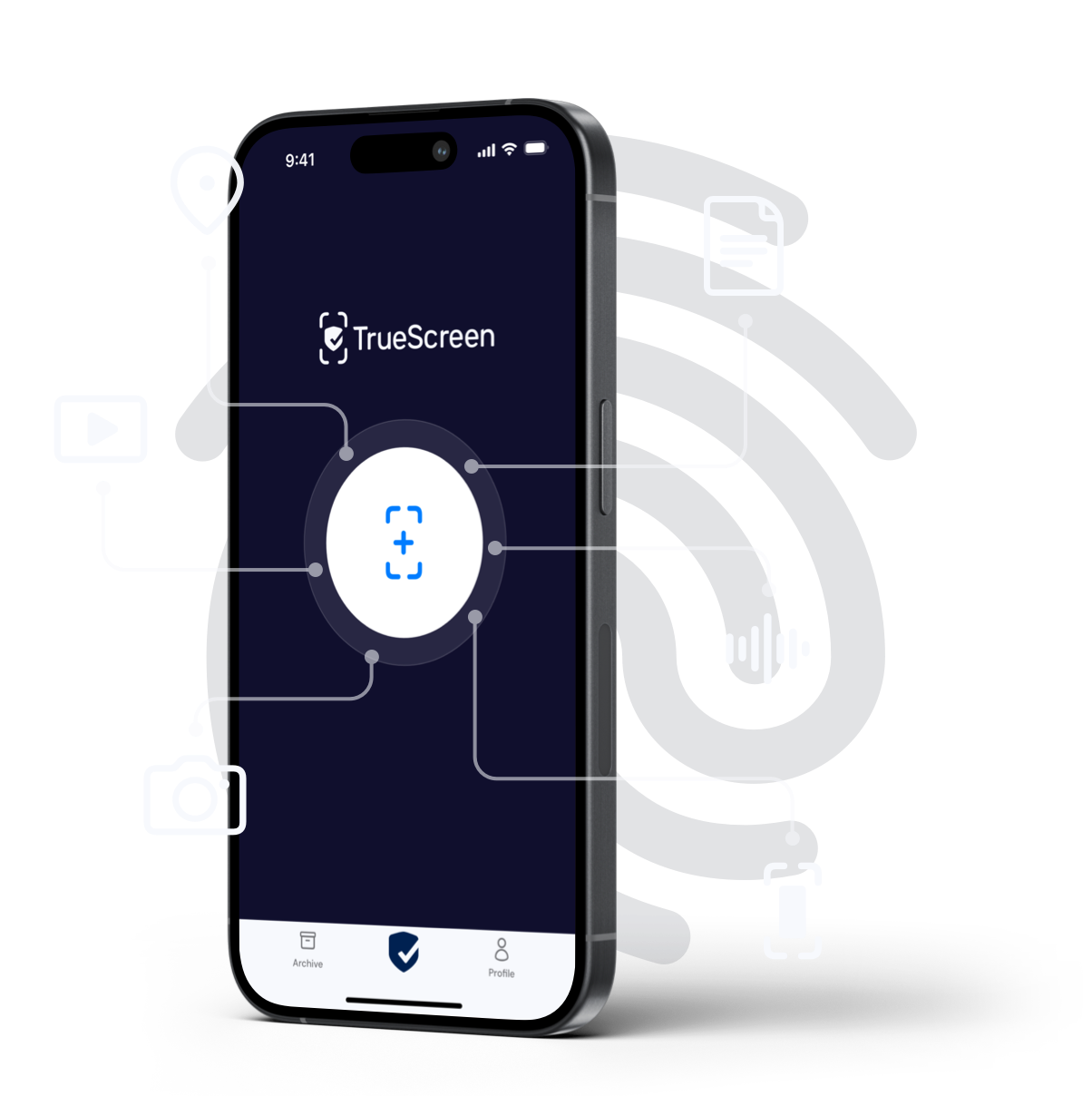
TrueScreen is the Data Authenticity Platform that enables professionals and companies to obtain authentic and reliable digital information in critical business processes.
Guarantee the true, not detect the false
TrueScreen does not try to identify false content. It certifies authentic content at the moment of creation. Every piece of data acquired through the platform is digitally signed, accompanied by a qualified timestamp, verified geolocation, cryptographic hash, and device metadata. The result is evidence with legal probative value, independently verifiable by any third party.
This approach is structurally different from detection. It does not depend on how fast recognition models are updated. It does not require forensic expertise for verification. It does not degrade over time as generative models improve.
End-to-end Digital Provenance
Through a complete process of forensic-grade acquisition, verification, and certification, TrueScreen guarantees the authenticity, traceability, and legal validity of information throughout its entire lifecycle. The vision is to establish the world’s trusted infrastructure for Digital Provenance: a universal standard that keeps digital information verifiable, tamper-proof, and legally valid.