
Updated on
Certifying WhatsApp chats: how to give legal value to your conversations
WhatsApp chats have become an integral part of everyday communication, both personal and professional. Contracts discussed via messages, verbal agreements confirmed with a digital “ok,” conversations that document workplace dynamics: everything goes through WhatsApp. Certifying WhatsApp chats is now a real necessity for anyone who wants to use them as evidence in legal proceedings.
The problem is that a screenshot, on its own, is not enough. It can be edited, taken out of context, or challenged in court. Without an acquisition process that guarantees integrity and authenticity, a WhatsApp conversation risks losing any evidentiary value. The question is straightforward: how do you certify a WhatsApp chat so that it holds full legal value?
The answer lies in a structured digital certification process that crystallizes the content, ensures its integrity through a digital signature and a qualified timestamp, and produces verifiable documentation that is enforceable against third parties. This approach follows the principles of the EU eIDAS Regulation on electronic identification and trust services, and is consistent with the way courts across multiple jurisdictions now treat authenticated digital records.
Are WhatsApp messages legally valid evidence?
Digital records as evidence: the international legal framework
Most legal systems around the world now accept digital records as admissible evidence. The eIDAS Regulation (EU No. 910/2014) establishes a common legal framework for electronic trust services across all EU member states, covering electronic signatures, seals, timestamps, and electronic documents. Under eIDAS, an electronic document cannot be denied legal effect solely because it is in electronic form.
Beyond the EU, the UNCITRAL Model Law on Electronic Commerce has influenced domestic legislation in over 70 countries, establishing the principle of functional equivalence: digital records should receive the same legal treatment as their paper counterparts, provided their integrity can be verified. WhatsApp messages, as electronic documents containing the digital representation of legally relevant facts, fall within this framework. No specific legislation on WhatsApp is needed: the legal infrastructure for treating digital communications as evidence already exists in most jurisdictions.
Case law trends: growing acceptance across jurisdictions
Courts across the EU, the United States, and the United Kingdom have increasingly accepted WhatsApp messages and other digital communications as documentary evidence. The consistent principle across jurisdictions is that digital records are admissible, but their evidentiary weight depends on provable integrity and authenticity. Where a party challenges the authenticity of a message, the burden typically shifts to demonstrating that the content has not been altered.
A key point: the challenge must be specific and substantiated. A generic objection is generally not sufficient to strip a digital record of its evidentiary value. Even when a challenge is raised, courts may still consider the message as one element among others in the overall assessment of evidence. The growing body of case law across EU member states, US federal and state courts, and UK tribunals confirms a clear trend: certified digital content, backed by verifiable integrity guarantees, carries significantly stronger evidentiary weight than unverified screenshots or raw files.
Why is a screenshot not enough as evidence?
How can a screenshot be challenged?
A screenshot is a static image. It can be produced using editing tools, apps that simulate messaging interfaces, or simple copy-and-paste operations. The opposing party in court can legitimately raise doubts about its authenticity: who guarantees that the message is real? That it has not been altered? That the date matches the actual one?
If these doubts are well-founded, they can lead the judge to reduce the evidentiary weight of the screenshot or, in the most serious cases, to consider it unreliable.
Missing metadata and chain of custody
A screenshot does not preserve verifiable metadata: there is no trace of the acquisition device, the exact moment it was captured, or the chain of custody that guarantees its integrity from the moment of acquisition to its presentation in court. Without these elements, the technical basis for proving that the content has not been modified is missing.
The ISO/IEC 27037 standard, which defines international guidelines for the collection and preservation of digital evidence, requires proper identification, traceable collection, and controlled preservation of evidence. A screenshot taken on a phone, saved to the gallery, and then forwarded via email meets none of these requirements.
How do you certify a WhatsApp chat?
Forensic acquisition vs digital certification
There are two main approaches to giving legal value to a WhatsApp chat.
Traditional forensic acquisition requires the involvement of a technical consultant who physically extracts data from the device, generates forensic copies, and produces an expert report. It is a thorough process but expensive, time-consuming, and not scalable: each acquisition requires physical access to the device and specialized expertise.
Digital certification represents a more accessible and immediate alternative. Through specialized platforms, the user acquires the content directly from their own device with a guided process that guarantees integrity, authenticity, and a certain date from the moment of capture. The result is certified digital evidence, with the same level of forensic reliability but without the operational complexity of the traditional approach.
What makes a certification valid?
For the certification of a WhatsApp chat to be solid and defensible, it must include some fundamental elements:
- Content integrity: the acquired data must not be alterable after capture. This is achieved through cryptographic hashing algorithms (such as SHA-256) that generate a unique digital fingerprint of the content.
- Certain date: a qualified timestamp, issued by a Qualified Trust Service Provider in compliance with the eIDAS Regulation, certifies the exact moment of acquisition.
- Digital signature: the electronic seal applied to the certified package guarantees the authenticity and non-repudiation of the content.
- Documented chain of custody: a structured report describing the entire acquisition process, device metadata, and operating conditions.
What can be certified in a chat?
Certification is not limited to written text. All elements present in a WhatsApp conversation can be certified:
- Text messages and their replies
- Images and photos shared in the chat
- Voice messages and audio notes
- Emoji and reactions
- Shared videos
- Documents and file attachments
The complete acquisition of a conversation, with all its multimedia elements, strengthens its evidentiary value because it preserves the full context of the communication.
Context matters most when the conversation records a fraud. When a payment request arrives from the hacked account of a real contact, it is the sequence of messages, not a single screenshot, that shows how the deception was built, and it has to be captured before the chat is deleted.
Certifying WhatsApp chats with TrueScreen
How does the certification process work?
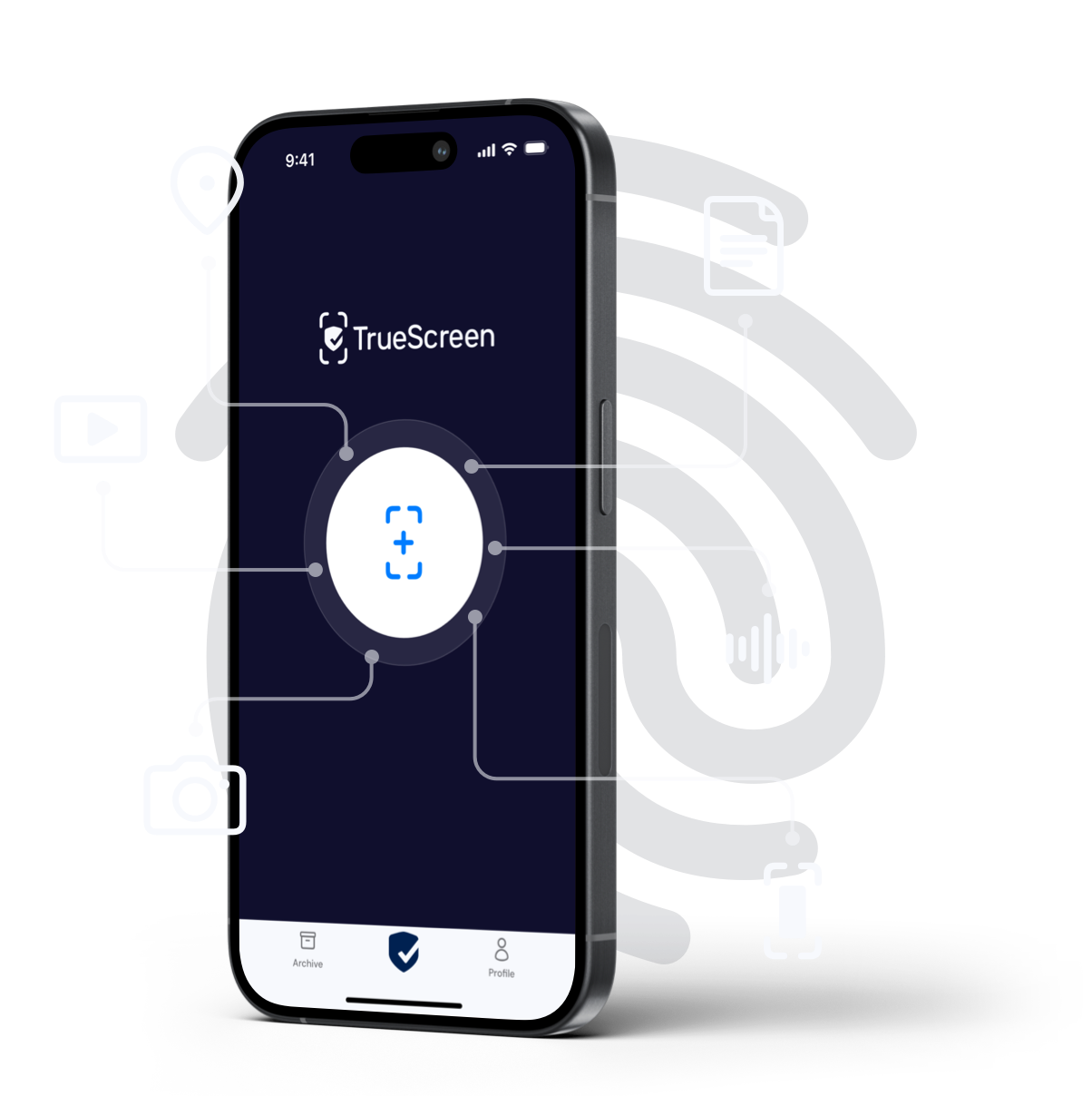
TrueScreen is the Data Authenticity Platform that allows users to acquire and certify digital content with legal value, following forensic methodologies that comply with international standards.
To certify a WhatsApp chat, TrueScreen offers several acquisition modes. Through the certified screen recording function, available on mobile devices, the user starts a certified screen recording while scrolling through the WhatsApp conversation: every frame is captured in a controlled environment, with no possibility of alteration. Alternatively, the main solution for desktop acquisition is the TrueScreen Forensic Browser, the patented forensic browser for macOS and Windows: it lets you navigate WhatsApp Web while recording the entire session, capturing certified screenshots and web archives of every piece of content displayed. The Web Notarization extension for Chrome and Edge is also available, letting you quickly certify any content during normal browsing.
The entire process complies with ISO/IEC 27037 and ISO/IEC 27001 standards, the recommendations of the Budapest Convention on Cybercrime, and the eIDAS Regulation for electronic certification.
Digital signature, timestamp, and forensic report
Upon completion of the acquisition, TrueScreen produces a complete certified package that includes:
- The original files, exactly as acquired, without any alteration to the original data or metadata
- A PDF report with data, metadata, and operational logs of the acquisition and certification process, optimized for consultation and sharing
- A JSON file with the same data as the PDF, intended for integration with information systems and digital workflows
- An XML file containing the Qualified Trust Service Provider certification, including the electronic seal and qualified timestamp
Any subsequent modification to the content becomes immediately detectable thanks to the cryptographic hashing algorithms applied. The certified package is designed to be usable in audits, verifications, legal proceedings, and internal investigations.

FAQ: WhatsApp chat certification
Do WhatsApp chats have legal value?
How can I certify a WhatsApp conversation?
Is a WhatsApp screenshot valid as evidence in court?
What is the difference between a screenshot and digital certification?
Can WhatsApp voice messages be certified?
TrueScreen editorial team
This section is edited by the TrueScreen editorial team, which brings together expertise in digital forensics, the law of digital evidence and regulatory compliance. Every article is checked against primary sources: legislation, published rulings, technical standards and official documentation, always cited in the text.


