
How to Make Digital Evidence Admissible: Step-by-Step Guide for Legal Professionals
Lawyers, investigators, and corporate counsel collect digital evidence every day: screenshots of defamatory posts, emails documenting contractual breaches, photographs of property damage, audio recordings of threats. Yet a significant portion of this evidence faces challenges or outright exclusion when presented in court. According to the ISO/IEC 27037:2012 framework for digital evidence handling, the problem lies not with the data itself but with inadequate guarantees of integrity from the moment of collection through to submission.
For legal professionals, this operational guide answers a practical question: how do you make digital evidence admissible from the point of origin, without relying on costly expert forensic examinations after the fact? The answer lies in adopting a structured forensic methodology that ensures integrity, authenticity, and chain of custody before the data ever reaches a courtroom.
This insight is part of our guide: How to Make Digital Evidence Admissible in Court (2026)
Technical requirements for digital evidence admissibility
The admissibility of digital evidence depends on demonstrating three fundamental elements: authenticity, integrity, and a proper chain of custody. The ISO/IEC 27037:2012 standard, the international reference for identification, collection, and preservation of digital evidence, requires that every phase of handling be documented and verifiable.
At the European level, the eIDAS Regulation (EU 910/2014) establishes the legal framework for electronic identification and trust services, including qualified timestamps and electronic seals that carry legal presumption of integrity across all EU member states. The Budapest Convention on Cybercrime further provides an international framework for the collection and handling of digital evidence in cross-border proceedings.
Authenticity and data integrity
Authenticity requires demonstrating that the data originates from the declared source and has not been altered. In practical terms, this means applying a cryptographic hash at the moment of acquisition and associating a qualified timestamp that certifies the exact moment of collection. Without these elements, any opposing party can reasonably argue that the data was modified after its creation.
Integrity is proven through hash verification: if the value calculated on the file presented in court matches the one recorded at the time of acquisition, the data has not been tampered with. A qualified timestamp, issued by a qualified trust service provider under eIDAS, adds an independent element that proves the exact moment of crystallization with legal validity throughout the European Union.
Chain of custody: from device to case file
The chain of custody documents every movement of the digital data from its origin to court submission. Who collected the data, when, with which tool, where it was stored, who had access. An incomplete or undocumented chain of custody is the primary reason digital evidence gets excluded in both civil and criminal proceedings. As explored in our comprehensive guide on digital evidence admissibility requirements, without traceable documentation the entire piece of evidence loses credibility.
Step-by-step guide: 7 steps to make evidence admissible
Making digital evidence admissible does not require advanced technical expertise, but it does require a rigorous procedure applied from the very first moment. This operational checklist covers the entire cycle, from identifying the relevant data to filing it with the court.
Step 1: identify and isolate the relevant data
Before any technical operation, establish which data has evidentiary relevance. A lawyer handling an online defamation case needs to identify the specific screenshot, the page URL, the visible timestamp in the browser. The most common mistake is capturing too little context: a screenshot without a visible URL, date, and time loses much of its probative value.
Step 2: acquire using certified forensic methodology
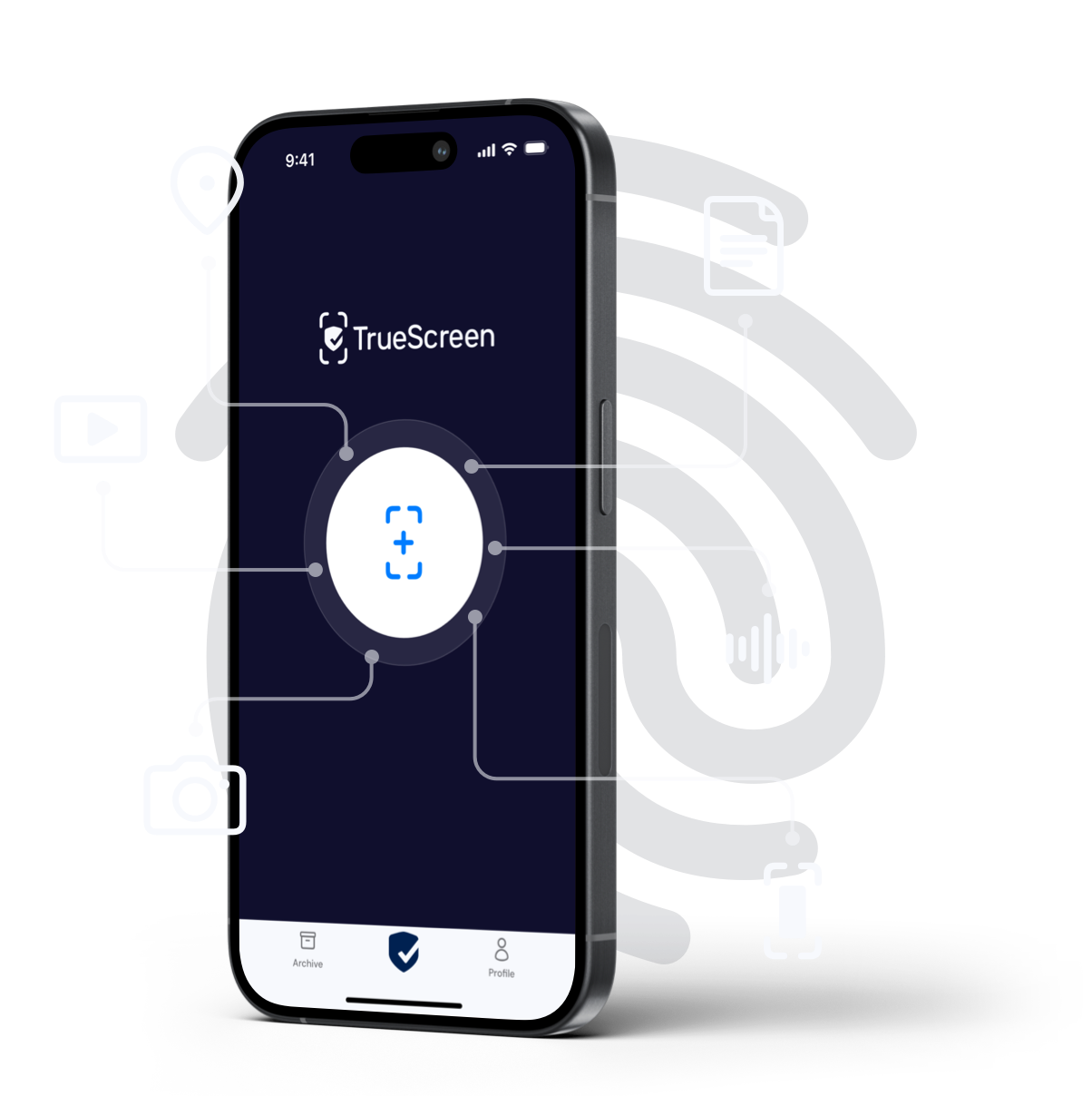
Forensic acquisition differs from a simple copy because it guarantees that the data is crystallized in the exact form it existed at the moment of collection. The ISO/IEC 27037 standard requires that acquisition be performed with validated tools and that the process be repeatable. TrueScreen automates this phase: when a user acquires data through the platform, the system automatically applies certified forensic methodology, generating a cryptographic hash and a qualified timestamp at the instant of capture.
Step 3: maintain the chain of custody
From the moment of acquisition, every access, transfer, or copy of the data must be recorded. The chain of custody is the chronological record that allows a judge to reconstruct the life of the data from collection to trial. With the TrueScreen platform, the chain of custody is generated automatically and attached to the acquisition certificate.
Step 4: apply digital seal and qualified timestamp
The digital seal binds the file content to its cryptographic representation, making any subsequent modification detectable. The qualified timestamp, issued by a trust service provider under the eIDAS Regulation, certifies the exact moment of acquisition with legal validity across all EU member states.
Step 5: document the process
Process documentation includes: identification of the person who performed the acquisition, the tool used, the method applied, and relevant environmental conditions. This documentation demonstrates that the acquisition followed recognized standards and that the data was not contaminated.
Step 6: prepare the technical report
For court filing, it is advisable to accompany the evidence with a technical report describing the acquisition methodology, tools used, and integrity guarantees. With TrueScreen, the acquisition certificate already contains all necessary elements: file hash, qualified timestamp, device metadata, and chain of custody documentation.
Step 7: file with proper formalities
Electronic filing requires that files be in formats accepted by the court system and that sizes comply with technical limits. Always attach the forensic acquisition certificate alongside the original file, so that the judge can independently verify the integrity of the data.
How TrueScreen automates the admissibility process
TrueScreen addresses the admissibility challenge at its root: instead of certifying evidence that already exists (with the risk it may have been altered), the platform performs forensic acquisition and certification in a single step. The user captures the data (photo, video, screenshot, document) through the mobile app or web platform, and the system automatically generates a cryptographic hash, qualified timestamp, device metadata, and chain of custody record.
This approach eliminates steps 2, 3, 4, and 5 of the checklist as manual operations: they are natively integrated into the acquisition workflow. The result is digital evidence that is admissible by design, without the need for additional forensic expert reports and with significantly reduced preparation time compared to traditional manual collection.
For a law firm handling litigation where digital evidence is central, from online defamation cases to contractual disputes documented via email, adopting a forensic certification platform transforms a complex and risky activity into a standardized, verifiable process.
| Step | Manual collection | With TrueScreen |
|---|---|---|
| Forensic acquisition | Requires specialized software and technical expertise | Automatic via app or web platform |
| Chain of custody | Manual compilation, prone to errors | Generated automatically with every acquisition |
| Seal and timestamp | Requires external TSA and separate procedure | Applied automatically at acquisition |
| Process documentation | Manual report to attach | Complete certificate generated automatically |
| Risk of challenge | High: depends on the operator | Minimized: standardized and certified process |