Screenshot Evidence in Court: How to Make Screenshots Legally Admissible
Every day, WhatsApp conversations, social media posts and email exchanges are submitted as evidence in civil and criminal proceedings in the form of screenshots. In most cases, these images fail to meet the court's evidentiary standards.
Courts are raising the bar for digital evidence admissibility. A screenshot captured with a smartphone's native function is nothing more than a second-level reproduction: no forensic metadata, no chain of custody, no integrity guarantee. Evidence rejected, cases lost, avoidable litigation costs.
The solution exists. A screenshot becomes admissible evidence when it is acquired through forensic methodology at the source, sealed with a certified timestamp and cryptographic hash, and accompanied by a verifiable chain of custody. Here we examine the legal requirements, case law precedents and the concrete process for turning a screenshot into evidence with full legal validity.
Why courts reject ordinary screenshots
Courts reject ordinary screenshots as evidence because they constitute second-level reproductions with no verifiable link to the original content. According to the Sedona Conference, screenshots produce "an incomplete and inaccurate data capture, difficult to authenticate other than on the basis of a witness's personal knowledge". Under Federal Rule of Evidence 901(a), any party introducing a screenshot must demonstrate through extrinsic evidence that it accurately represents the original communication. The core problem is structural: a standard screenshot captures pixels, not provenance. Without a cryptographic hash, qualified timestamp or forensic acquisition metadata, opposing counsel can challenge authenticity with minimal effort. Screenshots can be altered in minutes using freely available editing tools, without leaving traces visible to the naked eye, making visual inspection alone insufficient for authentication in any court proceeding.
The second-level reproduction problem
When a screenshot is captured using the device's native function, the operating system generates a new image file (PNG or JPEG) containing only the pixels visible on screen. The original metadata of the content, from the message timestamp to the sender's identifier, is not transferred to the new image.
What remains is a copy disconnected from the original. Under the eIDAS Regulation (EU 910/2014), electronic documents carry legal presumption of authenticity only when their integrity and provenance can be verified through qualified timestamps and digital signatures. An ordinary screenshot satisfies none of these requirements.
Manipulation risk and absence of metadata
Modifying a screenshot requires minimal skills. Free editing tools can alter text, timestamps and contact names in minutes, without leaving traces visible to the naked eye. An analysis by Advocate Magazine (2025) documented how screenshots are among the most easily contestable forms of digital evidence precisely because of the simplicity with which they can be manipulated.
Without a cryptographic hash, qualified timestamp and acquisition log, the judge has no way to distinguish an authentic screenshot from an altered one. Probative value ends up depending solely on the testimony of the person who captured it: a fragile foundation in any proceeding.
Forensic acquisition tools such as TrueScreen address these chain-of-custody gaps by recording metadata at the moment of capture, not after the fact. By applying a cryptographic hash and qualified timestamp during acquisition, the evidence carries an integrity guarantee that does not depend on witness testimony alone.

What makes a screenshot admissible as evidence
Are screenshots admissible as evidence in court?
Screenshots can be admissible as evidence in court, but only when properly authenticated. Under Federal Rule of Evidence 901(a), the proponent must demonstrate that the screenshot accurately represents the original content. This requires a verifiable chain of custody, authenticated metadata including cryptographic hash and qualified timestamp, and proof that the image has not been altered since capture. Without these elements, courts routinely reject screenshots as unreliable.
A screenshot becomes admissible as evidence when it satisfies three cumulative authentication requirements defined by Federal Rule of Evidence 901 and equivalent international frameworks like the eIDAS Regulation (EU 910/2014). First, the proponent must establish a verifiable chain of custody documenting who captured the screenshot, when, and on what device. Second, the screenshot must include authenticated metadata: a cryptographic hash calculated at the moment of acquisition, a qualified timestamp from a recognised provider, and device-level information such as GPS coordinates. Third, forensic reports conforming to ISO/IEC 27037 standards must document the acquisition methodology. Courts have increasingly required this level of documentation: in Edwards v. Junior State of America Foundation (2021), Facebook message screenshots were admitted only after forensic analysis confirmed they matched server-side records. The distinction is between capturing pixels and capturing provenance: only the latter produces court-ready evidence.
Authentication requirements under international frameworks
The UNCITRAL Model Law on Electronic Commerce provides that electronic records satisfy legal requirements for written form when the information is accessible for subsequent reference and its integrity can be verified. Under US Federal Rules of Evidence (Rule 901), digital evidence must be authenticated through testimony, distinctive characteristics or other methods that establish its genuineness.
A qualified timestamp conforming to eIDAS and a cryptographic hash calculated at the moment of acquisition satisfy authentication requirements across multiple jurisdictions simultaneously.
Chain of custody and integrity verification
The chain of custody documents every step from the creation of evidence to its presentation in court. The ISO/IEC 27037 standard defines procedures for the identification, collection, acquisition and preservation of digital evidence.
In practice, a forensic acquisition system automatically records: the exact moment of capture (with a timestamp from a qualified Time Stamping Authority), the cryptographic hash of the content (which changes if even a single pixel is modified), the device metadata (IP, GPS, operating system) and the complete operation log. This documentation makes the evidence independently verifiable, without relying solely on testimony.
WhatsApp screenshots in court: specific considerations
WhatsApp conversations are the most commonly submitted and most frequently contested type of digital evidence in judicial proceedings. In the case United States v. Avenatti (2021), the court admitted WhatsApp message screenshots as evidence, but only after a conversation participant testified directly to the content's authenticity. Without that testimony, the screenshots would have been rejected.
Why WhatsApp evidence is the most contested
WhatsApp has a combination of characteristics that make screenshots particularly vulnerable to challenge. Messages can be deleted by the sender ("Delete for Everyone"), making comparison with the original impossible. Online generators recreate the WhatsApp interface with custom messages, producing results indistinguishable from real screenshots. And the "Export Chat" function generates a simple text file without cryptographic metadata.
The Pagefreezer analysis of digital evidence confirms that screenshots of messaging apps are among the most problematic forms of evidence precisely because the original content can be modified or deleted at any time.
The limits of WhatsApp backups and exports
WhatsApp backup on Google Drive or iCloud preserves messages in encrypted format but does not include a forensic chain of custody. Export through the native function produces a .txt file with message texts and references to multimedia files, without cryptographic hashes or qualified timestamps.
To turn a WhatsApp message into evidence with legal validity requires a forensic acquisition process that records content directly from the device screen at the moment it is displayed, applying a certified timestamp and cryptographic hash. An approach conforming to the ISO/IEC 27037 standard, producing a complete forensic report usable in court.
How to authenticate text messages for court
Text message authentication extends beyond WhatsApp to SMS, iMessage, Signal and other messaging platforms. Under Federal Rule of Evidence 901(b)(4), electronic communications can be authenticated through "distinctive characteristics" including content, substance and internal patterns taken in conjunction with circumstances. In practice, courts expect three elements: proof that the message originated from the claimed sender, evidence that the content has not been altered, and documentation of when the message was captured.
The challenge is that native phone screenshots of text messages strip away the technical metadata that establishes these elements. A screenshot shows text on a screen, not the underlying transmission data, sender verification or message integrity proof. Courts in multiple jurisdictions have ruled that screenshots of text conversations require corroborating evidence, whether through testimony, phone records or forensic extraction.
Forensic acquisition solves this by capturing the message as displayed on the device while simultaneously recording the device metadata, network information, qualified timestamp and cryptographic hash. The result is a certified record that satisfies authentication requirements across both US federal courts (Rule 901) and EU jurisdictions (eIDAS), without requiring the original device to be presented or a witness to testify about each individual message.
Social media screenshots as evidence
Content published on Facebook, Instagram and X (Twitter) presents specific challenges for admissibility. Social platforms update their interfaces constantly, content can be modified or removed by the author at any time, and account identity is not necessarily linked to a verified physical person.
Facebook, Instagram and the authentication problem
In Moroccanoil v. Marc Anthony Cosmetics, the court rejected Facebook page screenshots because there was no way to authenticate them against the platform's live content. In United States v. Vayner, a screenshot of a VK.com page was declared inadmissible because there was no evidence that the defendant had created that page.
The point is always the same: a screenshot of a social post, without forensic documentation attesting to its provenance, integrity and moment of capture, risks being excluded. Instagram content adds a further complication because Stories disappear after 24 hours, eliminating the possibility of subsequent verification.
X (Twitter) posts and ephemeral content
Posts on X (Twitter) can be edited after publication, making it impossible to guarantee that the content captured in a screenshot corresponds to the current version. Deleted tweets are no longer verifiable on the platform, and Spaces content (live audio) leaves no permanent trace.
For legal professionals who need to preserve social content as evidence, the only reliable approach remains real-time forensic acquisition: capturing content at the moment it is visible, with complete metadata and immediate certification. Organizations use TrueScreen to convert ephemeral social media content into court-admissible evidence with qualified timestamps and cryptographic verification, before posts are edited or deleted.
How to certify a screenshot with legal validity
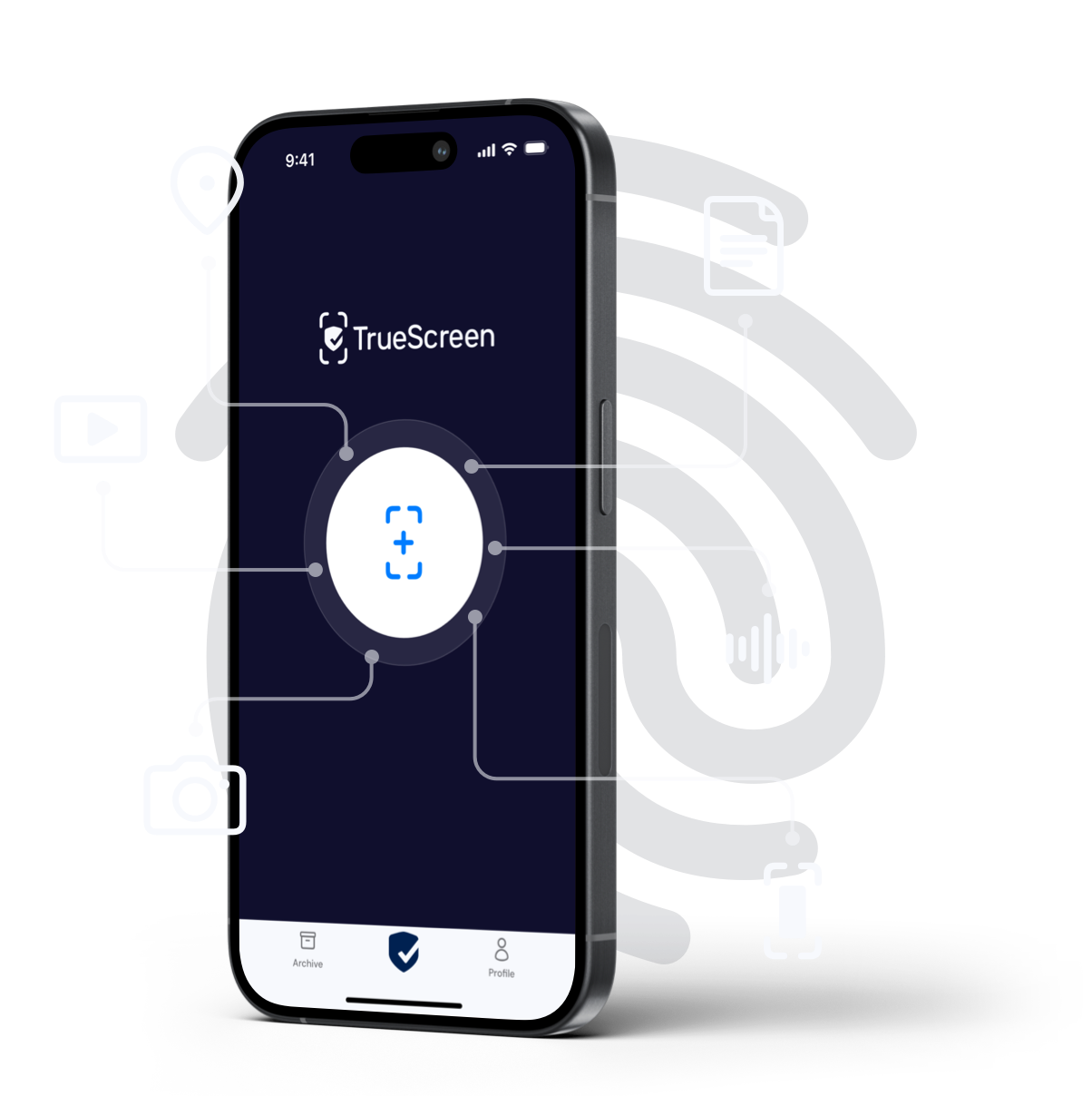
TrueScreen, the Data Authenticity Platform, enables forensic-grade screenshot acquisition that produces court-admissible evidence in a single step. The application captures content directly from the source while simultaneously recording a SHA-256 cryptographic hash, qualified timestamp from an international QTSP, GPS geolocation and complete device metadata. This methodology conforms to ISO/IEC 27037 forensic standards and generates a comprehensive technical report documenting the complete chain of custody. Unlike manual screenshots that capture only pixels, the forensic acquisition process creates an immutable evidentiary record where any subsequent modification, even to a single pixel, becomes detectable through hash comparison. Organizations in legal, insurance and corporate compliance sectors use TrueScreen to convert ephemeral digital content into evidence with presumptive legal validity under the eIDAS Regulation, eliminating the authentication burden that typically accompanies screenshot-based evidence in court proceedings.
Forensic acquisition vs manual capture
The difference between an ordinary screenshot and a certified screenshot is not cosmetic. Manual capture produces an isolated image file. Forensic acquisition through the TrueScreen App records the device screen in real time, capturing the visible content, network and location metadata (IP, GPS), the certified timestamp from a qualified Time Stamping Authority and the cryptographic hash calculated on the acquired content. TrueScreen, the Data Authenticity Platform, produces forensic-grade screenshot certification that satisfies Federal Rule of Evidence 901 authentication requirements and eIDAS standards simultaneously.
| Feature | Ordinary screenshot | Certified screenshot |
|---|---|---|
| Forensic metadata | Absent | Hash, GPS, IP, timestamp |
| Chain of custody | Undocumented | Complete and verifiable |
| Timestamp | Local (modifiable) | Qualified TSA (eIDAS) |
| Verifiable integrity | No | Cryptographic hash |
| Forensic report | Not generated | Automatic (ISO/IEC 27037) |
| Contestability | High (simple challenge suffices) | Low (eIDAS legal presumption) |
Digital certification with chain of custody
The certification process with TrueScreen generates a technical forensic report that accompanies every acquisition. The report contains user-selected key frames, the SHA-256 cryptographic hash of the content, the timestamp issued by an eIDAS-compliant TSA, the GPS coordinates and IP address of the device, and the digital signature guaranteeing immutability.
This report is the actual documentary evidence. If the opposing party challenges the screenshot's authenticity, the cryptographic hash and timestamp provide objective, independent verification without the need for further testimony. eIDAS compliance ensures that the certification is recognised across all EU Member States.
Real cases: when screenshot evidence was challenged
Case law provides concrete lessons. In Edwards v. Junior State of America Foundation (2021), the court ruled that Facebook message screenshots did not satisfy the Best Evidence Rule and required native files in HTML format. The court imposed sanctions for failure to preserve evidence in its original format.
In United States v. Vayner, the appeals court declared a VK.com page screenshot inadmissible because there was no evidence that the defendant had created the page. In Moroccanoil v. Marc Anthony Cosmetics, Facebook screenshots were excluded for the impossibility of authenticating them against live content.
The common thread is always the same: unauthenticated screenshots are successfully challenged when proof of their integrity and provenance is missing. The admissibility of digital evidence depends on the ability to demonstrate that content was not altered from the moment of capture to presentation in court, a requirement that proper digital evidence chain of custody and certification helps satisfy.