Mobile Inspection App for Insurance: Certified Field Evidence for Claims
U.S. property and casualty carriers have rebuilt field inspections around mobile software. Claim adjusters, loss surveyors and underwriters now work from a field inspection app that replaces paper and scattered attachments: photos, video, GPS pings, signatures and checklists flow straight into the claims system. What mobile has not solved is that the photos captured in the field are still ordinary JPEGs, editable like any other file, and the trail between the adjuster's phone and the claim folder is invisible. When Verisk estimates that roughly one in ten U.S. property and casualty claims contains an element of fraud, for about 38 billion dollars a year in losses, that invisibility stops being a technical detail and starts being a loss ratio problem.
A mobile inspection app for insurance delivers lasting value only when it pairs the operational layer with a forensic certification layer built into capture itself. Speed, offline mode and damage templates are table stakes. The differentiator is whether each photo leaves the sensor already sealed as evidence. That is the blind spot TrueScreen, THE Data Authenticity Platform, closes for insurance field work.
What a field inspection app does in insurance today
A field inspection app for insurance is a B2B tool that lets claim adjusters, loss surveyors and underwriting teams document a loss site or an insured asset directly from a smartphone, capturing photos, video, audio, GPS coordinates and checklists in a single package that syncs to the claims system. Its job is to collapse the round trip between the field and the back office.
In practice the app shows up in four scenarios. In auto claims, the adjuster opens a pre-filled claim card, walks around the vehicle capturing 360 degree damage photos, records plate and VIN, and closes the file before leaving. In property loss surveys, a field rep documents fire, water, wind or hail damage through geotagged photos and walk-throughs. In underwriting, a surveyor photographs the condition of a building, a roof or a piece of equipment before binding coverage. In remote video inspections, the adjuster guides the insured through a smartphone call and captures frames without traveling to the scene.
The feature set is standardized: offline capture, custom templates, customer e-signature, PDF export, API integration with core claims platforms. Vendors from SafetyCulture and TrueContext to Cotality, Solera and Tekmetric compete on speed, usability and lines of business covered. Almost none ask the different question: what actually happens to those photos between the moment the shutter closes and the moment opposing counsel demands them in discovery?
The blind spot: photos captured by the app are not forensic evidence
Photos captured by a standard field inspection app, however useful operationally, are not forensic evidence. They are JPEGs stored on the phone and later pushed to a server. In between sit several moments where the file can be altered, intentionally or by accident, and no server-side timestamp can rule that out after the fact. This is where the actual loss-ratio risk of digital inspections lives.
EXIF metadata is editable and device timestamps are unreliable
EXIF metadata (date, time, camera model, GPS coordinates) is baked into the image file but fully editable with free tools. A few seconds are enough to change the capture date or shift coordinates by a few miles. The device clock is just as weak: system time can be adjusted, the time zone swapped, the date set back before the shot. None of these signals carries evidentiary weight on its own, because their integrity depends on the handset rather than a verifiable external source. Under Federal Rule of Evidence 901, a photograph must be authenticated with evidence sufficient to support a finding that the item is what the proponent claims it is. An EXIF field an adjuster could have edited on the drive back does not clear that bar.
Chain of custody goes missing between the field and the back office
Chain of custody is the continuous trail that follows a file from the instant of capture to the moment it enters the record. In a traditional inspection app that trail effectively does not exist. The file lands in the camera roll, is uploaded to a server, is attached to a claim number, and each hop quietly breaks the guarantee that the file in the folder is the same one the adjuster captured. The adjuster may pick the "best" shot from a burst. The back office may reassign it. A sync job may silently replace it. In litigation, that opacity is the first lever the other side pulls to challenge admissibility. ISO 27037 and the SWGDE Best Practices for Mobile Device Evidence Collection both point in the same direction: without a verifiable custody trail, the evidentiary value of field photos is fragile.
The real cost: fraud losses, contested claims, longer cycle times
The absence of forensic evidence at source translates directly into loss ratios. Verisk estimates about one in ten U.S. property and casualty claims contains an element of fraud, for 38 billion dollars a year, and the Coalition Against Insurance Fraud puts the total bill at roughly 308 billion dollars across all U.S. lines. A January 2026 client update from Debevoise & Plimpton reports a documented rise in claims supported by synthetic or post-capture manipulated photos, driven by the collapsing cost of image generation. An app that does not certify at source lets this contamination walk into the claim folder, where it is very hard to catch downstream. The cost is doubled: fraudulent payouts slip past the desk auditor, and legitimate claims drag on when the documentation is too thin to defend.
What makes field-captured evidence "certified"
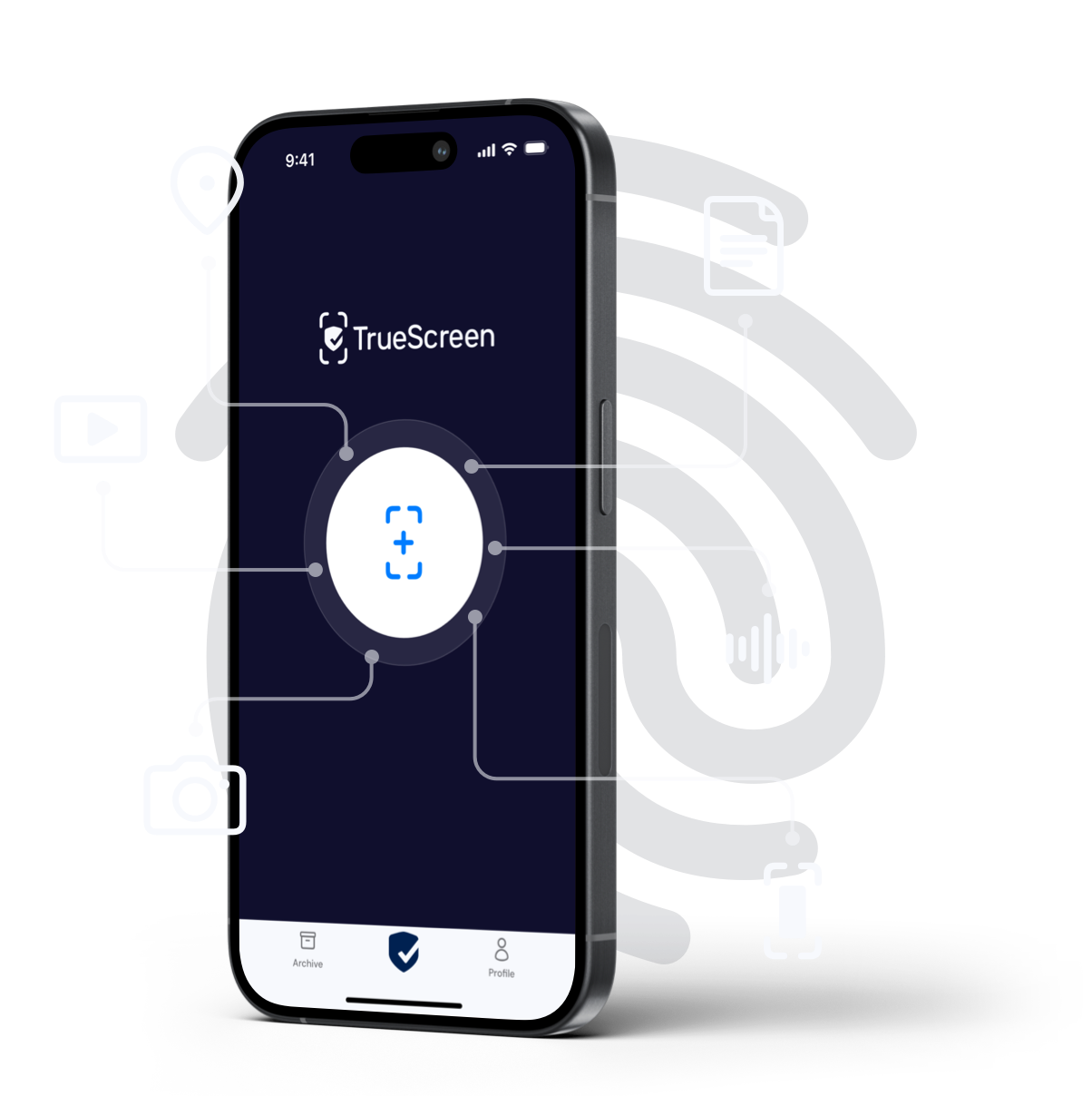
A piece of field evidence is "certified" when four verifiable technical properties hold at the same time: integrity at source, qualified timestamping, verified geolocation, and an immutable chain of custody. Drop any one of them and the photo or video will not survive a contested proceeding, no matter which app produced it. Almost no mainstream vendor positions on this perimeter, and it is where TrueScreen draws its line. The four properties are not interchangeable, and the difference between them is where most of the confusion in vendor conversations lives.
Integrity at source versus a seal after the fact
A file has integrity at source only if it is sealed on the device, before it can leave the camera. Many "certified" solutions instead apply a seal server-side, after the photo has already traveled: that seal only certifies the file did not change after the server received it, and says nothing about the interval between shutter and upload. That interval is exactly where the worst manipulations happen. Integrity at source means the cryptographic hash is computed on the adjuster's device the moment the sensor closes exposure: any later change, even a single bit, invalidates the proof. This is the perimeter the SWGDE "Best Practices for Mobile Device Evidence Collection" describes as forensically sound acquisition.
Hash, timestamp and digital signature: what each one proves
Three distinct technical pieces, each solving a different problem. A cryptographic hash proves integrity: two files sharing the same hash are bit-for-bit identical. A qualified timestamp, issued by a trusted time authority under a recognized framework such as eIDAS, proves the file existed in that exact form at a specific moment, independent of the phone's clock. A digital signature binds the file to the identity of the person who captured it. Together, these elements form the minimum packet a court considers when deciding whether a digital image is admissible under Federal Rules of Evidence 901 and 902. For a step-by-step walkthrough of how to certify a photo as tamper-proof evidence, the same principles apply to any field capture by an adjuster. On top of that foundation sits the chain of custody for digital evidence, which tracks every subsequent access and transfer.
What makes a TrueScreen-certified inspection admissible in court
A TrueScreen-certified inspection is admissible in court because every piece of evidence is cryptographically sealed the instant the adjuster presses the shutter, before the file can be altered, and then followed through the life of the claim by an immutable chain of custody log. The photo is no longer a document the carrier has to defend once it is challenged. It shows up in the record already defended.
TrueScreen is THE Data Authenticity Platform that certifies photos and videos at capture with chain of custody, qualified timestamp and FRE 901/902 admissibility. The adjuster app computes the hash of every photo, video and audio clip at capture, applies a qualified timestamp from an independent time authority, verifies geolocation and opens a tamper-evident custody log that records every downstream access and transfer. The output is a forensically sound file usable in civil, criminal and administrative proceedings, aligned with Federal Rules of Evidence 901 and 902, eIDAS for qualified timestamps and ISO 27037 for the handling of digital evidence. Carriers use TrueScreen to certify auto damage walk-arounds, property loss surveys, certified live video inspection sessions, construction progress surveys and underwriting condition reports, integrating the platform into core claims systems through APIs. A concrete example: a carrier handling 50,000 auto claims a year sees around 3% of files contested on the authenticity of photo evidence. With certification at source, those disputes collapse because the other side has no remaining lever on the acquisition chain.

Insurance use cases for a certified field inspection app
The insurance use cases for a certified field inspection app cluster in four scenarios where the evidentiary value of a photo decides whether a claim closes in days or drags on in litigation for months. In all four, forensic certification adds no work for the adjuster. It adds defensibility to the file.
The first is auto claims adjustment. The adjuster works through a 360 degree template around the vehicle, logs the plate, captures the impact points and records the declared dynamics. Every shot is sealed before it leaves the phone, so when desk review flags something odd a month later the file answers for itself. The second is property loss surveys for fire, water, wind, hail and catastrophe response. Loss scenes evolve fast and a certified photo freezes the exact state at the moment the rep was on site. The third is live video inspections, where a specialist guides the insured through a smartphone call from the claims office and captures certified frames on the fly: the adjuster never travels, yet the file comes back equivalent to a physical survey. The fourth is underwriting and builder's risk inspections on construction sites, wind farms and commercial properties, where teams share a need to nail down dates and conditions the counterparty cannot contest. From the adjuster's perspective the app behaves like any other: open, capture, close.
Operational integration: from the adjuster's app to the claims system
Integrating a certified field inspection app into an existing claims ecosystem is where most insurance innovation projects quietly fail. A tool that forces the adjuster into a parallel workflow, or forces the desk team to manage a separate silo of "certified" files, gets abandoned within six months. The correct principle: the adjuster's day stays identical, and certification plugs into the pipeline already in place through APIs.
The flow has three steps. The adjuster receives the assignment with claim metadata already attached. Capture happens with the same gestures as any other app, but under the hood each file is sealed on the device, qualified-timestamped and recorded in the custody log. Finally the certified files are pushed to the claims system through an API, with the forensic metadata embedded in the file rather than attached as a loose certificate. The claim folder does not hold "a photo plus a separate certificate" in some drawer. It holds a photo that is itself the proof. This model avoids duplicate archives and preserves the workflow the adjuster already knows, the single most important predictor of adoption.
Anti-fraud: why certification reduces contested claims
Forensic certification at source reduces contested claims because it moves the carrier's defensive line from ex-post detection (expensive and unreliable) to prevention of contamination at the exact moment the photo is taken. The two strategies are not interchangeable. The first chases a problem evolving faster than its detection tools. The second keeps the problem out of the file before it can get in.
Verisk estimates one in ten U.S. property and casualty claims contains fraud, for 38 billion dollars in annual losses, and the Coalition Against Insurance Fraud puts the total bill at roughly 308 billion dollars across all lines. Debevoise & Plimpton (January 2026) reports a documented rise in claims supported by images generated or retouched after the fact, a trend the NAIC has flagged as a supervisory priority for insurers deploying AI in claims handling. Against this class of manipulation, traditional SIU tools (reverse image search, metadata analysis, EXIF inspection) work inside a window that shrinks every quarter. Certification at source does not depend on telling real from fake after the fact. It prevents an uncertified photo from ever entering the claim folder.
The second effect is on litigation over genuinely valid claims. When an uncertified photo is introduced as evidence, opposing counsel routinely challenges the acquisition chain even without real signs of fraud, and discovery stretches. With a forensic file the authenticity argument closes in the opening minutes and the judge moves on to the merits. For a broader legal framing, the requirements that underpin admissibility are covered in this analysis of chain of custody in legal contexts.
How to choose a certified field inspection app: an 8-point checklist
Choosing a certified field inspection app means separating tools that seal evidence at the source from tools that stick trust labels on files after the fact. This 8-point checklist lets an insurance innovation lead, an IT claims manager or an SIU director compare proposals on real forensic properties, not on operational feature lists that have all converged on the same baseline.
| # | Requirement | What to verify |
|---|---|---|
| 1 | Seal at source | The cryptographic hash is computed on the device at the moment of capture, not server-side after upload. |
| 2 | Qualified timestamp | The time marker is issued by an independent trusted time authority (eIDAS or equivalent), not the phone clock. |
| 3 | Operator digital signature | The file is bound to the identity of the adjuster or surveyor and that binding can be verified independently. |
| 4 | Verified geolocation | GPS coordinates are captured securely and cannot be substituted after the fact. |
| 5 | Immutable chain of custody | Every access and transfer of the file is recorded in a log that cannot be rewritten. |
| 6 | Stated evidentiary value | The vendor explicitly documents alignment with Federal Rules of Evidence 901/902, eIDAS, ISO 27037 or SWGDE guidelines. |
| 7 | API integration | The app plugs into the existing claims system without creating a parallel silo of certified files. |
| 8 | Forensic offline mode | Certification works with no network, then syncs securely when the device reconnects. |
A tool that clears all eight produces defensible evidence. One that clears only the first four produces tidy documents. One that clears none just produces JPEGs in better-organized folders.