
What is digital provenance? Definition, tracking and trust in 2026
Digital provenance is quickly becoming the defining standard for how organizations verify and trust their digital assets. Every business today depends on digital content for operations, evidence, and compliance. Photos document insurance claims. Videos record construction progress. Emails formalize agreements. Data streams drive decisions across every department.
But the ground has shifted. Generative AI tools can produce images, audio, and video so convincing that human reviewers cannot reliably distinguish them from genuine material. A photo of flood damage, a recorded statement, a signed document: any of these can now be fabricated with minimal effort and near-perfect realism.
When any digital asset might be synthetic or manipulated, trust collapses. Organizations cannot rely on content they receive, courts question the admissibility of digital evidence, and compliance frameworks demand proof of authenticity that traditional workflows never required. Digital provenance offers a structural answer: rather than trying to detect what is fake after the fact, it establishes the origin, integrity, and history of content at the point of creation, making authenticity verifiable by design.
What is digital provenance? Definition and meaning
Digital provenance is the verifiable record of a digital asset’s origin, modifications, and chain of custody from creation to its current state. It uses cryptographic technologies such as hashing, digital signatures, and the C2PA standard to ensure that any downstream consumer can independently verify the authenticity and integrity of content. Organizations implement digital provenance to comply with regulations like the EU AI Act, protect against deepfake-driven misinformation, and establish legally admissible evidence trails. According to Gartner’s 2026 Top 10 Strategic Technology Trends, search interest in digital provenance has grown over 350% year-over-year, and organizations that fail to invest in these capabilities by 2029 face sanction risks potentially reaching billions of dollars.
The concept is also referred to as content provenance when applied specifically to media files and digital content. While the terms are closely related, “digital provenance” encompasses a broader scope that includes documents, data, and software alongside media, whereas content provenance typically focuses on images, video, and audio. Both share the same core objective: establishing a verifiable chain of trust from source to consumer.
In practical terms, digital provenance is a system that answers three questions about any file, image, video, or document: who created it, when and where, and has it been modified? These answers are recorded using cryptographic techniques that make them independently verifiable and tamper-evident.
Digital provenance combines cryptographic hashing, qualified timestamps, and chain-of-custody records to create tamper-evident proof that travels with the content itself. Unlike data provenance, which tracks transformations in data pipelines, digital provenance focuses on authenticating media files, documents, and any digital object that may be subject to manipulation. Organizations implementing provenance at the source gain an attestation infrastructure that functions as legal-grade evidence, usable in insurance claims, litigation, compliance audits, and regulatory reporting across jurisdictions. Platforms such as TrueScreen extend this foundation with forensic-grade acquisition that meets ISO/IEC 27037 and eIDAS requirements, making content provenance records legally admissible across jurisdictions.
Gartner named digital provenance among its top 10 strategic technology trends for 2026, recommending that organizations implement software bills of materials, attestation databases, and digital watermarking to validate and track digital assets. The stakes are substantial: Gartner predicts that by 2029, organizations that fail to invest adequately in digital provenance capabilities will face sanction risks potentially running into billions of dollars.
The three questions provenance answers
A digital provenance system addresses three core questions about any piece of content:
- Who created it? Provenance records the verified identity of the original creator, including the device, software, and authentication method used.
- When and where was it created? Each asset is associated with precise temporal and geolocation data, reconstructing its original context.
- Has it been altered? Through cryptographic hashing and digital signatures, the system detects any modification and confirms whether the content matches its original state.
These three answers, recorded and sealed cryptographically, form the foundation of verifiable trust.
From physical certificates to cryptographic records
Traditional provenance relied on paper documentation, expert testimony, and institutional trust. An artwork’s history was reconstructed through auction records and certificates of authenticity. A legal document’s validity depended on a notary’s seal.
This approach carries well-known limitations: records are scattered across archives, updates are slow and bureaucratic, verification requires intermediaries, and forgery remains a persistent risk.
Digital provenance represents a fundamental shift. Provenance technology has moved from static paper trails and manual checksums to automated, real-time cryptographic systems that operate at scale. Records are cryptographically sealed, making tampering detectable. Verification is independent: any authorized party can confirm authenticity without relying on intermediaries. The system scales across platforms, formats, and jurisdictions, following international standards such as C2PA and ISO/IEC 27037.
Comparing data provenance, digital provenance, and content provenance
| Data Provenance | Digital Provenance | Content Provenance | |
|---|---|---|---|
| Definition | Record of data origin and transformations within processing pipelines | Verifiable record of any digital asset’s origin, integrity, and chain of custody | Verifiable record of media content’s creation history and modifications |
| Scope | Datasets, database records, ML training data | All digital assets: documents, media, software, data | Images, video, audio, and published media |
| Primary use case | Data engineering, AI governance, data lineage tracking | Legal evidence, compliance, fraud prevention, regulatory reporting | Media verification, misinformation prevention, editorial transparency |
| Key technology | Metadata catalogs, lineage graphs, version control | Cryptographic hashing, digital signatures, C2PA, forensic acquisition | C2PA Content Credentials, embedded metadata, watermarking |
Data provenance vs digital provenance: understanding the difference
The terms “data provenance” and “digital provenance” are sometimes used interchangeably, but they refer to different concepts with distinct applications.
Data provenance tracks the origin and transformation history of data as it moves through processing pipelines, databases, and analytical workflows. It is primarily relevant in data engineering, AI/ML model training, and business intelligence contexts. Data provenance answers questions like: where did this dataset come from? What transformations were applied? Which version of the data was used to train this model?
Digital provenance focuses on the authenticity and integrity of digital content: photos, videos, documents, audio recordings, and other media. It is relevant in legal, compliance, insurance, journalism, and security contexts. Digital provenance answers: is this file genuine? Was it captured at the claimed time and place? Has it been altered since creation?
The key distinction is scope. Data provenance operates within data infrastructure and concerns data lineage. Digital provenance operates at the content level and concerns authenticity verification. An organization might use data provenance to track how a dataset was assembled and digital provenance to certify that the photos within that dataset are genuine and unaltered.
Both disciplines share common technical foundations (cryptographic hashing, immutable logs, chain of custody documentation), but they serve different organizational functions and different stakeholders.
TrueScreen provides forensic-grade digital provenance with qualified timestamps and digital signatures under eIDAS, ISO/IEC 27037, and GDPR.
How digital provenance tracking works
Digital provenance tracking combines several technologies to create an unbroken chain of trust from the moment content is created through every subsequent interaction. The market demand reflects this urgency: according to Grand View Research, the global digital watermarking market alone was valued at USD 1.45 billion in 2024 and is projected to reach USD 3.80 billion by 2033, growing at a compound annual growth rate of 11.4%, driven by rising demand for content authentication and regulatory compliance.
Core technologies: hashing, signatures, and C2PA
- Cryptographic hashing: every digital file produces a unique hash value. If even a single bit changes, the hash changes completely, making any alteration immediately detectable.
- Digital signatures: a qualified trust service provider applies a digital seal and timestamp to the content, providing a legally recognized guarantee of integrity and authenticity.
- C2PA (Coalition for Content Provenance and Authenticity): an open international standard, expected to become an ISO standard, that assigns each piece of content a cryptographically sealed provenance record. This record travels with the content across platforms and formats. The Content Authenticity Initiative (CAI), founded by Adobe, The New York Times, and Twitter, works alongside C2PA to drive industry adoption of content provenance standards across platforms and devices. Major platforms including LinkedIn, Meta, YouTube, and Adobe products already support or are adopting C2PA.
- Invisible watermarking: embedded signals that survive format conversion, cropping, and compression, providing an additional layer of traceability even when metadata is stripped.
Content credentials, C2PA, and forensic acquisition
The term content credentials refers to the content provenance information embedded in or attached to a digital asset, typically following the C2PA standard. Content credentials record who created a piece of content, what tools were used, and whether any edits were applied. Major platforms including Adobe, LinkedIn, Meta, and YouTube already support content credentials for transparency and verification.
However, C2PA-based content provenance has a structural limitation: embedded metadata can be stripped when content moves between platforms that do not support the standard, which affects most social media networks and messaging apps as of 2026. This means that content provenance records attached via C2PA alone may not survive the distribution chain.
TrueScreen supports C2PA content credentials but goes further with forensic-grade acquisition methodology. Where C2PA metadata can be stripped when content crosses platforms or messaging apps, TrueScreen creates an independent forensic record at the source: device identity, geolocation, timestamp, integrity hash, and a qualified digital seal from a certified Trust Service Provider. This forensic layer holds as admissible evidence in court, not just as a content label. Solutions like TrueScreen address the metadata-stripping limitation by maintaining an independent attestation database that preserves provenance records even when embedded C2PA metadata is removed by platforms.
AI provenance: tracking synthetic content origin
As generative AI tools proliferate, AI provenance has emerged as a specific application of digital provenance: the ability to trace whether content was created by an AI system and which model produced it. The EU AI Act requires that AI-generated content carry disclosure and provenance metadata. Organizations producing or consuming AI-generated assets need provenance systems that distinguish between human-created and machine-generated content, and that preserve this distinction across the content lifecycle.
The digital chain of custody
A chain of custody documents every access, modification, and sharing event in a content’s lifecycle. In legal and regulatory contexts, this chain proves that a file was properly handled and remains admissible as evidence.
For organizations managing large volumes of digital assets, the chain of custody transforms from a manual documentation burden into an automated, cryptographically verified process. Each event is recorded with immutable timestamps and identity verification, creating an audit trail that regulators, courts, and business partners can independently verify.
A practical example: insurance claim management
Consider an insurance company processing a property damage claim. The claimant submits photographs of the damage. Without provenance, the insurer must trust that the photos are genuine, taken at the claimed location and time, and have not been manipulated.
With digital provenance, each photograph carries embedded proof of when it was captured, on which device, at which GPS coordinates, and a cryptographic seal confirming it has not been altered. If a dispute arises about the authenticity of the evidence, the provenance record provides immediate, independent verification. This reduces fraud, accelerates settlement, and eliminates the cost of contested claims.
Real-world scenarios where digital provenance matters
Beyond insurance, digital provenance addresses critical trust gaps across industries:
- CEO impersonation and business deepfakes: in 2024, a multinational company lost $25 million after employees were deceived by a deepfake video call impersonating their CFO. With provenance-enabled communication tools, participants can verify that video feeds and shared documents originate from authenticated sources, making impersonation attempts immediately detectable. This is one of the fastest-growing categories of corporate disinformation risk.
- News media and editorial integrity: newsrooms increasingly face manipulated images and fabricated quotes. Content provenance systems allow journalists to verify that photos and video footage are original and unmodified before publication, and allow readers to independently confirm the authenticity of published media.
- Legal proceedings and digital evidence: courts worldwide are tightening standards for admissibility of digital evidence. A screenshot, video recording, or email presented as evidence must demonstrate an unbroken chain of custody and verifiable integrity. Digital provenance provides the cryptographic proof that transforms a digital file from a claim into admissible evidence.
The regulatory push for content authenticity
Governments and standard bodies worldwide are moving to require verifiable content provenance. This regulatory momentum reflects a shared recognition: voluntary trust is no longer sufficient in an environment saturated with synthetic content.
Key frameworks and legislation
Several jurisdictions have introduced or are developing requirements for digital provenance:
- EU AI Act: requires transparency obligations for AI-generated content, including disclosure of synthetic media and provenance information.
- California Provenance, Authenticity and Watermarking Standards Act: since March 2025, major online platforms must disclose provenance data found in watermarks or digital signatures within distributed content.
- New York Stop Deepfakes Act (2025): requires synthetic content providers to include provenance data conforming to C2PA specifications.
- ISO/IEC 27037: provides international guidelines for the identification, collection, and preservation of digital evidence to ensure integrity and legal admissibility.
- eIDAS Regulation (EU): establishes the legal framework for electronic identification, trust services, and digital signatures across the European Union.
The pattern is clear: provenance is shifting from a competitive advantage to a compliance requirement. Organizations use platforms like TrueScreen to establish legally admissible provenance records at the point of data creation, ensuring compliance with eIDAS, ISO/IEC 27037, and the EU AI Act without the need for retroactive verification workflows.
Tangible benefits for organizations
Beyond regulatory compliance, digital provenance delivers measurable operational value:
- Strengthened trust: when stakeholders, clients, and partners can independently verify content authenticity, business relationships and brand reputation improve.
- Fraud reduction: automated verification at the point of creation reduces the attack surface for document manipulation, deepfake fraud, and evidence tampering.
- Operational efficiency: automated provenance tracking replaces manual verification workflows, reducing time and cost for audits, claims processing, and legal proceedings.
- Intellectual property protection: creators and organizations can prove ownership and originality through verifiable, timestamped records of creation.
Challenges and limitations of digital provenance
While digital provenance offers a robust framework for content authenticity, it is not without challenges. Understanding these limitations is essential for organizations planning their implementation strategy.
Lack of universal standards and interoperability
Although C2PA is emerging as a leading standard, adoption remains uneven. Many platforms, devices, and software tools do not yet support provenance metadata natively. This fragmentation means that provenance records created in one system may not be recognized or verifiable in another. Until interoperability improves, organizations must account for gaps in the provenance chain when content moves across ecosystems.
Metadata stripping by platforms
Social media networks, messaging apps, and content management systems frequently strip metadata from uploaded files, including provenance records. A photo certified with full content provenance data at the point of capture may lose its embedded credentials when shared via WhatsApp, uploaded to Instagram, or processed through a CMS. This is one of the most significant practical barriers to end-to-end content provenance. Forensic acquisition tools that maintain an independent attestation database, separate from embedded metadata, provide a mitigation path: even when the embedded record is lost, the source certification remains verifiable through the external database.
Scalability with large volumes of digital assets
Organizations that handle millions of digital assets daily (insurers processing claims, media companies managing archives, logistics firms documenting shipments) face computational and storage challenges when applying provenance to every item. Cryptographic operations, secure storage, and verification queries at scale require infrastructure investment. Cloud-based provenance platforms help reduce this burden, but the cost-benefit calculation remains a consideration for large-scale deployments.
User adoption and awareness
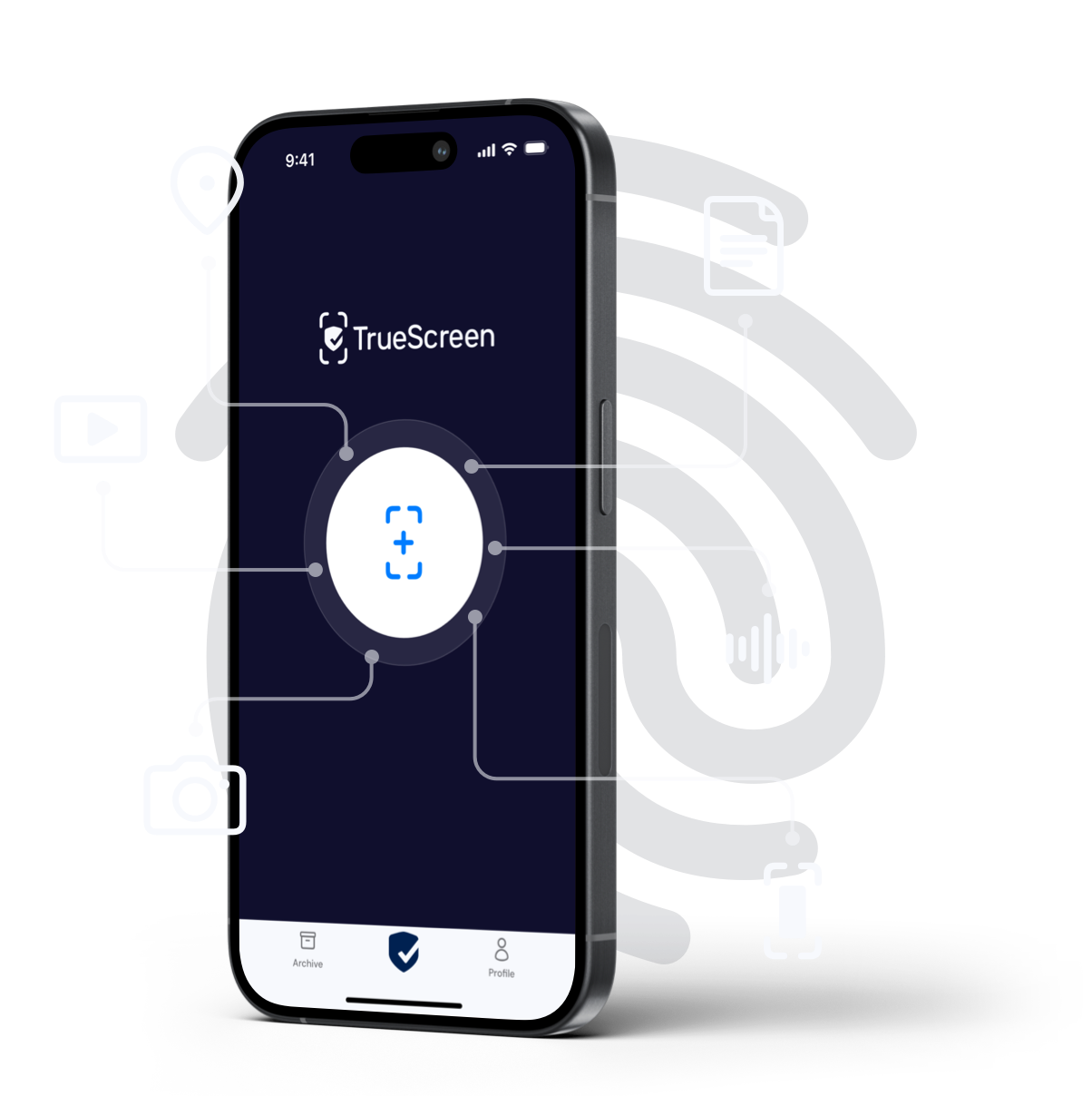
Digital provenance is only effective when it becomes part of standard workflows. Employees, partners, and end users need to understand why provenance matters and how to use provenance-enabled tools. Without organizational change management, provenance systems risk being bypassed or underutilized. The most effective implementations embed provenance transparently into existing processes, so users benefit from content authenticity guarantees without changing their behavior. TrueScreen takes this approach by integrating forensic-grade capture directly into mobile and web workflows, including a dedicated mobile app for on-the-ground acquisition, that require no specialized training.
Guaranteeing the real vs. detecting the fake
The traditional approach to combating synthetic content focuses on detection: building AI models that identify deepfakes, manipulated images, or generated text. While detection has a role, it faces a structural limitation that makes it insufficient as a standalone strategy. A deeper analysis reveals why detection alone fails and how forensic certification works instead.
Why detection alone falls short
Detection technologies operate in a perpetual arms race with generation technologies. Each improvement in detection triggers a corresponding improvement in generation. The result is an escalating cycle where the cost and complexity of detection increase while reliability decreases.
The numbers confirm this structural weakness. According to research by Sensity AI, the number of deepfake videos online has doubled every six months since 2018, while detection accuracy for state-of-the-art models drops below 70% when tested against generation techniques they were not trained on. This asymmetry explains why a growing number of regulatory frameworks, including the EU AI Act and California AB 602, require proactive provenance labeling rather than relying on post-hoc detection tools.
More fundamentally, detection asks the wrong question. It asks: “Is this content fake?” The more productive question for organizations is: “Can I prove this content is authentic?”
The source-certification approach
Digital provenance flips the paradigm. Instead of examining content after the fact to determine whether it might be fake, provenance certifies authenticity at the source. Content that passes through a provenance-enabled workflow carries built-in proof of its origin and integrity.
This approach is inherently more resilient. It does not depend on keeping pace with generation technology. It does not degrade as synthetic content becomes more sophisticated. It establishes a clear standard: verified content carries provenance, and content without provenance carries no presumption of authenticity. This source-certification methodology is implemented by tools like TrueScreen, which captures environmental metadata, timestamps, and geolocation data at the moment of acquisition, producing forensic-grade records that hold as legal evidence regardless of how generation technology evolves.
The shift is significant: from a world where everything was considered true unless proven false, to one where digital information requires a verifiable guarantee of authenticity to be trusted.
How TrueScreen enables digital provenance
TrueScreen is the Data Authenticity Platform that enables organizations to implement digital provenance without technical complexity. Through forensic-grade data capture, verification, and certification, TrueScreen guarantees the authenticity, traceability, and legal validity of digital information throughout its entire lifecycle.
Data authenticity infrastructure
TrueScreen provides end-to-end provenance across every content type that organizations handle: photos, videos, audio recordings, documents, emails, screenshots, and web browsing sessions. Each certified asset receives a forensic package containing the original files, a detailed PDF report, machine-readable JSON data, and an XML certification from an international Qualified Trust Service Provider.
The certification process applies cryptographic hashing and a digital seal with a qualified timestamp, ensuring that any subsequent modification is immediately detectable. The methodology complies with eIDAS, follows ISO/IEC 27037 and ISO/IEC 27001, and aligns with the Budapest Convention on Cybercrime.
From certification to attestation database
TrueScreen’s secure archive functions as an attestation database: a centralized, tamper-evident repository where all certified assets are encrypted, indexed, and stored with multiple redundant backups. Organizations can share certified content with internal teams or external stakeholders through permission-based access, maintaining full traceability throughout the process.
This architecture supports the exact model that Gartner recommends: an attestation database that organizations can deploy to comply with regulations, prevent fraud, and enable trusted collaboration.
Industries and use cases
Digital provenance applies across sectors, and TrueScreen offers industry-specific solutions designed for each vertical. In the legal sector, law firms certify screenshots, recordings, and documents to build admissible digital evidence. Insurance companies authenticate claim documentation to reduce fraud. Law enforcement agencies use forensic-grade acquisition for investigations. Construction, real estate, and logistics organizations document site conditions and shipments with certified proof.
For any organization looking to operationalize digital provenance, TrueScreen delivers the infrastructure to make every digital asset verifiable, traceable, and legally valid.