Digital Notarization: Why Forensic Methodology Matters More Than Blockchain
The digital notarization market hit $905 million in 2025 and is on track for $3.28 billion by 2032. Remote Online Notarization (RON) platforms handle millions of transactions a year. More than 40 US states now authorize some form of remote notarization. Organizations rely on these systems to authenticate documents, verify signers, and produce legally binding records without anyone being in the same room.
But there is a gap that neither RON platforms nor blockchain timestamping address. RON verifies *who* signed a document. Blockchain proves *when* a document existed. Neither answers a more basic question: was the content authentic at the moment of creation?
A contract screenshot could have been edited before a notary session. A compliance document could have been generated by AI before being hashed on a blockchain. The notarization process itself provides no safeguard against pre-existing manipulation. Only forensic-grade acquisition, capturing data with environmental metadata at the point of creation, closes this content authenticity gap.
What Is Digital Notarization
Digital notarization is the electronic process of authenticating documents and verifying signer identity through remote online notarization (RON), electronic notary services, or cryptographic certification. Traditional notarization requires physical presence before a commissioned notary public. Digital methods remove that requirement but typically confirm who signed a document, not whether the content was authentic or unaltered at the time of creation. The digital notary service market, valued at $905 million in 2025, is forecast to grow at a 20.21% CAGR to $3.28 billion by 2032, driven primarily by RON adoption and electronic notarization platforms. This growth reflects demand for faster, remote-accessible services, yet the underlying methodology has stayed the same: verify the signer, timestamp the event, store the record. None of the dominant approaches address a fundamental question: whether the document content was genuine before the notarization process began. That gap has significant implications for legal admissibility and compliance.
Three approaches currently fall under the umbrella of digital notarization, each with different strengths and blind spots.
Remote Online Notarization (RON)
RON connects a signer with a commissioned notary public through a live audio-video session. The notary verifies the signer's identity using knowledge-based authentication (KBA) or credential analysis, witnesses the signing in real time, and applies a digital seal. In the United States, RON operates under frameworks from the ESIGN Act, UETA, and the Revised Uniform Law on Notarial Acts (RULONA). The SECURE Notarization Act of 2025 aims to standardize RON across all US states.
RON's strength is identity verification: it confirms that a specific person signed a specific document at a specific time. Its limitation is that it says nothing about the document's content before the signing session began.
Electronic Notarization (e-Notarization)
Electronic notarization digitizes the traditional notarial act without requiring a remote session. The signer appears in person, but the notary uses an electronic journal, a digital seal, and an electronic signature instead of ink and paper. E-Notarization improves record-keeping and reduces fraud in the notarial process itself. Like RON, though, it focuses entirely on the signer's identity and the act of signing. The document's content is taken at face value.
Blockchain Timestamping
Blockchain timestamping creates a cryptographic hash of a document and records it on a distributed ledger. This proves that a specific version of the document existed at a specific point in time: if the document changes after hashing, the hash will no longer match. Several platforms market this as "blockchain notarization," but the approach has a constraint worth examining closely.
The Identity Problem: RON Verifies Who Signs, Not What Is Signed
Remote online notarization handles identity verification well. A notary confirms the signer is who they claim to be, witnesses the signing act, and creates an auditable record. For transactions where identity is the primary concern (real estate closings, powers of attorney, affidavits) RON works. But identity verification is only half the digital notarization equation when document integrity is at stake.
How RON Works: the Three-Step Process
A typical RON session follows three steps. First, the signer connects to a platform and submits identification documents. The platform runs knowledge-based authentication questions or credential analysis to confirm identity. Second, the notary joins a live video call, reviews the documents, and asks the signer to confirm their intent. Third, the signer applies an electronic signature, and the notary affixes a digital seal and electronic notarization certificate. The full session is recorded and stored.
Every step in this digital notarization process focuses on the *signer*. The platform checks who is signing. The notary watches *who* is signing. The recording proves *who* signed. Nobody verifies whether the document being signed contains authentic, unaltered content.
The Content Authenticity Blind Spot
Here is a practical scenario. A compliance officer needs to notarize a screenshot of a regulatory filing. The officer opens a RON session, the notary verifies the officer's identity, and the screenshot receives a digital notarization seal. The notarized document is now legally attributable to the officer.
But was the screenshot itself genuine? Could it have been edited, cropped, or generated before the session? The RON process has no mechanism to answer these questions. This gap is not academic: under the Federal Rules of Evidence (Rule 901), authentication requires establishing that evidence "is what the proponent claims it is," not merely that someone attested to it.

Why Blockchain Notarization Falls Short
Blockchain notarization records a cryptographic hash of a document at a specific point in time on a distributed ledger. The document existed in that exact form at that exact moment: any subsequent modification would produce a different hash. According to the National Institute of Standards and Technology (NIST), blockchain provides immutability and transparency for timestamped records. That capability, however, solves only the "when" question. It tells you nothing about whether the content was genuine before the hash was generated. A manipulated document produces a valid hash just as readily as an authentic one, meaning blockchain certifies existence without verifying origin. For organizations that need to prove content was authentic and unaltered at creation, blockchain timestamping alone does not meet the evidentiary threshold. For a deeper analysis, see how blockchain notarization compares to forensic approaches.
The Hash-First Problem
The core limitation of blockchain notarization is what we can call the "hash-first problem." A user creates or obtains a document, generates a cryptographic hash, and submits that hash to a blockchain. From that moment forward, the blockchain guarantees the document has not been altered. But what happened *before* the hash was generated?
A manipulated photograph, an AI-generated contract, a doctored screenshot: all produce valid hashes. The blockchain certifies the hash faithfully, creating an immutable record of potentially inauthentic content. It cannot distinguish between a genuine document and a fabricated one. It timestamps whatever it receives.
Immutability Without Authenticity
Immutability is valuable, but it is not authenticity. A blockchain record proves that document X existed at time T. It does not prove that document X was authentic at time T. For legal proceedings requiring compliance with eIDAS or the Federal Rules of Evidence, this distinction carries real weight. Courts and regulators increasingly demand proof of origin and integrity, not just proof of existence. Under the Daubert standard used in US federal courts, the methodology behind digital evidence collection must be reliable and peer-reviewed. Hashing a document on a blockchain does not meet this threshold on its own.
Forensic Methodology: Certifying Data at the Source
Forensic-grade digital certification captures data at the point of creation, embedding environmental metadata that establishes a verifiable chain of custody from origin. RON verifies the signer after a document already exists. Blockchain timestamps a hash of a pre-existing file. Forensic acquisition operates at the moment content comes into being: a different point in the lifecycle entirely. By recording device identification, GPS coordinates, network conditions, and precise timestamps during capture, forensic methodology produces evidence whose provenance is verifiable and whose integrity is demonstrable from the first moment of existence. This approach aligns with ISO/IEC 27037, the international standard for identification, collection, acquisition, and preservation of digital evidence. The Budapest Convention on Cybercrime, adopted by over 60 countries, requires that digital evidence be collected using methodologies that preserve integrity from the point of acquisition. Forensic certification meets this requirement by design.
What Forensic Acquisition Means in Digital Context
Forensic acquisition in a digital context means capturing content while simultaneously recording the environmental conditions under which it was created. When a user takes a screenshot, a photo, or a video through a forensic acquisition tool, the system records device identification data, GPS coordinates, network information, and precise timestamps at the moment of capture. These metadata points are not added later. They are embedded during creation.
The process follows a structured pipeline. Device integrity verification confirms the capture device has not been compromised. Metadata authenticity validation ensures timestamps and location data are genuine. The acquisition itself captures content with all environmental context. Identity certification links the capture to a verified user. Technical reporting generates a forensic audit trail. And cryptographic sealing makes the package tamper-proof through a digital seal and qualified timestamp issued by a Qualified Trust Service Provider (QTSP) under eIDAS.
Environmental Metadata as Chain of Custody
Environmental metadata turns a simple file into a piece of digital evidence with a verifiable chain of custody. A standard photograph is just pixels. A forensically acquired photograph carries proof of where it was taken, when, on which device, by whom, and under what network conditions. This metadata serves the same function as physical chain-of-custody documentation in traditional forensics: it establishes provenance and makes tampering detectable.
The difference between adding metadata after creation and capturing it during creation is like the difference between a witness statement and an eyewitness recording. Post-hoc metadata can be fabricated. Metadata captured in real time, within a controlled forensic environment, carries far stronger probative value. This distinction is what separates forensic acquisition from conventional digital notarization approaches.

RON vs Blockchain vs Forensic Acquisition: a Comparison
| Criterion | RON | Blockchain Timestamping | Forensic Acquisition |
|---|---|---|---|
| Verifies identity | Yes (primary function) | No | Yes (identity certification phase) |
| Verifies content authenticity | No | No | Yes (captured at origin) |
| Timestamp | Session-level | Hash-level (post-creation) | Qualified timestamp at capture |
| Environmental metadata | Video recording only | None | Device ID, GPS, network, timestamps |
| Pre-creation manipulation | Not detected | Not detected | Prevented (data captured at source) |
| Legal framework | ESIGN, UETA, RULONA | Varies by jurisdiction | ISO/IEC 27037, eIDAS, GDPR |
| Tamper resistance | Post-signing only | Post-hashing only | From point of creation |
| Court admissibility support | Strong for identity | Limited (Daubert concerns) | Strong for content + identity |
The gap shows up clearly here. RON and blockchain each handle one piece. Forensic acquisition covers the dimension both miss: whether content was authentic at the moment it came into existence.
How Forensic Acquisition Solves the Content Authenticity Gap
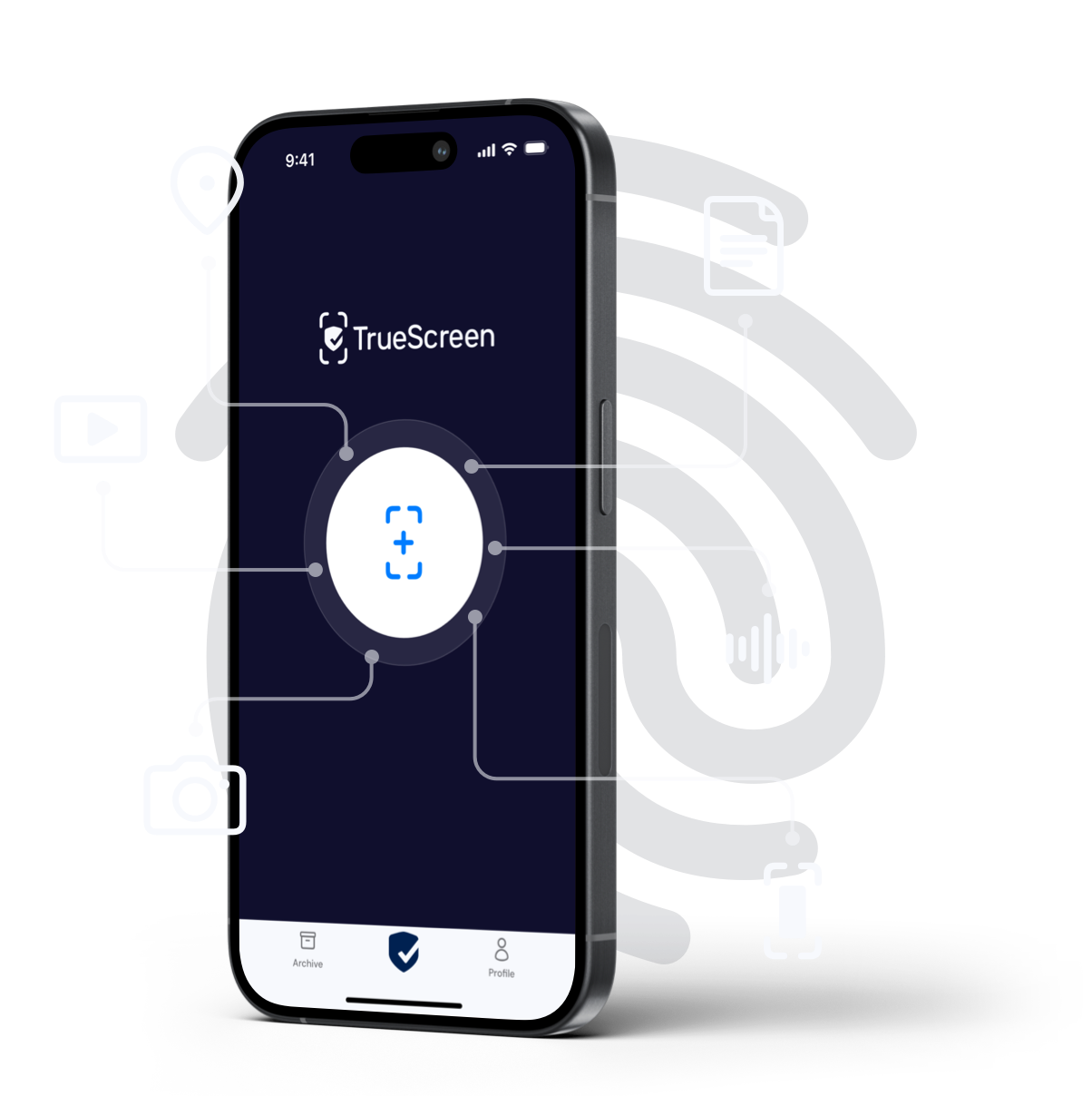
Forensic acquisition fills the space between identity verification (RON) and existence proof (blockchain) by certifying the data itself at the moment of creation. Where RON confirms a signer and blockchain confirms a timestamp, forensic acquisition confirms that the content was genuine when it came into existence. TrueScreen, the Data Authenticity Platform, applies this forensic methodology to digital content certification. When a user captures a photo, video, screenshot, or document through the TrueScreen platform, the system runs a six-phase forensic pipeline: device integrity verification, metadata authenticity validation, forensic environment acquisition, identity certification, technical reporting, and cryptographic sealing. The output is a certified digital asset with an unbroken chain of custody from origin. The approach is compliant with ISO/IEC 27037 for digital evidence handling and ISO/IEC 27001 for information security management. The cryptographic seal is issued by a QTSP under eIDAS regulation.
From Legal Evidence to Compliance Documentation
Legal professionals and compliance officers deal with a recurring problem: proving that a piece of digital content was genuine at the time it was recorded. Insurance adjusters photograph damage at a claim site. HR departments capture screenshots of policy violations. Legal teams document web pages as evidence for litigation. In each case, the evidence is only as strong as the proof that it was not manipulated.
Organizations use TrueScreen to ensure that photos, videos, documents, and screen recordings carry legally admissible proof of authenticity from the moment of creation. A forensically certified screenshot, for example, carries embedded proof of digital provenance: the device that captured it, the GPS location, the exact timestamp, and a cryptographic seal that makes any post-capture modification detectable.
Certified Screenshots, Photos, and Videos
Each content type benefits from forensic acquisition in different ways. Screenshot certification captures web pages with full browser context, URL verification, and rendering metadata. Photo certification records camera sensor data, device orientation, and environmental conditions alongside the image. Video certification preserves the entire recording with frame-level integrity verification.
Take a compliance officer who needs to document that a vendor's website displayed specific terms on a specific date. A regular screenshot can be challenged as potentially edited. A forensically certified digital evidence package contains the screenshot, the device and browser context, GPS and network data, a qualified timestamp, and a digital seal: all captured simultaneously when the screenshot was taken.
When to Use What: a Decision Framework
The choice between RON, blockchain timestamping, and forensic acquisition depends on what needs to be proven. These approaches serve legitimate but different purposes, and selecting the wrong one creates gaps in legal defensibility that surface only when evidence is challenged. Organizations dealing with document authenticity verification should evaluate whether their primary need is identity confirmation, existence proof, or content authenticity before selecting a method. According to Research and Markets, the digital notary service market's projected growth to $1.04 billion in 2026 reflects increasing enterprise demand across all three categories, but content authenticity verification is the fastest-growing segment, and forensic methodology sits at its center. The SECURE Notarization Act of 2025 introduces stricter identity verification and audit trail requirements, signaling a regulatory push toward more comprehensive digital notarization frameworks that go beyond simple identity checks.
When RON Is Enough
RON is the right choice when the primary requirement is verifying *who* signed a document. Real estate closings, powers of attorney, affidavits, and loan documents all fit this category. The document's content is typically prepared by attorneys or generated by trusted systems, and the risk of pre-signing manipulation is low. In these scenarios, a digital notary service that confirms signer identity through KBA and video recording meets the legal requirements.
When Blockchain Adds Value
Blockchain timestamping adds value when an organization needs to prove that a document or dataset existed in a specific form at a specific time, and public verifiability matters. Intellectual property filings, code commits, and research data snapshots benefit from the transparency and decentralization of a blockchain record. The limitation remains: the content must already be trusted before it is hashed.
When Forensic Acquisition Is Necessary
Forensic acquisition becomes necessary when the authenticity of the content itself needs to be proven, not just who signed it or when it was registered. This is where digital notarization reaches its limits. Litigation evidence, compliance documentation, insurance claims, whistleblower reports, workplace investigations: any scenario where the opposing party might challenge whether the content was genuine at the time of capture. Solutions like TrueScreen apply forensic-grade acquisition to digital content, embedding immutable metadata that proves not just when a document existed, but that it was authentic at the moment of capture. These are the cases where forensic methodology closes the gap that RON and blockchain leave open.