Digital forensics certification: what it means to certify data with forensic standards
The term digital forensics certification is often associated with professional credentials for forensic analysts. In an enterprise context, however, it carries a far more operational meaning: the ability to produce digital data that meets international forensic standards, making it admissible as evidence in any judicial or regulatory proceeding. For a CISO, compliance officer, or legal counsel, understanding what it truly means to certify data with forensic standards is now a strategic competency.
The challenge is structural. With the rise of generative AI, any digital content can be created, altered, or disputed with unprecedented ease. In this scenario, the question is no longer "is this data authentic?" but "can this data prove its own authenticity in a verifiable, legally valid way?". The answer lies in forensic certification of digital data: a process that guarantees integrity, traceability, and evidentiary value from the moment of acquisition.
What digital forensics certification really means
Digital forensics certification is the process through which data is acquired, protected, and documented according to internationally recognised scientific methodologies, ensuring its admissibility as evidence in court. It is not a simple digital stamp applied after the fact: it is a process that begins at the very moment the data is generated or captured.
Two elements distinguish forensic certification from simple timestamping or digital notarization:
- Forensic-grade acquisition: data is collected following protocols that guarantee integrity from the source. Source integrity checks, acquisition environment verification, and procedural documentation are integral parts of the process.
- Certification and sealing: a digital seal, qualified timestamp, and digital signature make the data immutable and legally enforceable, with certified date and recognised evidentiary value.
This distinction is critical. Anyone can apply a hash and a timestamp to a file, but if the file was altered before the seal, the entire operation has no forensic value. Forensic certification ensures that data is reliable because it was collected using scientific methodology, not merely because it was sealed.
International standards: ISO/IEC 27037 and ISO/IEC 27042
The regulatory framework for certified audit trails for AI agents management is built on two foundational ISO standards:
ISO/IEC 27037 provides guidelines for the identification, collection, acquisition, and preservation of digital evidence. It establishes the principles of relevance, reliability, sufficiency, and auditability that every piece of digital evidence must satisfy. In practice, it specifies how data must be acquired to maintain integrity and chain of custody.
ISO/IEC 27042 covers the analysis and interpretation of digital evidence, providing a framework to ensure that forensic analysis results are reproducible, verifiable, and defensible in court.
Together, these standards define the concept of forensic-grade data: digital data acquired, preserved, and analysed according to methodologies that make it usable as evidence in any jurisdiction that recognises international standards.
Other relevant regulatory references include:
- eIDAS (EU Regulation 910/2014): establishes the legal framework for cross-border recognition of qualified electronic seals and qualified timestamps within the European Union
- Budapest Convention: the first international treaty on cybercrime, setting standards for the collection and preservation of electronic evidence
- UNCITRAL Model Law on Electronic Evidence: provides a reference framework for the admissibility of electronic evidence in international commerce
- EU E-Evidence Regulation: harmonises requirements for cross-border collection and exchange of digital evidence across EU jurisdictions
Forensic certification vs simple timestamping: why the difference matters
Many organisations confuse forensic certification with simple timestamping or digital notarization services. The difference, however, is substantial and has direct consequences on the admissibility of evidence in court.
Timestamping applies a timestamp to a file, certifying that the file existed at a specific moment. It says nothing, however, about how the file was created, whether it was modified before the timestamp, or whether the acquisition environment was intact.
Forensic certification, by contrast, covers the entire data lifecycle:
- Controlled acquisition: data is captured in a verified environment, with source integrity checks that prevent pre-certification manipulation
- Documented chain of custody: every step from creation to certification is tracked and documented
- Seal and certified date: digital seal, qualified timestamp, and digital signature complete the process, making the data legally enforceable
In litigation, a judge can legitimately challenge a file that only has a timestamp: "who guarantees the file was not already altered before the timestamp?". Data with complete forensic certification, on the other hand, addresses this objection by documenting the entire acquisition process.
Admissibility requirements across jurisdictions
To be admitted as evidence in court, digital evidence must satisfy specific requirements that vary by jurisdiction but converge on common principles:
- Integrity: it must be demonstrable that the data was not altered after acquisition
- Authenticity: it must be verifiable that the data originates from the declared source
- Chain of custody: every step from collection to court presentation must be traceable
- Reproducibility: the acquisition and preservation method must be documented so that a third party can verify it
The eIDAS regulation in the European Union provides the legal framework for cross-border recognition of qualified trust services, including electronic seals and timestamps. The Budapest Convention and the recent EU E-Evidence Regulation are harmonising requirements for the collection and exchange of digital evidence across different jurisdictions.
In many jurisdictions, courts apply the principle that digital reproductions carry full evidentiary weight unless formally challenged by the opposing party. A robust forensic certification makes such challenges extremely difficult to sustain, as it documents the entire process from acquisition to presentation.
How TrueScreen implements enterprise forensic certification
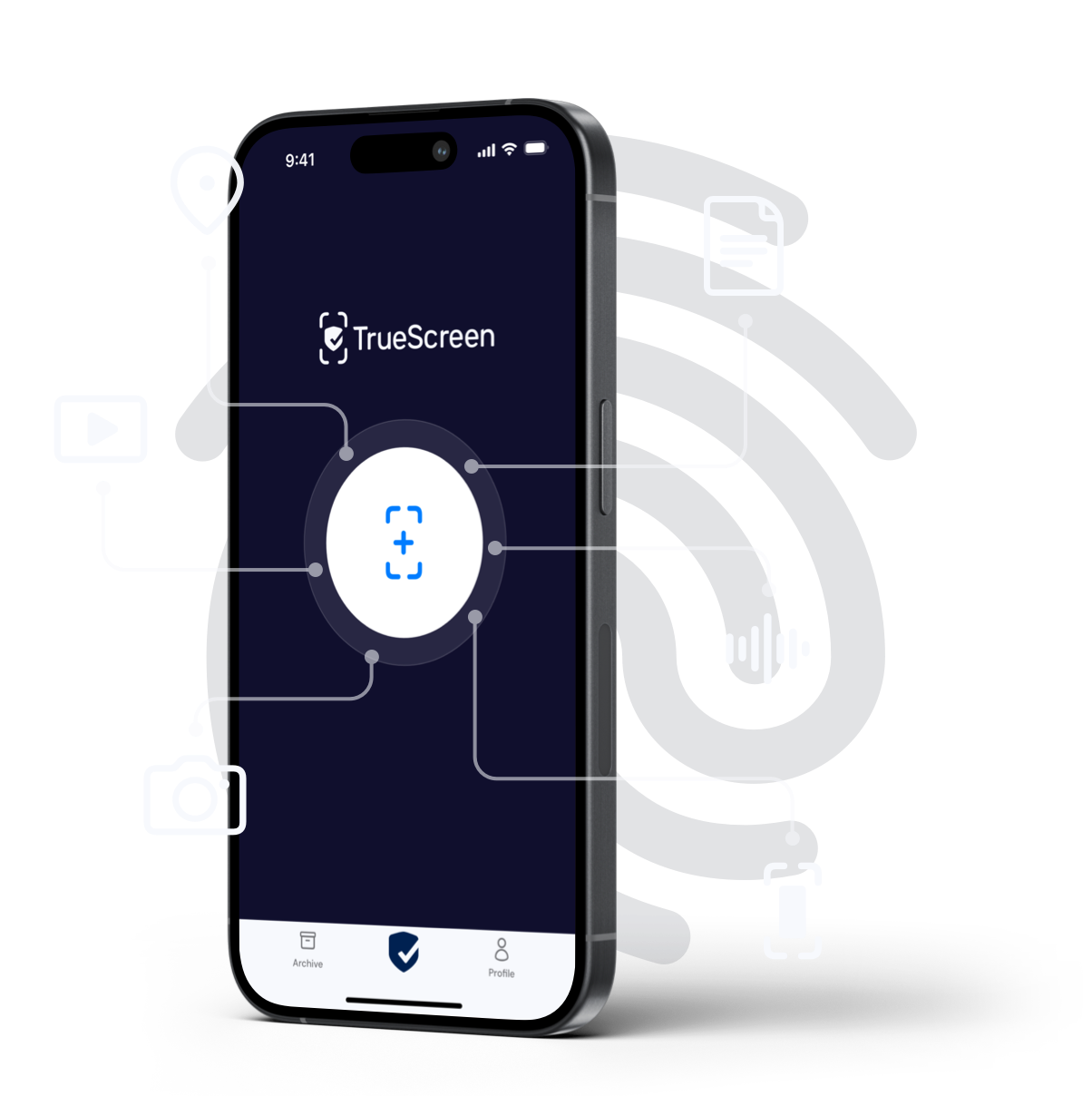
TrueScreen is the Data Authenticity Platform that automates the forensic certification process for organisations, transforming a traditionally manual and complex operation into a workflow integrated with existing business processes.
The process consists of two inseparable phases:
1. Forensic acquisition at the source
When data is acquired through TrueScreen, the platform applies a forensic methodology compliant with international standards (ISO/IEC 27037). Source integrity checks verify that the acquisition environment is intact and that the data has not been manipulated. Environmental metadata, acquisition timestamps, and verification parameters are documented automatically.
2. Certification with legal value
Once forensic acquisition is complete, the data is protected with a digital seal, qualified timestamp (eIDAS-compliant), and digital signature. The result is forensic-grade data: a digital asset usable in court without the need for additional expert assessments to prove its authenticity.
This architecture allows an organisation to integrate TrueScreen into its operational workflows and obtain automatic forensic certification of every critical data point: inspection photographs, contractual documents, communications, surveillance footage, web page screenshots. Every piece of acquired data becomes verifiable evidence, with a complete chain of custody and recognised legal value.
Use case: automatic forensic certification in enterprise workflows
A concrete example illustrates the value of automated forensic certification. A company with operations distributed across multiple locations needs to document periodic inspections of its facilities for regulatory compliance. Traditionally, the process involved photographs taken with uncontrolled devices, transferred via email, stored in shared folders: no guarantee of integrity, no chain of custody, no evidentiary value in case of dispute.
By integrating TrueScreen into the inspection workflow, every photograph is acquired with forensic methodology directly from the inspector's mobile device. The platform verifies the acquisition environment integrity, applies source checks, documents environmental metadata (geolocation, timestamp, device parameters), and certifies the data with a digital seal and qualified timestamp. The result: an archive of forensic-grade evidence that the company can present in any setting, from compliance audits to civil litigation, without requiring additional expert assessments.
For a CISO or compliance officer, this means transforming digital evidence management from an operational risk into a strategic asset: every critical data point is certified at the source, traceable, and legally enforceable.
FAQ: Digital Forensics Certification
What is the difference between forensic certification and timestamping?
Timestamping only certifies that a file existed at a given moment. Forensic certification covers the entire data lifecycle: acquisition using forensic methodology, source integrity checks, documented chain of custody, and finally a digital seal with a qualified timestamp. Only forensic certification guarantees that data is reliable from its origin, not just that it has existed since a certain point in time.
What does "forensic-grade data" mean?
Forensic-grade data is digital data that has been acquired, preserved, and certified according to international forensic standards (such as ISO/IEC 27037 and ISO/IEC 27042). It can be used as evidence in court without requiring additional expert assessments to prove its authenticity and integrity.
Which international standards govern digital forensics certification?
The main standards are ISO/IEC 27037 (identification, collection, acquisition, and preservation of digital evidence) and ISO/IEC 27042 (analysis and interpretation). At the regulatory level, the eIDAS regulation, the Budapest Convention, and the EU E-Evidence Regulation define the framework for cross-border admissibility.
Is TrueScreen forensic certification valid internationally?
Yes. TrueScreen uses a forensic methodology compliant with international standards and qualified trust services under the eIDAS regulation, which ensures cross-border recognition within the European Union. Certified data meets admissibility requirements recognised in major jurisdictions worldwide.
How does forensic certification integrate into business workflows?
TrueScreen integrates into existing business processes via mobile app, web platform, and API. Every critical piece of data acquired is automatically certified using forensic methodology, without requiring specialised technical expertise. The result is a workflow where every piece of digital evidence is born with evidentiary value.