Data provenance: tracking data origin, lineage, and source authenticity
Data provenance is now a baseline requirement for organizations that manage digital information for decisions, compliance, or legal proceedings. As data volumes grow and automated pipelines process content at scale, tracing where data came from, how it was transformed, and whether it remains reliable is no longer optional.
But most implementations have a blind spot. They track transformations, ownership changes, and processing steps with precision. They rarely verify whether the source data was authentic in the first place. A pipeline can document every step a dataset took from ingestion to analysis. If the original photographs were manipulated, the documents fabricated, or the recordings synthetic, the entire provenance chain sits on unverified foundations.
That blind spot is getting harder to ignore. Generative AI tools produce realistic images, documents, and audio at minimal cost. The EU AI Act now requires organizations to document training data provenance and demonstrate transparency about their data sources. The question has shifted from whether to implement data provenance to whether existing implementations verify source data before tracking it.
What is data provenance? Definition and core concepts
Data provenance is the documented record of where a piece of data came from, what happened to it, and who handled it at each stage of its lifecycle.
The concept borrows from the art world, where provenance means the documented chain of ownership that confirms an artwork's authenticity. In data systems, the function is the same: provenance is the evidence trail that lets stakeholders assess whether data is trustworthy, complete, and fit for purpose.
The applications are broad. In data governance, provenance supports audit trails and regulatory compliance. In AI and machine learning, it documents the datasets behind model training, supporting reproducibility and bias detection. In legal contexts, it establishes the reliability of records used in proceedings.
The three pillars of data provenance
A working data provenance system covers three areas:
- Origin: where the data was created or collected, by whom, with what method, and under what authorization. This is the starting point of the provenance chain.
- Transformation history: every processing step applied after creation, from conversion and aggregation to filtering and enrichment. Each step is logged with timestamps, tool versions, and operator identities.
- Ownership and access: who had custodial responsibility at each stage, who accessed the data, and under what governance framework.
When all three are documented and verifiable, an organization can reconstruct the full lifecycle of any dataset and defend its reliability to auditors, regulators, or courts.
Standards and frameworks: W3C PROV and OpenLineage
Two standards have shaped how organizations build data provenance at scale.
The W3C PROV specifications provide a domain-agnostic data model for provenance information. Built around three core concepts (entities, activities, and agents), W3C PROV defines how to represent relationships between data, the processes that created or transformed it, and the people or systems responsible. Published as a W3C Recommendation, it is the foundational ontology for provenance metadata across industries from scientific research to healthcare.
OpenLineage, hosted by the LF AI & Data Foundation, is more operational. It is an open standard for collecting lineage metadata from running data pipelines, with integrations for Apache Airflow, Apache Spark, dbt, Snowflake, and BigQuery. Since 2020 it has become the industry standard for pipeline-level lineage, and IBM announced expanded support within watsonx in early 2026.
Both standards focus on tracking what happens to data after it enters a system. Neither one verifies whether the source data was authentic before ingestion.
TrueScreen provides forensic-grade source verification with qualified timestamps and digital signatures under eIDAS, ISO/IEC 27037, and GDPR.
Data provenance vs data lineage: a critical distinction
"Data provenance" and "data lineage" get used interchangeably. They should not be.
Where data lineage ends and provenance begins
Data lineage maps the technical path data follows through systems: from source tables through ETL processes to dashboards or models. It answers "what transformations were applied?" and "which systems touched this data?" Lineage is a technical artifact, useful for debugging pipelines, impact analysis, and migration planning.
Data provenance includes lineage but goes further. It captures the context behind each step: who authorized the collection, why a transformation was applied, what governance policies governed access, and whether the source met authenticity requirements. Lineage tells you what happened. Provenance tells you why, by whom, and under what authority.
Put differently: lineage is a subset of provenance. An organization with full data lineage knows how data moved through its systems. An organization with full data provenance also knows whether that data should have been trusted to begin with.
Why the confusion matters
Here is where the distinction bites. A lineage system will faithfully document every transformation applied to a dataset of manipulated insurance photographs. It will track those images through ingestion, normalization, storage, and analysis. It will never flag that the source images were fabricated, because lineage does not check source authenticity.
The regulatory implications are direct. The EU AI Act requires providers of general-purpose AI models to publish detailed summaries of their training data, covering sources, collection methods, and quality measures. Lineage alone does not satisfy these requirements. Provenance, with source verification, does.
Why data provenance matters for AI and machine learning
AI systems trained on massive datasets have turned data provenance from a data engineering concern into a compliance problem.
Training data quality and model reliability
Machine learning models inherit the characteristics of their training data. If training sets contain manipulated images, synthetic text presented as genuine, or documents with altered metadata, the models carry those distortions forward. Provenance is how organizations verify training data quality and authenticity before it shapes model behavior.
Organizations deploying AI increasingly need to show that their training data was collected lawfully, represents the population it claims to describe, and has not been contaminated by synthetic content. Without provenance, these claims are assumptions.
EU AI Act and regulatory requirements for data transparency
The EU AI Act high-risk AI system obligations take effect in August 2026. Article 10 requires providers to implement data governance covering training data provenance, scope, characteristics, and bias mitigation.
For general-purpose AI models, the European Commission has released a mandatory disclosure template covering data sources, collection methods, and processing steps. Non-compliance carries fines of up to 15 million euros or 3% of global annual revenue.
Gartner reinforced the trajectory by naming digital provenance among its top 10 strategic technology trends for 2026, predicting that organizations without adequate provenance capabilities could face sanction risks in the billions by 2029.
The missing layer: source data authenticity
Most data provenance systems start tracking at the point of ingestion. They document what happens inside the organization's infrastructure. They assume the incoming data is genuine.
When provenance tracks manipulated data
An insurance company receives photographs documenting property damage. The images enter the claims management system, get tagged, stored, and routed for assessment. The provenance system records everything: upload timestamp, file format, storage location, assessor assignment, decision outcome.
Nowhere in this chain does anyone verify whether the photographs are real. The metadata could have been altered. The images could have been generated with AI. The GPS coordinates could have been spoofed. The provenance chain is technically complete but substantively hollow: it documents the handling of potentially fraudulent content with the same thoroughness as authentic evidence.
Generative AI tools already produce realistic claim photographs, medical records, and legal documents. Without source verification, provenance systems document the handling of unverified content and call it governance.
Digital provenance as the input verification layer
Digital provenance fills this gap. Where data provenance tracks what happens to data inside systems, digital provenance verifies authenticity and integrity at the moment of creation or capture.
A digital provenance system seals each file with cryptographic hashes, qualified timestamps, device identifiers, and geolocation data at the point of acquisition. Any later modification is immediately detectable. Data provenance systems can then track these verified inputs with confidence, because the starting point of the chain has been authenticated.
The two disciplines work together. Data provenance needs digital provenance at the input layer for the same reason a supply chain audit needs verified raw materials. Without authenticated inputs, downstream tracking is record-keeping for unverified content.
How TrueScreen bridges the authenticity gap in data provenance
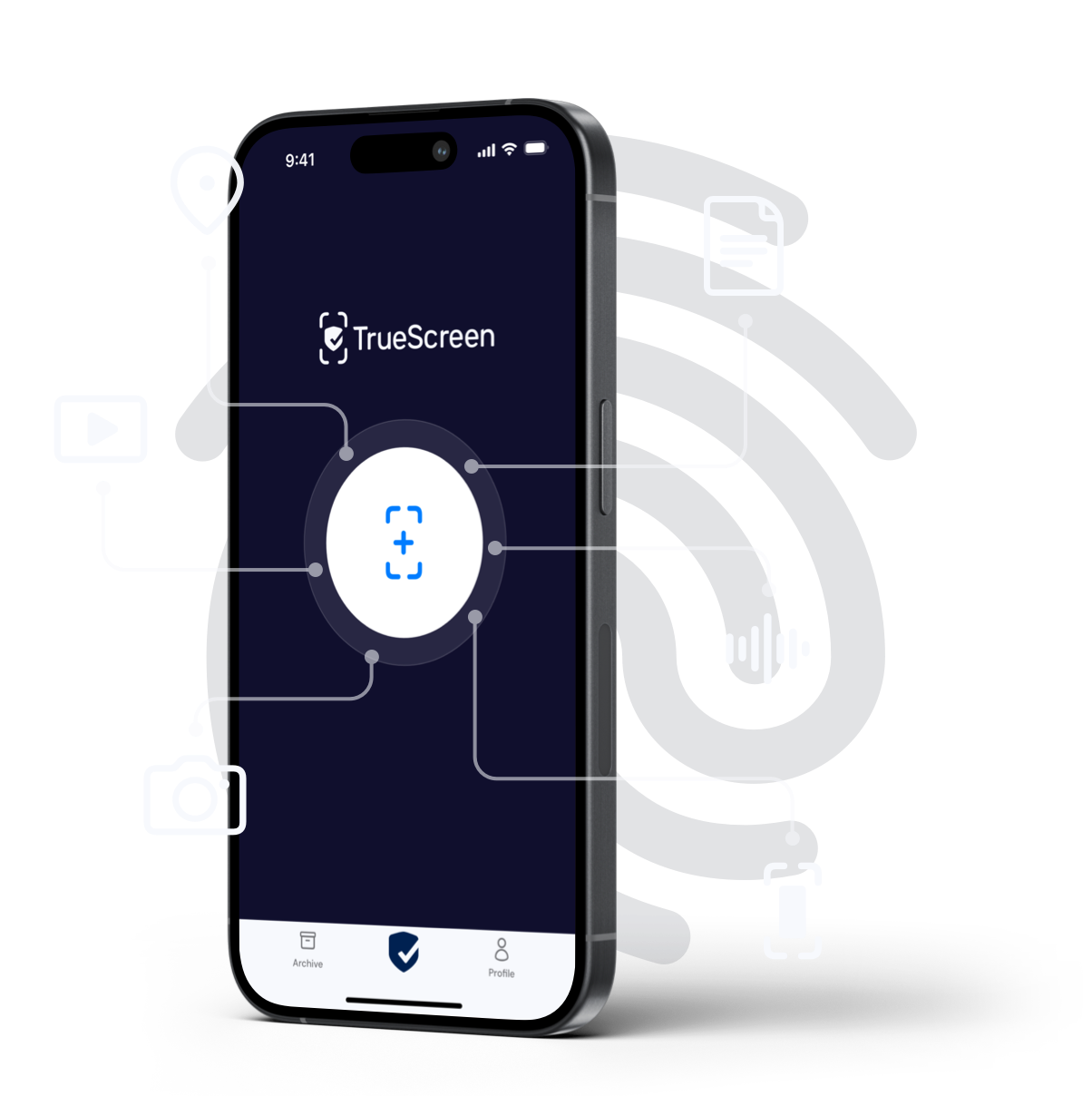
TrueScreen is the Data Authenticity Platform that provides the source verification layer missing from traditional data provenance. Through forensic-grade capture, verification, and certification, TrueScreen guarantees the authenticity, traceability, and legal validity of digital content from the moment of acquisition.
Forensic-grade certification at the point of capture
Every file certified through TrueScreen receives a Digital Seal and qualified timestamp from an international Qualified Trust Service Provider. The process captures device identifiers, geolocation, and timestamps, and generates cryptographic hashes that make any post-capture modification detectable.
The methodology complies with ISO/IEC 27037 for digital evidence handling, ISO/IEC 27001 for information security, eIDAS for electronic trust services, and GDPR for data protection. Each certified asset includes a forensic package: original files, a PDF report, machine-readable JSON, and an XML certification.
Integration with enterprise data workflows
TrueScreen works across mobile devices, desktop environments, and enterprise systems through its platform SDK and API. Organizations embed forensic-grade acquisition into existing data collection workflows so that content is authenticated before it reaches pipelines, claims systems, or evidence repositories.
In insurance, field teams capture certified photographs that enter the claims pipeline with verified provenance. In construction, site documentation gets sealed at capture. In legal proceedings, digital evidence carries admissible certification from acquisition through presentation. In each case, the data provenance system receives authenticated inputs instead of unverified files, and the full chain holds up to scrutiny.