Data Certification for AI Agents: Governance, Compliance and Legal Liability
AI agents are changing how businesses operate. In insurance, they process claims autonomously. In law firms, they analyze contracts and draft opinions. In HR departments, they screen candidates. In finance, they execute transactions and generate compliance reports. AI certification and the verification of AI outputs are becoming a priority. Their adoption is accelerating: industry estimates project the global AI governance market will reach $15 billion by the end of 2026, driven by the explosion of agentic AI in enterprise operations. Agentic AI governance, the discipline of ensuring these autonomous systems operate within verifiable and legally defensible boundaries, is becoming the defining challenge for compliance, legal, and technology teams.
The problem is that the more autonomous an AI agent becomes, the more opaque its decision-making process gets. An agent analyzing documents today will negotiate contracts tomorrow, interact with clients, manage critical processes with minimal margin for error. Yet most companies adopting them have no system to answer the question that actually matters: how do you prove what an AI agent received, what it did, and what it produced?
A simple technical log is not enough. What is needed is legally binding data certification, applied at every stage of the agent’s lifecycle. A certification that makes data immutable, timestamped with legal certainty, and enforceable against third parties, exactly as prescribed by the leading international guidelines for managing data with evidentiary value.
Organizations deploying AI agents without certifying their data face fines up to EUR 15 million or 3% of global turnover, plus an evidentiary gap in any dispute. The EU AI Act mandates traceability requirements for high-risk systems starting August 2026. The Product Liability Directive, effective December 2026, extends strict liability to AI software. This is not optional: it is a regulatory obligation and a legal necessity.
Why AI agents create a data trust problem for agentic AI governance
AI agents, or agentic AI, are autonomous systems capable of planning, deciding, and acting without direct human intervention. Unlike traditional chatbots, an AI agent can call external tools, query databases, produce documents, send communications, and make decisions with real operational and legal consequences. According to industry estimates, over 40% of large European enterprises are experimenting with AI agents in their processes in 2026. The problem is that this operational autonomy is not matched by equivalent data traceability: most enterprise deployments rely on modifiable application logs that carry no evidentiary value. The result is a gap between the agent’s decision-making capability and the organization’s ability to prove how those decisions were made, on what data, and with what instructions.
According to a report by the UC Berkeley Sutardja Center, agentic AI marks the transition from AI as an advisory tool to AI as an operational agent. It is no longer a system that suggests: it is a system that acts. And when a system acts, the governance of the data it consumes and produces becomes a priority for the entire organization.
This level of autonomy creates three serious problems.
The autonomy paradox
The more independently an agent operates, the less visible the path that led it to a particular decision. An agent analyzing fifty insurance documents and producing a rejection recommendation does not, by default, leave a verifiable trace of its reasoning. The input data might have been corrupted. The instructions might have been ambiguous. The internal reasoning might have generated a hallucination. Or the agent might have consulted external sources no longer available, combining information in a statistically plausible but factually incorrect way. Without certification, none of these hypotheses is verifiable. The organization has no way to distinguish between a configuration error, compromised data, and a model defect.
The hallucination cascade
In multi-agent environments, where multiple AI agents collaborate on a complex process, a single error propagates through the chain. An agent that misclassifies a transaction feeds a second agent that produces an incorrect compliance report. That report triggers a third agent that sends a communication to the regulator with false data. According to an analysis by Lumenova AI, a single hallucination in a multi-agent system can trigger cascading compliance violations that are difficult to reconstruct after the fact.
The absence of evidence
When a dispute reaches court, the organization that deployed the AI agent must prove what happened. But a modifiable application log has no evidentiary value. It can be altered after the fact, deleted by mistake, or intentionally manipulated. A log database is an internal reconstruction, not evidence. The difference matters: evidence has a legally proven timestamp, is immutable, and is enforceable against third parties. Without certification, the organization enters court with arguments, not evidence.
Under a strict liability regime like that of the Product Liability Directive, arguments are not sufficient. Evidence has a legally proven timestamp, is immutable, and is enforceable against third parties. A modifiable application log carries none of these properties.
The 4 levels of certification for agentic AI
AI agent data certification encompasses four distinct levels, each corresponding to a stage in the agent’s lifecycle: input data (knowledge base), instructions received (prompts), actions taken (operations), and results generated (output). Each level covers a specific regulatory risk and answers a distinct question in litigation. Article 12 of the EU AI Act (Regulation 2024/1689) requires automatic event recording for high-risk systems, but does not specify that logs must carry evidentiary value. Legally binding certification fills this gap, turning every piece of data in the agent’s lifecycle into evidence enforceable against third parties. If even one level is missing, the entire evidentiary chain is compromised and the organization faces challenges it cannot counter with certifiable evidence.
| Level | What is certified | Risk without certification | Regulation |
|---|---|---|---|
| 1. Knowledge Base | Data feeding the agent (documents, datasets, RAG context) | Corrupted data produces unreliable outputs | AI Act Art. 10, NIS2 |
| 2. Prompts & instructions | Instructions given to the agent: system prompt, user prompt, configurations | Impossible to prove what was asked | AI Act Art. 26 |
| 3. Operations | Agent actions: tool calls, reasoning, intermediate decisions | No traceability of the decision process | AI Act Art. 12, Art. 19 |
| 4. Output | Results produced: documents, decisions, analyses, communications | Impossible to prove what the agent generated | PLD 2024/2853, eIDAS |
Traditional logging vs. certified audit trail
| Dimension | Traditional application log | Certified audit trail |
|---|---|---|
| Tamper resistance | Modifiable, deletable, no integrity guarantee | Cryptographically sealed, immutable after certification |
| Timestamp | System clock (adjustable, no legal standing) | Qualified timestamp from eIDAS-compliant QTSP |
| Legal standing | Internal document, no evidentiary value | Legally binding evidence, enforceable across EU |
| Burden of proof | Organization must prove log was not altered | Certification proves integrity automatically |
| AI Act Art. 12 compliance | Satisfies letter (logging) but not spirit (evidence) | Full compliance with evidentiary value |
| Data provenance | No origin verification | Source authenticated and recorded in certificate |
Level 1: the knowledge base
The data feeding an AI agent determines its behavior. If a company uses an agent to analyze contracts and the knowledge base contains an outdated version of the relevant regulation, every analysis produced is potentially flawed. Certifying the knowledge base means recording the exact state of the data at the moment the agent consulted them, with a legally proven timestamp and guaranteed immutability. If challenged, the organization can prove the data was correct and intact at that precise moment.
Level 2: prompts and instructions
Who instructed the agent? When? With what content? In a corporate setting, instructions may come from a system prompt configured by the technical team, a user prompt entered by an operator, or both. Certifying them creates immutable proof of exactly what was asked of the agent at a given moment. An often overlooked point: when a flawed decision ends up in litigation, liability might fall on whoever configured the agent rather than whoever developed it. Without prompt certification, there is no way to distinguish the two scenarios.
Level 3: operations
AI agents do not produce outputs from nothing. They reason, consult tools, and perform intermediate steps. An agent analyzing an insurance claim might query a database of precedents, call an external API to verify coverage, generate internal reasoning, and produce an intermediate assessment before reaching its final decision. Certifying operations means recording each step with legal value, turning the log into a certification enforceable against third parties. Article 12 of the AI Act requires exactly this: the automatic recording of relevant events throughout the system’s lifecycle.
Level 4: outputs
The final output is the document, decision, analysis, or communication the agent delivers. Whether it is an insurance claim recommendation, a contract review, a compliance report, or an automated response to a customer, this is the artifact with the most direct operational and legal consequences. Certifying the output means sealing it at the moment of generation with a qualified timestamp and a cryptographic hash, creating immutable proof of what the agent produced, when, and in what form. If the output is later challenged, the organization can demonstrate its exact content at the time of generation, eliminating any dispute about whether it was altered after the fact.
The legal framework: why certifying AI data is not optional
The European regulatory landscape is converging on a clear principle: organizations using AI systems must be able to demonstrate what those systems did and on what data they operated. Four principal regulations define the obligations, with tight deadlines and significant penalties. The AI Act (Regulation 2024/1689) mandates automatic logging for high-risk systems from 2 August 2026, with fines up to EUR 15 million or 3% of global turnover. The Product Liability Directive (Directive 2024/2853) extends strict liability to AI software from 9 December 2026, including a presumption of defectiveness favoring the injured party. NIS2 requires data integrity and incident reporting for essential services. GDPR Article 22 guarantees the right to explanation for automated decisions. Organizations operating AI agents must address all these obligations simultaneously. An effective agentic AI governance framework must cover not just process controls but the data infrastructure underlying every agent decision.
| Regulation | Key articles | Obligation | Deadline | Maximum penalty |
|---|---|---|---|---|
| AI Act (Reg. 2024/1689) | Art. 12, 14, 19, 26 | Automatic logging, human oversight, transparency | 2 August 2026 | EUR 15M or 3% global turnover |
| Product Liability Directive (Dir. 2024/2853) | Art. 4, 6, 9 | AI software = product, strict liability | 9 December 2026 | Unlimited civil liability |
| NIS2 (Dir. 2022/2555) | Art. 21 | Data integrity, incident reporting, supply chain security | In force | EUR 10M or 2% turnover |
| GDPR (Reg. 2016/679) | Art. 22 | Right not to be subject to automated decisions | In force | EUR 20M or 4% turnover |
AI Act Article 12: mandatory logging
Article 12 of the AI Act requires high-risk AI systems to enable automatic recording and transparency of events throughout the system’s lifecycle. Logs must allow identification of risk situations, facilitate post-market monitoring, and enable operational oversight. The minimum retention period is six months, extendable by national legislation. For AI agents operating in regulated sectors such as finance, healthcare, or insurance, high-risk classification is highly likely. The critical point is that Article 12 requires recording but does not specify that logs must have evidentiary value. A modifiable technical log satisfies the letter of the regulation but does not protect the organization in court. Legally binding certification goes further, turning the log into enforceable evidence.
Product Liability Directive: AI as a product
Directive 2024/2853, which EU member states must transpose by 9 December 2026, explicitly includes software and AI systems in the definition of “product” subject to strict liability. According to an analysis by Gibson Dunn, developers, integrators, and distributors of AI systems face the same liability as manufacturers of defective physical goods. If an AI agent produces an erroneous output that causes harm, the deployer may be held liable even without fault, unless they demonstrate they adopted all reasonable measures. Data certification at every level becomes the documentation of those measures.
The burden of proof is reversed. The Product Liability Directive introduces an evidentiary presumption: if the product is technically complex and the injured party encounters “excessive difficulties” in proving the defect, the court may presume defectiveness. It is the organization that must prove its AI agent operated correctly, with certified and traceable data.
NIS2: AI data integrity in essential services
Organizations using AI systems within essential or important services fall under the NIS2 Directive. Article 21 requires security measures that include AI data integrity protection and incident reporting. A failure of an AI agent that compromises the availability, integrity, or confidentiality of information must be treated as a critical incident. Data poisoning, the manipulation of an agent’s context data, is a cyber threat in every respect under NIS2.
Beyond the AI Act and NIS2, the DORA Regulation (Digital Operational Resilience Act, EU 2022/2554) imposes stringent traceability and operational resilience requirements on financial institutions for all ICT systems, including AI agents used for automated trading, credit analysis, and compliance. Data certification for AI agents becomes an operational requirement under DORA as well, since the regulation demands the ability to reconstruct every digital operation with verifiable evidence.
GDPR Article 22: automated decisions
When an AI agent makes decisions with significant effects on individuals, such as rejecting an insurance claim, evaluating a candidate, or assigning a credit score, Article 22 of the GDPR applies. The data subject has the right to an explanation of the logic used. Certification of the agent’s operations (Level 3) is the technical prerequisite for providing that explanation in a verifiable manner.
An additional reference is the ISO/IEC 42001 standard, the management system for artificial intelligence. Published in 2023, it provides a framework for governing AI processes at the organizational level. It is complementary to data certification. ISO 42001 defines processes and policies; certification ensures that data produced and consumed by those processes is intact and verifiable. An organization compliant with ISO 42001 that does not certify its AI data has solid processes but weak evidence. One that certifies data without governed processes has strong evidence but fragile governance. Both are needed.
There is also an element often overlooked: the regulatory gap left by the withdrawal of the AI Liability Directive. The European Commission withdrew the proposal in early 2025, following criticism of its complexity and potential anti-innovation effect. This means liability for harm caused by non-defective but autonomously operating AI remains governed by national laws, which are not harmonized across the EU. For organizations, the message is direct: in the absence of an EU framework for AI tort liability, self-protection through data certification is not just good practice but a necessity.
The chain of liability in agentic AI: who pays when the agent gets it wrong
Who is liable when an autonomous AI agent causes harm?
Liability distributes across three parties: the model developer bears responsibility for intrinsic defects, the deployer is strictly liable under the EU Product Liability Directive 2024/2853 for operational failures and configuration errors, and the end user assumes risk for manifestly inadequate instructions. Without certified audit trails across all four data levels, determining which party caused the harm becomes impossible in litigation.
An AI agent has no legal personality. It cannot be sued, does not answer for its errors, has no assets to seize. When it causes harm, liability falls on the natural and legal persons who designed, deployed, and authorized it. According to an analysis by Clifford Chance, the liability chain involves three main actors.
The developer is liable for the AI model and its fundamental capabilities. If harm results from an intrinsic model defect, such as systematic bias or an architecture that produces hallucinations under certain conditions, liability falls on the model provider.
The deployer is the organization that puts the AI agent to work in its processes. Article 26 of the AI Act imposes specific obligations: use the system according to instructions, ensure human oversight, monitor operations. If harm arises from misconfiguration, an inadequate prompt, or failure to supervise, the deployer is liable.
The end user, when an enterprise operator interacting directly with the agent, may be involved if the instructions provided were manifestly inadequate or if risk warnings from the system were ignored.
There is also a grey area: data providers. Those supplying the datasets used in the agent’s knowledge base may be held liable if that data is incorrect, outdated, or manipulated. Knowledge base certification (Level 1) is the only way to prove data quality at the moment of use.
In practice, agentic AI risk management requires acknowledging that liability is often not attributable to a single actor. An agent that produces a flawed decision may have done so because of a model defect, a configuration error, corrupted knowledge base data, or a combination of all of these. Without data certification across all 4 levels, reconstructing the causal chain and assigning liability becomes impossible.
Insurers are already taking note. According to Lumenova AI, in 2026 insurers increasingly require verifiable proof of “bounded autonomy”: documented evidence that the AI agent operates within controlled and traceable limits, as a condition for covering AI-related risks.
TrueScreen: how to certify AI agent data with legal standing
The problems described above, opaque decision-making, cascading hallucinations, evidentiary gaps, fragmented liability, converge on a single operational need: every piece of data in an AI agent’s lifecycle must be certified with legal standing, automatically and at scale. This is what TrueScreen does.
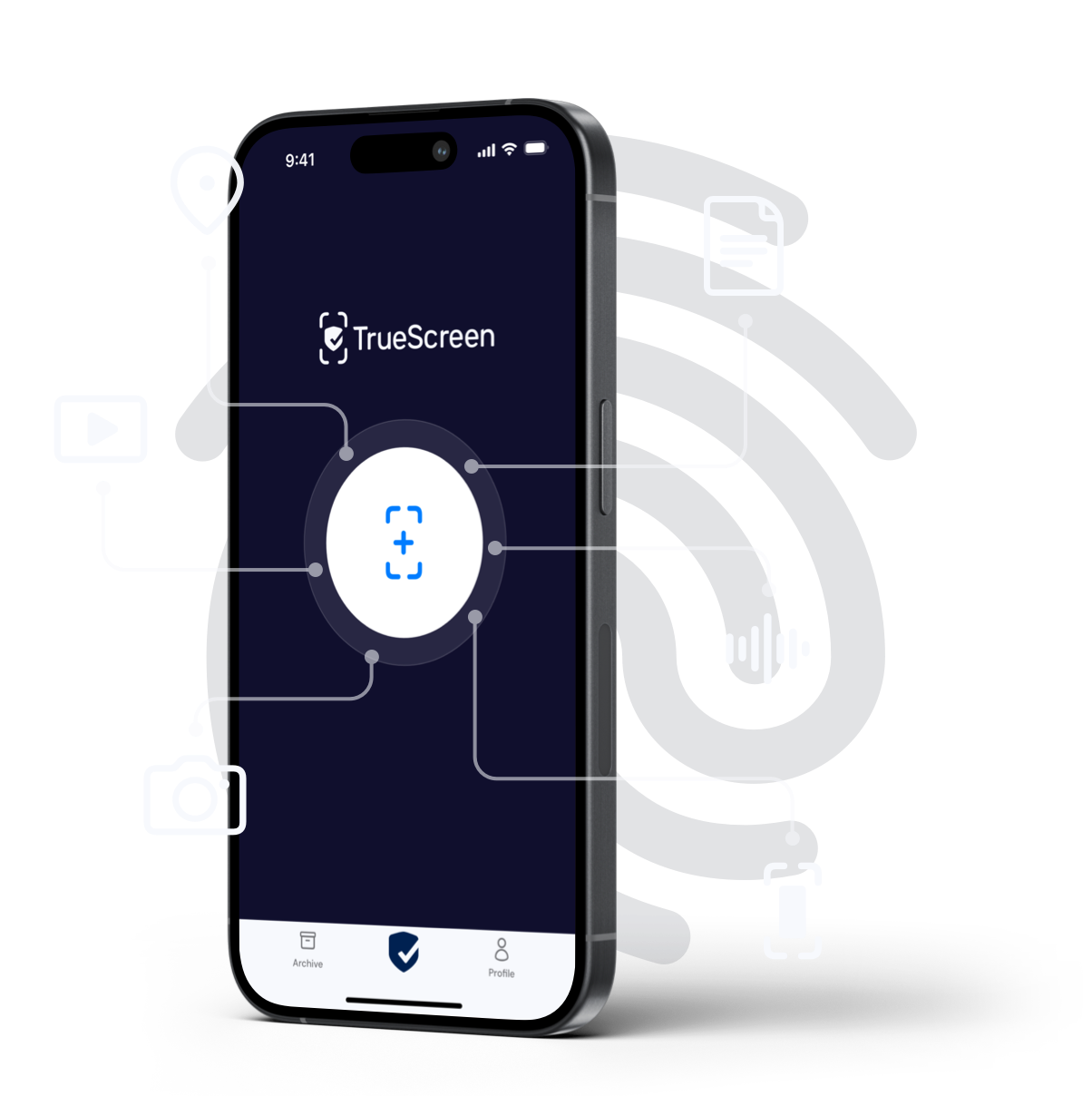
TrueScreen is the Data Authenticity Platform that certifies data at the source: it does not apply a seal to pre-existing files, but verifies data origin, acquires it through a forensic methodology, and produces a digital certificate with a qualified timestamp issued by an eIDAS-compliant Qualified Trust Service Provider. The result is not a log entry but legally binding evidence: immutable, timestamped with legal certainty, and enforceable across all EU member states.
TrueScreen certifies every piece of data in the AI agent’s lifecycle across all 4 levels: knowledge base, prompts, operations, and output. Each certification generates a structured report reconstructing the acquisition context, the verifications performed, and the chain of custody. The result is a documentary ecosystem with legal standing, not a simple sealed file.
What distinguishes TrueScreen from generic timestamping or logging services is the depth of the certification process. For each data point, TrueScreen:
- Verifies data origin: the source of the data is authenticated and recorded as part of the certificate, establishing provenance.
- Generates structured reporting: every certification produces a detailed report documenting the acquisition context, the integrity checks performed, and the metadata chain. This report is designed for audit, compliance review, and court proceedings.
- Organizes and indexes acquired data: certified data points are searchable and analyzable within TrueScreen’s certified data room, enabling systematic retrieval across agents, workflows, and time periods.
- Integrates programmatically: REST APIs and the official TrueScreen MCP (Model Context Protocol) enable native integration into any AI agent workflow, including LangChain, AutoGen, CrewAI, Claude Code, ChatGPT, and Gemini. A technical team can add certification checkpoints with minimal code changes.
The practical effect: when an AI agent consults a knowledge base, receives instructions, performs operations, or generates output, TrueScreen certifies each step automatically. If that agent’s decision is challenged three months later, the organization produces a complete, legally binding chain of evidence, not a reconstruction from application logs, but a sequence of certificates each carrying a qualified timestamp and evidentiary value.
This directly addresses the regulatory requirements outlined above. Article 12 of the AI Act demands automatic event recording: TrueScreen’s certified audit trail satisfies this requirement while adding the evidentiary value the regulation does not mandate but courts require. The Product Liability Directive’s reversed burden of proof becomes manageable: the organization can prove, with legally binding evidence, that its AI agent operated on correct data, with documented instructions, through traceable operations. Insurers requiring proof of “bounded autonomy” receive exactly that: a verifiable record of the agent’s operational boundaries and every action taken within them.
Practical implementation: from insurance claims to compliance reporting
Practical scenario: an AI agent in insurance
An insurance company uses an AI agent to process auto damage claims. The workflow has four phases, each with its own certification.
The agent receives the claim documentation: photos of the damage, police report, policyholder statement, body shop assessment. All documents are certified upon acquisition (Level 1: certified knowledge base).
The operator configures the instructions: “Analyze the documentation, verify consistency between the assessment and photos, compare with precedents in the same geographic area, produce a reasoned recommendation.” The instructions are certified (Level 2: certified prompt).
The agent performs the analysis. It queries the precedent database (47 similar claims in the past year), verifies policy coverage, detects an inconsistency between the declared date and photo metadata, and produces an intermediate assessment flagging fraud risk. Each step is recorded in the certified audit trail (Level 3: certified operations).
The agent generates the final recommendation: “Reimbursement suspended pending verification due to suspected document inconsistency.” The output is certified with a digital seal and timestamp (Level 4: certified output).
Three months later, the client disputes the decision and sues. The company produces the entire certification chain in court: every document received, every instruction given, every analytical step, every decision. All with legally proven dates and evidentiary value. The court reconstructs exactly what happened.
Roadmap: where to start certifying your AI agents’ data
Organizations building an AI compliance framework should implement certification in three phases, starting with the highest-risk systems and embedding certification into the operational workflow from the beginning, not as an afterthought.
Phase 1: assessment and mapping
Identify where AI agents touch critical data within the organization. For each agent, map four dimensions: what data it consults (knowledge base), who instructs it and in what form (prompts), what operations it performs (tool calls, external system access, reasoning, intermediate decisions), and what output it produces (documents, decisions, communications, reports). Then classify each agent under the AI Act risk framework (unacceptable, high, limited, minimal). Agents in regulated sectors such as finance, healthcare, insurance, and public administration are almost certainly high-risk. But agents in seemingly low-risk contexts may also qualify if their decisions affect individuals. An AI agent screening job applicants produces concrete legal effects on data subjects and falls under GDPR Article 22.
Phase 2: progressive implementation
Start with Level 4 (output) and Level 1 (knowledge base): they are the fastest to implement and the most relevant in disputes. Certified output proves what the agent produced; the certified knowledge base proves what data it operated on. Together they cover “what went in and what came out,” which is the first question in any challenge.
Then integrate Level 2 (prompts) and Level 3 (operations) to close the certification chain. Level 2 matters most where multiple operators interact with the same agent: certifying who gave which instruction and when enables specific liability attribution. Level 3 requires deeper code integration but directly satisfies Article 12 of the AI Act.
Phase 3: continuous monitoring
Certification is not a one-time activity. Data changes, knowledge bases are updated, configurations evolve, new agents enter production. A continuous process operating in real time is needed, generating a certified audit trail for every operation.
Periodic agentic AI audits, at least quarterly, verify chain completeness: does every agent have all 4 levels covered? Are there gaps in operations certification? Is certified data retained for the minimum required period (six months under the AI Act, potentially longer under national regulations)?
This approach prepares the organization for the AI Act deadline in August 2026 and for the ongoing compliance required by NIS2 and GDPR. Digital provenance of data becomes a verifiable business asset, not a compliance cost.
| Phase | Action | Certification levels | Timeline |
|---|---|---|---|
| 1. Assessment | Map AI agents, classify under AI Act risk framework | None (analysis) | Months 1-2 |
| 2. Implementation | Certify output + knowledge base, then prompts + operations | Levels 4+1, then 2+3 | Months 2-4 |
| 3. Monitoring | Continuous audit trail, periodic audits, update classifications | All 4 levels | Ongoing |