NIS2 and AI Data Integrity: What Essential Services Must Do
Organizations operating in the European Union's essential and important sectors face an unprecedented regulatory challenge. The NIS2 Directive mandates strict cybersecurity requirements for network and information systems. At the same time, the growing adoption of AI systems across these sectors introduces attack surfaces that the directive did not explicitly anticipate, yet fully covers under its scope.
The core issue is data integrity for AI agents. When an automated system makes operational decisions based on context data, manipulating that data becomes a cyber attack vector in every meaningful sense. NIS2 addresses this through Article 21, which requires risk management measures proportionate to system criticality. For organizations deploying AI agents in their processes, as detailed in our guide on data certification for AI agents, ensuring data integrity at the source is no longer a best practice: it is a regulatory obligation.
This insight is part of our guide: Data Certification for AI Agents: Governance, Compliance and Legal Liability
Article 21 NIS2: how it applies to AI systems
Article 21 of the NIS2 Directive establishes ten mandatory cybersecurity risk management measures for essential and important entities. Three of these carry direct implications for organizations using AI systems in their operational processes.
The first concerns risk analysis and information system security policies. An AI agent that processes data to produce decision-making outputs qualifies as an information system under NIS2. Organizations must therefore include AI agents in their risk assessments, mapping data sources, models in use, and interfaces with other systems. According to the ENISA Threat Landscape 2025 report, attacks targeting the AI supply chain are increasing, with over 80% of social engineering attacks in 2025 leveraging AI components.
The second measure addresses incident handling. NIS2 requires notification of significant incidents within 24 hours and a full report within 72 hours. If an AI agent produces incorrect outputs due to manipulated data, the organization must document the event with verifiable evidence: which data was compromised, when, and with what impact.
The third measure covers supply chain security. For AI agents, the supply chain encompasses training datasets, real-time context data, third-party APIs, and pre-trained models. Each link in this chain represents a potential compromise point.
Data poisoning as a cyber threat under NIS2
Data poisoning, the deliberate manipulation of data feeding an AI system, falls within the scope of cyber threats addressed by NIS2. This is not a theoretical category. A 2026 analysis by TTMS calls it "the invisible cyber threat of 2026," highlighting how manipulating AI agent context data can alter operational decisions without leaving obvious traces in traditional logs.
For NIS2 entities, this scenario carries concrete consequences. An AI agent managing energy grid balancing that receives altered context data could make dangerous operational decisions. An AI system in healthcare fed with manipulated clinical data could generate harmful recommendations. In both cases, the organization bears responsibility under Article 21 for failing to implement adequate data integrity protections.
NIS2 and the AI Act: a unified compliance approach
The regulatory convergence between NIS2 and the EU AI Act is creating a complex but coherent landscape. Both frameworks require risk management measures, incident documentation, and operational transparency. As highlighted in a 2025 European Parliament study, a single AI security incident can simultaneously trigger reporting obligations under both regulations.
| Requirement | NIS2 (Art. 21) | AI Act |
|---|---|---|
| Risk assessment | Mandatory for all information systems | Mandatory for high-risk AI systems |
| Incident reporting | 24h initial notification, 72h full report | Reporting of serious malfunctions |
| Data integrity | Cryptography and protection measures | Data governance for training datasets |
| Supply chain security | Supplier verification and supply chain | Traceability of models and data (Art. 50) |
| Documentation | Documented policies and procedures | Mandatory technical documentation |
The key takeaway for organizations: an integrated approach to AI agent data certification covers the requirements of both regulations simultaneously. Certifying data integrity at the source, combined with a verifiable chain of custody, satisfies both the NIS2 requirement for information system protection and the AI Act requirement for data governance in high-risk systems.
NIS2 sectors where AI agents operate
The sectors classified as essential under NIS2 (energy, transport, healthcare, digital infrastructure, public administration) are also the ones where AI agent adoption is growing fastest. In energy, AI agents manage grid balancing and predictive maintenance. In transport, they optimize logistics and routing. In healthcare, they support triage and diagnostic image analysis. In each of these contexts, the integrity of the data feeding the agent is directly tied to the security of the essential service.
How TrueScreen supports NIS2 compliance for AI data
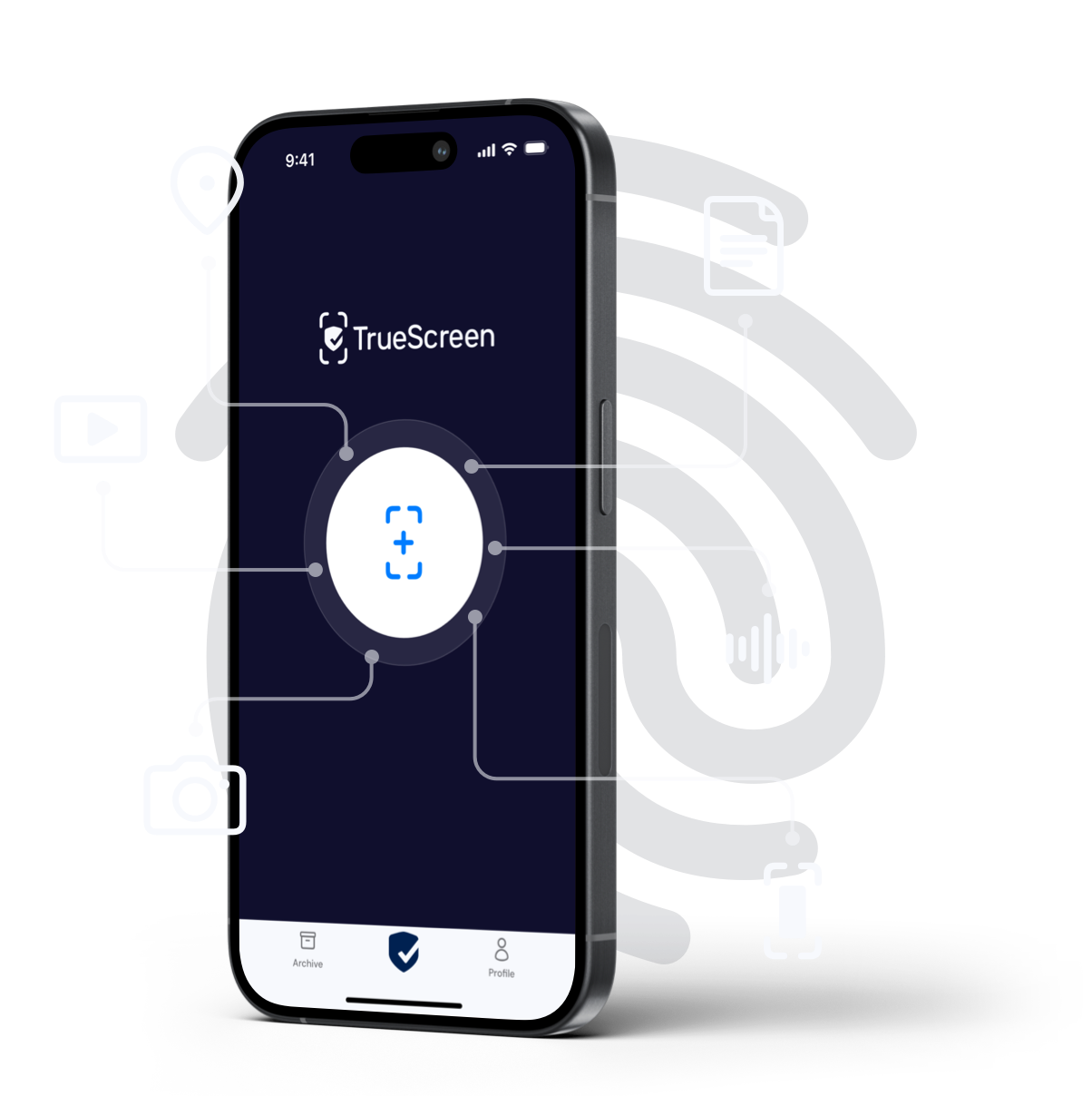
TrueScreen is the Data Authenticity Platform that ensures data integrity at the source through forensic acquisition and legally binding certification. For organizations subject to NIS2 that deploy AI systems, the platform addresses three specific Article 21 requirements.
On data integrity, every piece of data acquired through TrueScreen receives a digital signature, qualified timestamp, and immutable chain of custody at the moment of creation. Context data feeding an AI agent can be certified before entering the decision-making process, making any subsequent manipulation attempt detectable.
Regarding incident documentation, if AI data is compromised, TrueScreen certifications provide evidence with probative value that documents the state of the data before, during, and after the incident. This supports compliance with the notification timelines required by the directive.
On supply chain security, certifying data at every entry and exit point of the AI supply chain creates a verifiable record that meets the traceability requirements. The platform is available via API, SDK, and white-label technology, enabling direct integration into existing AI workflows. Compliance with ISO/IEC 27037, ISO/IEC 27001, and eIDAS ensures certifications are recognized across Europe.