Digital Provenance in the Energy Sector: Certifying Field Inspections and Audits
The energy sector runs on documentation. Every turbine inspection, every solar panel audit, every substation safety check generates records that regulators, insurers, and courts may scrutinize years later. Yet a growing body of evidence suggests that much of this documentation cannot be trusted. Fraudulent inspection reports, backdated certifications, fabricated compliance records: these have become systemic problems across European energy markets. Digital provenance offers an answer that works at the structural level: instead of trying to detect falsified records after the fact, it guarantees authenticity at the moment of capture.
For energy companies managing hundreds or thousands of distributed assets, the stakes are not abstract. A single unverified inspection report can trigger regulatory penalties, void insurance coverage, or expose operators to criminal liability. The question has shifted from whether field documentation needs to be trustworthy to how to make it so at scale.
This insight is part of our guide: Digital Provenance: What It Is, How It Works, and Why It Is the Future of Digital Authenticity
Documentation Challenges in the Energy Sector
Energy infrastructure is dispersed by nature. A single utility may operate wind farms across three countries, solar installations in dozens of municipalities, grid substations in hundreds of locations. This geographic fragmentation creates a documentation problem that paper-based workflows and even basic digital systems cannot solve reliably.
Geographic Dispersion and Subcontractor Chains
Field inspections in the energy sector rarely involve a single organization. The operator contracts a maintenance firm. That firm subcontracts specialized technicians, who may further delegate specific tasks. Each link in the chain produces its own records, often in different formats, with varying levels of rigor. No single party has full visibility over the whole picture, and verifying that an inspection actually occurred at the stated location, on the stated date, can be close to impossible.
The Testing, Inspection, and Certification (TIC) market for energy and utilities is projected to grow from $12.62 billion in 2025 to $15.44 billion by 2030. That growth reflects expanding infrastructure, but also mounting pressure from regulators who demand verifiable proof that inspections were actually performed as reported.
Document Fraud: Inspections Reported but Never Performed
The scale of documentation fraud in energy is not hypothetical. In 2024, Eurojust dismantled a fraud scheme involving EUR 27 million in illegal energy efficiency certificates, leading to 20 arrests. The scheme exploited a straightforward weakness: certificates were issued based on documentation that no one could independently verify at the point of origin.
Endesa reported conducting 428,000 inspections in 2024 and detecting 200 fraud cases per day, a 33% increase over the previous year. Meanwhile, investigative reporting has suggested that as much as 60% of Europe's "green energy" may not be truly renewable, with certification gaps that enable greenwashing at industrial scale. None of this is anecdotal. The pattern points to a built-in vulnerability in how the energy sector documents and verifies its operations.
Regulatory Requirements: What Energy Regulators Demand
EU energy regulators have progressively tightened documentation requirements, moving from general record-keeping obligations toward demands for verifiable, traceable evidence. Companies that rely on self-reported data without provenance guarantees face increasing legal exposure.
RED II Directive, ISO 14001, and ISO 50001
The Renewable Energy Directive (RED II), specifically Article 30, requires sustainability verification through mass balance traceability. Operators must demonstrate, with documented evidence, that renewable energy claims are backed by verified production and consumption data. This is not a box-ticking exercise: regulators can and do audit these records, and discrepancies carry real penalties.
ISO 14001 (environmental management) mandates documented evidence from environmental audits. ISO 50001, Clause 9.1, explicitly requires monitoring, measurement, and documented evidence of energy performance. Both standards share a common thread: the documentation itself must be reliable, not merely present.
Critical Entity Resilience and Compliance Documentation
The EU Critical Entities Resilience Directive (CER, 2022/2557) adds a further obligation. Energy operators classified as critical entities must demonstrate resilience measures through documented compliance programs. The directive does not prescribe specific technologies, but it establishes that documentation must be verifiable and that operators bear the burden of proof.
Under the eIDAS framework, qualified electronic seals provide a presumption of integrity and correct origin for digital documents. For energy companies, field documentation bearing a qualified seal carries legal weight that unsigned PDFs and unverified photos simply cannot match.
How TrueScreen Certifies Field Inspections
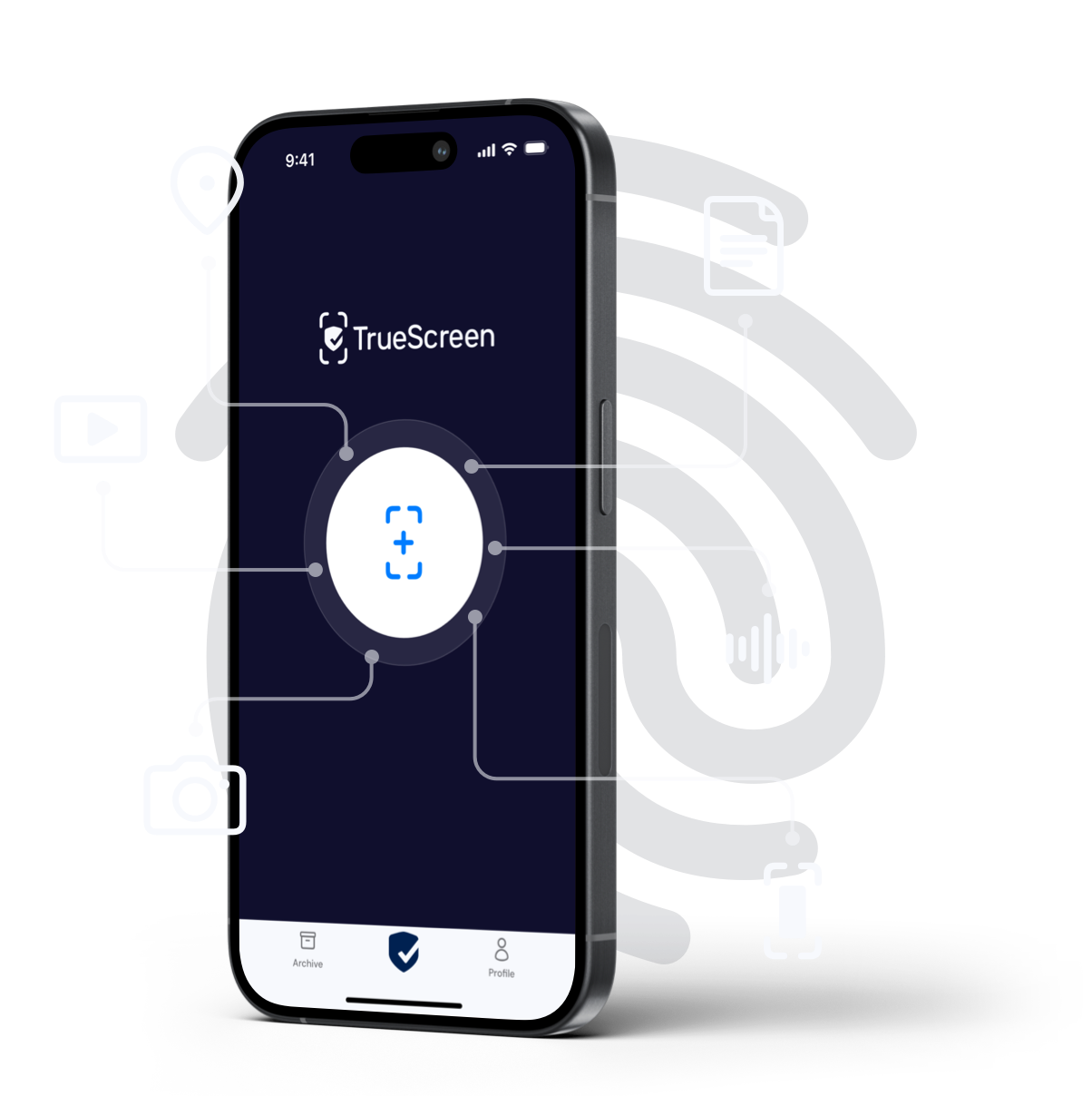
TrueScreen closes the documentation integrity gap through forensic acquisition at the point of capture. Most certification tools apply a seal to existing files, files whose origin is unknown and whose content may have been altered. TrueScreen works differently: it acquires data directly from the device's sensors and immediately certifies it with a digital signature, timestamp, and verified metadata including GPS coordinates. The resulting record is tamper-proof from creation, not from whenever someone gets around to signing it.
Mobile Certification: Photos, Videos, and Documents with Verified Geolocation
Through the TrueScreen mobile app, field technicians capture photos, videos, and documents during inspections with automatic certification. Each capture records verified geolocation, device metadata, and a precise timestamp, producing an unbroken chain of custody from the field to the compliance archive. Since authenticity is locked in at the source, the certified record holds up when regulators audit it, when insurers examine it, and when lawyers test it in court.
Scenario: Utility Managing Hundreds of Distributed Plants
Here is what this looks like in practice. A renewable energy operator runs 350 solar installations across Southern Europe. Eight different subcontractors handle monthly inspections. Before digital provenance, the operator received inspection reports as email attachments: photos with no verified metadata, PDFs that could have been created at any time, compliance checklists with no proof of on-site completion.
With TrueScreen, each subcontractor's technician captures inspection evidence through the app. The operator receives certified records with verified geolocation confirming the technician was physically at the installation, timestamps proving when the inspection occurred, and photos that cannot be altered after capture. When a regulator requests proof of compliance under RED II, the operator produces records whose digital provenance is independently verifiable: no need to take the subcontractor's word for it.
McKinsey estimates that digitalization in the energy sector can increase profitability by 20-30% and reduce inspection costs by 15-20%. Certified digital provenance makes that shift possible without giving up the evidentiary rigour that regulators and courts expect.
| Aspect | Traditional Documentation | Certified Digital Provenance |
|---|---|---|
| Origin verification | Self-reported: relies on subcontractor claims | Forensic acquisition: data captured and certified at the source |
| Geolocation | Not verified or easily spoofed | Verified GPS coordinates embedded at capture |
| Timestamp | File metadata (editable) | Qualified timestamp with legal value |
| Tamper resistance | None: files can be altered without detection | Digital signature ensures any modification is detectable |
| Regulatory acceptance | Subject to challenge in audits and disputes | Presumption of integrity under eIDAS framework |
| Scalability | Manual review bottlenecks as assets grow | Automated certification across distributed teams |
FAQ: Digital Provenance in the Energy Sector
Can certified field documentation replace traditional paper-based inspection reports for regulatory compliance?
In most EU jurisdictions, yes. Under the eIDAS framework, documents bearing a qualified electronic seal carry a presumption of integrity and correct origin. Certified digital records are legally equivalent to, and often stronger than, paper reports for regulatory audits under RED II, ISO 14001, and ISO 50001. The critical distinction: authenticity must be guaranteed at the point of capture, not at the point of filing.
How does digital provenance address the problem of subcontractors reporting inspections that never took place?
It removes the possibility of fabricated reports. When a technician uses TrueScreen to document an inspection, the system captures verified geolocation, a certified timestamp, and device metadata all at once. You cannot generate that report from an office desk or backdate it: the provenance data would immediately expose the discrepancy.
What is the cost impact of implementing certified digital provenance for field inspections?
According to McKinsey research, digitalization of field operations in the energy sector reduces inspection costs by 15-20% while increasing overall profitability by 20-30%. Most of the savings come from eliminating manual verification workflows and cutting dispute resolution costs. The financial fallout of fraudulent or non-compliant documentation, which can include fines, project delays, and lost contracts, is also avoided.