Certifying the AI Agent Knowledge Base: Data Integrity and Provenance
AI agents are only as reliable as the data they consume. Organizations pour resources into model selection and prompt engineering for their autonomous agents, yet the most fragile link in the chain gets surprisingly little attention: the knowledge base. A single poisoned document in the context window can compromise up to 48% of an AI agent's outputs (Lin et al., 2025). When the underlying data lacks integrity guarantees, every downstream decision inherits that vulnerability. AI knowledge base certification closes this gap: verifiable provenance and tamper-proof integrity for every data asset an agent relies on, so the knowledge base becomes a trust anchor rather than an unguarded attack surface. As we examine in our guide on data certification for AI agents and governance compliance, this is not an optional improvement: it is becoming a regulatory requirement.
This insight is part of our guide: Data Certification for AI Agents: Governance, Compliance and Legal Liability
Why the Knowledge Base Is the Vulnerable Point of AI Agents
AI agents depend on retrieval-augmented generation (RAG) pipelines that pull context from external knowledge bases at inference time. Unlike model weights, which are fixed after training, these knowledge bases are living repositories: updated, extended, and sometimes altered without audit trails. The OWASP LLM Top 10 lists data and model poisoning (LLM04) among its top risks, and Gartner predicts that by 2028, 50% of organizations will adopt zero-trust data governance specifically because unverified AI-generated data is proliferating across enterprise systems.
Data Poisoning: Manipulation of Context Data
Data poisoning in a RAG context works differently from traditional training-time attacks. The attacker does not need to retrain anything. Modifying or inserting a single document in the knowledge base is enough. Research from Lakera demonstrates that replacing just 0.001% of training tokens with misinformation causes a 7-11% increase in harmful or factually incorrect responses. In a knowledge base scenario, the impact is even more concentrated: the poisoned content lands directly in the agent's context window, bypassing any statistical dilution that large-scale training data would provide.
Consider a procurement AI agent that retrieves supplier compliance certificates from a shared knowledge base. If a single certificate is tampered with (an expiration date altered, a certification scope broadened), the agent will authorize transactions based on false premises. Without cryptographic proof of document integrity, the organization cannot detect the manipulation until the damage surfaces in an audit or legal dispute.
Stale Data and Dataset Bias
Poisoning is deliberate. But knowledge bases also degrade on their own, and this form of decay gets far less attention. Regulatory documents expire. Market data loses relevance. Internal policies get revised, while older versions remain in the repository. Gartner reports that 60% of AI projects are abandoned due to data that is not AI-ready: incomplete, outdated, or simply inconsistent across sources. For AI agents that operate autonomously, stale data goes beyond an accuracy problem. It creates liability. An insurance claims agent working with outdated coverage terms, or a compliance bot referencing superseded regulations, generates outputs that expose the organization to legal and financial risk.
Dataset bias compounds the problem. If the knowledge base over-represents certain jurisdictions or industries while neglecting others, the agent's outputs will mirror those blind spots. Certification with verifiable timestamps and provenance metadata makes these gaps visible, so governance teams can assess coverage before the agent acts on incomplete information.
AI Act Article 10 and GDPR: Regulatory Requirements for Data Quality
The EU AI Act, enforceable from August 2, 2026, sets explicit data quality mandates for high-risk AI systems. Article 10 requires that training, validation, and testing datasets be "relevant, sufficiently representative, and as far as possible, free of errors and complete." While the regulation targets training data directly, its principles extend to any data that materially influences an AI system's output, including RAG knowledge bases that feed context to autonomous agents. ISO/IEC 42001, the first AI Management System standard with 38 controls, reinforces this by requiring organizations to document data governance practices across the AI lifecycle.
Data Governance for Training and Context Datasets
Article 10 of the AI Act does not distinguish between data baked into model weights and data retrieved at inference time. The regulatory intent is clear: if data shapes the output, it must be governed. For organizations deploying AI agents in high-risk domains (healthcare, legal, financial services, public administration), this means the knowledge base needs the same governance rigor applied to training datasets. Documented provenance, version control, integrity verification: none of these are optional for context data that directly shapes agent behavior.
Traditional IT controls alone fall short. File modification logs track changes but do not prove authenticity. Version control systems record commits but cannot guarantee that the stored version matches what was originally ingested. The gap is between process documentation and actual proof. Regulators are moving toward the latter: certified timestamps, digital signatures, and immutable records that hold up in an audit or court proceeding.
Knowledge Bases Containing Personal Data: GDPR Implications
When a knowledge base includes personal data (customer records, employee profiles, health information), GDPR adds another layer of obligation. Article 25 mandates data protection by design and by default. Article 22 grants individuals the right not to be subject to decisions based solely on automated processing. If an AI agent makes decisions that affect individuals based on uncertified, potentially corrupted data, the organization is exposed on two fronts: AI Act non-compliance for data quality failures, and GDPR violations for processing inaccurate personal data without adequate safeguards.
Certifying the knowledge base creates an auditable chain of custody that demonstrates due diligence under both frameworks. Each document's integrity, timestamp, and origin become verifiable: exactly the evidentiary baseline that data protection authorities look for during investigations.
How to Certify the Knowledge Base with TrueScreen
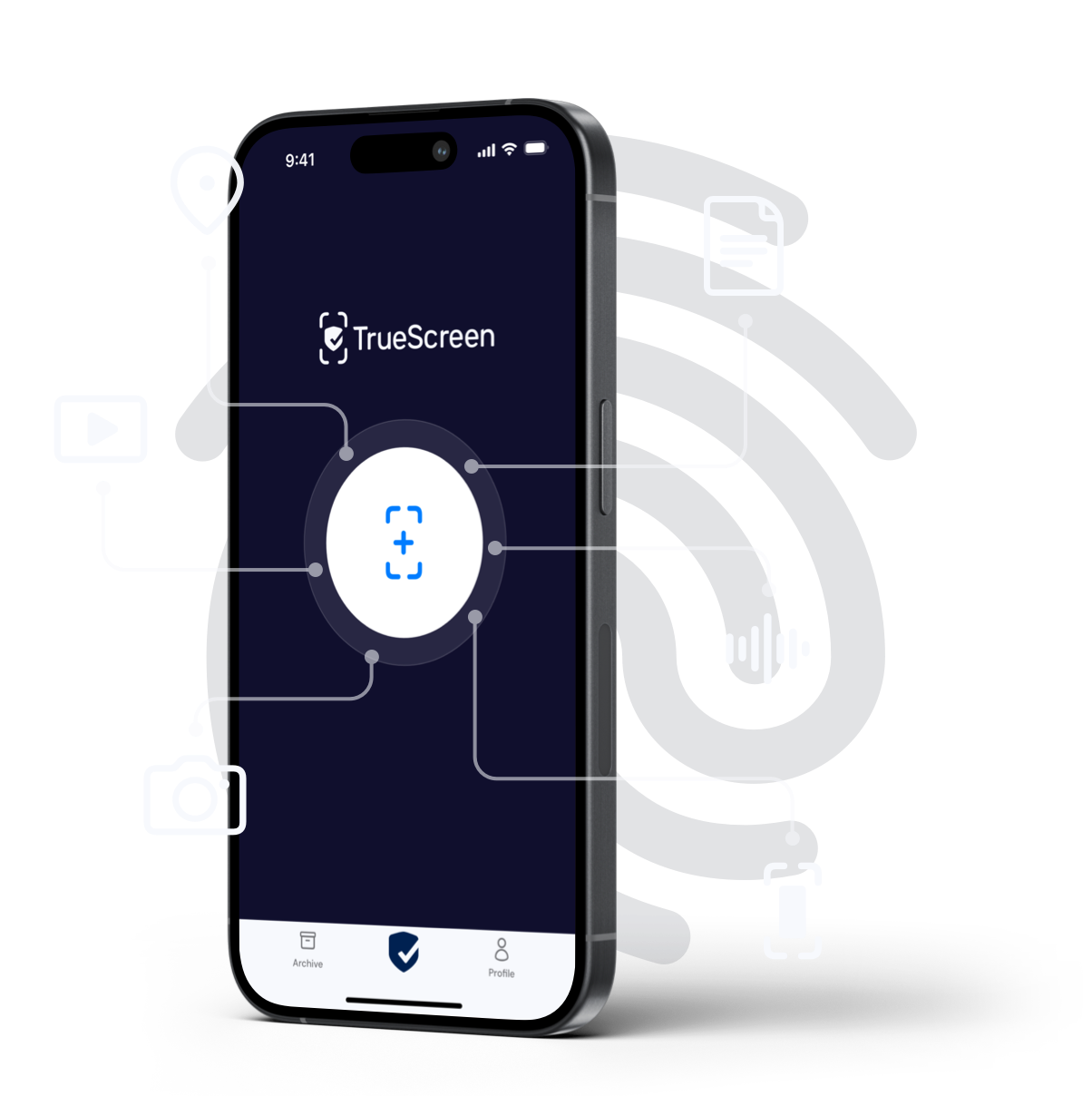
TrueScreen provides forensic data acquisition combined with digital certification to establish legally binding proof of integrity for every document in an AI agent's knowledge base. Rather than simply applying a seal to existing files, the platform captures data at its origin with a forensic methodology, then applies digital signatures and certified timestamps that carry legal value under the eIDAS regulation. What this produces is a tamper-proof, court-ready record: what data the agent consumed, when it was certified, and proof that nothing changed afterward.
API-Based Certification: Data Integrity and Certified Timestamps
The TrueScreen certification API integrates directly into the knowledge base ingestion pipeline. Each time a document enters the repository, an API call triggers forensic acquisition and certification. The process generates a digital signature and a qualified timestamp that anchors the document's state to a specific moment in time. Under eIDAS, qualified electronic seals carry a presumption of integrity, meaning the burden of proof shifts to anyone challenging the document's authenticity.
The approach scales without manual intervention. A knowledge base with 50 regulatory documents and one with 500,000 product specifications go through the same programmatic flow. Governance teams get a certification dashboard with full audit trails: which documents are certified, when, and whether any have been modified since.
Practical Scenario: Legal AI Agent with Certified Regulatory Knowledge Base
A law firm deploys an AI agent to assist with regulatory research across multiple jurisdictions. The agent draws from a knowledge base of statutes, case summaries, and regulatory guidance documents. The firm integrates TrueScreen's API into the ingestion workflow: every document is forensically acquired and certified at the moment it enters the knowledge base. The legal sector benefits particularly from this approach because attorney work product and legal opinions carry strict evidentiary requirements.
Six months later, a client challenges a regulatory interpretation that the AI agent provided. The firm pulls up the certified version of the source document. It can demonstrate, with legally binding proof, that the data in the knowledge base was authentic and unaltered at the time the agent generated its response. The certified timestamp and digital provenance record turn what would otherwise be a credibility dispute into a verifiable chain of evidence.
| Dimension | Technical logging (Git, checksums, access logs) | Legally binding certification (TrueScreen) |
|---|---|---|
| Integrity proof | Hash-based, self-attested | Digital signature with eIDAS-qualified timestamp |
| Legal standing | Internal documentation only | Presumption of integrity under eIDAS; court-admissible |
| Tamper detection | Detectable if logs are not compromised | Cryptographically verifiable, independent of internal systems |
| Provenance metadata | Source URL + commit history | Forensic acquisition origin + certified timestamp + full chain of custody |
| AI Act compliance | Partial: demonstrates process, not proof | Full: meets data quality and governance obligations with legally binding evidence |
| Scalability | Native to CI/CD pipelines | API-driven, integrates into ingestion pipelines programmatically |