Deepfakes in the 2026 Elections: Why Certified Proof Matters More Than Fact-Checking
In March 2026, the National Republican Senatorial Committee released a video in which Democratic Senate candidate James Talarico appears to say things he never said. The video runs over a minute. The "AI Generated" label appears in near-illegible text in the bottom-right corner, visible for just a few seconds. CNN reported it on March 13, 2026, calling it the first political deepfake in which a candidate is realistically recreated for an entire clip. That same month, entirely synthetic videos showing alleged Iranian missile strikes on Tel Aviv went viral on X. Millions shared them as real. When users asked Grok, X's own AI chatbot, to verify them, it confirmed them as authentic, even fabricating citations from Reuters and CNN. Euronews documented the episode on March 6, 2026.
These are not isolated incidents. The 2026 United States midterm elections are the first electoral cycle where political deepfakes are deployed at industrial scale. The problem goes beyond technology: it threatens the integrity of democratic processes. When citizens cannot distinguish authentic video from fabricated content, and when automated verification tools themselves fail, chasing every individual fake no longer works. A different approach is needed: ensuring that authentic content is recognizable as such.
2026 Midterms: the first democratic stress test in the deepfake era
The 2026 midterm elections are the proving ground that disinformation experts have feared for years. Political deepfakes are no longer academic experiments or technological demonstrations. They are campaign tools, deployed by national political organizations with professional budgets and distribution networks.
The Talarico case: a candidate recreated with AI for over a minute
The ad published by the NRSC on March 11, 2026, shows an AI-generated version of James Talarico, Democratic Senate candidate in Texas, appearing to read excerpts from his own old tweets on divisive issues. According to CNN, it is the first political deepfake where a candidate speaks realistically for over a minute: a leap from previous attempts lasting only seconds. The "AI Generated" disclosure appears in microscopic text: first for about three seconds, then in even smaller font for the rest of the video. A Reuters report from March 28, 2026, identifies the Talarico ad as one of at least three recent deepfakes produced by the Republican party at the national level.
Geopolitical disinformation: Iranian synthetic videos that fooled Grok
The phenomenon extends well beyond American campaigns. In March 2026, during the escalation between Iran, Israel, and the United States, a series of entirely synthetic videos showing alleged missile strikes on Tel Aviv went viral on X. The videos had anomalies visible to a trained eye: duplicated rooftops, unnatural orange smoke, no sirens. Millions shared them as real footage. The most alarming data point: when users asked Grok to verify those videos, the chatbot confirmed them as authentic. It even fabricated citations from Reuters and CNN to support its claims. The Atlantic Council's Digital Forensic Research Lab later documented over 300 contradictory responses from Grok about a single fake video of a bombed airport, as reported by Euronews.
Why fact-checking and AI detection are no longer enough
The instinctive response to electoral disinformation is to strengthen fact-checking and develop deepfake detection tools. But this strategy has a limit that cannot be circumvented: it is reactive, slow, and destined to lose the race against synthetic content generation.
The gap between generation and detection
The asymmetry is stark. Generating a convincing synthetic video requires a few hours and resources accessible to anyone. Detecting it requires models trained on specific datasets that become obsolete every time generative technology advances. A study from the University of Edinburgh demonstrated that so-called AI fingerprints, the basis of most deepfake detection systems, are vulnerable and bypassable. As long as verification infrastructure depends on identifying fakes, it will always be one step behind.
People cannot recognize video deepfakes
If automated systems do not work, people might compensate. They do not. A study published in the Journal of Creative Communications in 2025 by Mina Momeni demonstrated that people struggle to identify deepfake videos and that their opinions are influenced by this type of disinformation. A pre-registered experiment (N = 210) published in iScience confirms the finding: people do not reliably detect deepfakes. Neither risk awareness nor financial incentives improve accuracy.
The regulatory gap: only 31 out of 50 states with political deepfake laws
The legislative landscape is not equipped for the scale of the problem. According to the Public Citizen tracker updated to 2026, only 31 US states have laws regulating deepfakes in elections (up from 28 at the end of 2025: Maine, Tennessee, and Vermont passed new legislation in 2026). At the federal level, no legislation exists that prohibits the use of deepfakes in political campaigns. In Texas, where the Talarico case occurred, the law (Election Code § 255.004) classifies distribution of manipulated videos as a misdemeanor, but only within 30 days of an election. A time constraint that is easily circumvented. Meanwhile, Meta and X have eliminated professional fact-checking systems in favor of user-generated community notes.
Source certification: guaranteeing truth without chasing fakes
If fake detection does not hold, the question changes: how do you build a system that works regardless of how sophisticated generated content becomes?
The paradigm shift: from analyzing fakes to guaranteeing authenticity
The answer lies in a change of perspective. Instead of analyzing every piece of content to determine whether it is fake, you certify authentic content at the moment it is created. A video acquired and certified at the time of recording carries verifiable proof of authenticity: who recorded it, where, when, with which device. And most importantly, the guarantee that no bit has been modified after acquisition. Every version circulating online can be compared against the original certificate. If it does not match, it has been altered. This approach works even when generation surpasses detection, because it does not depend on analyzing copies: it relies on guaranteeing the original.
Forensic acquisition, digital seal, and timestamp: how it works
Source certification has two inseparable components. The first is forensic acquisition of data at the origin: content is captured directly from the device with verified metadata (geolocation, timestamp, hardware identifier) and made immutable from the moment of recording. The second is the digital seal with signature and timestamp that guarantees legal validity and immutability over time. This is not a stamp applied to an existing file. The process starts from acquisition itself, before any manipulation can intervene. This principle underpins Digital Provenance: tracing and verifying the origin and history of digital content throughout its lifecycle.
What source certification is and how it protects electoral integrity
Source certification is the process that associates verifiable, legally valid proof of authenticity with digital content, generated at the moment of data acquisition. TrueScreen, the Data Authenticity Platform, implements this process with a forensic methodology covering the entire cycle: from content capture on the device to generating a certificate verifiable by third parties. In an electoral context, a candidate, journalist, or observer who certifies their own statements and recordings creates an incontestable authentic archive. Every video, photo, or document acquired and certified becomes the official reference version. Any deepfake can be debunked by comparing it with the certified original: the burden of proof shifts from the victim of manipulation to the producer.
Mobile app: certifying video, photos, and audio directly from the device
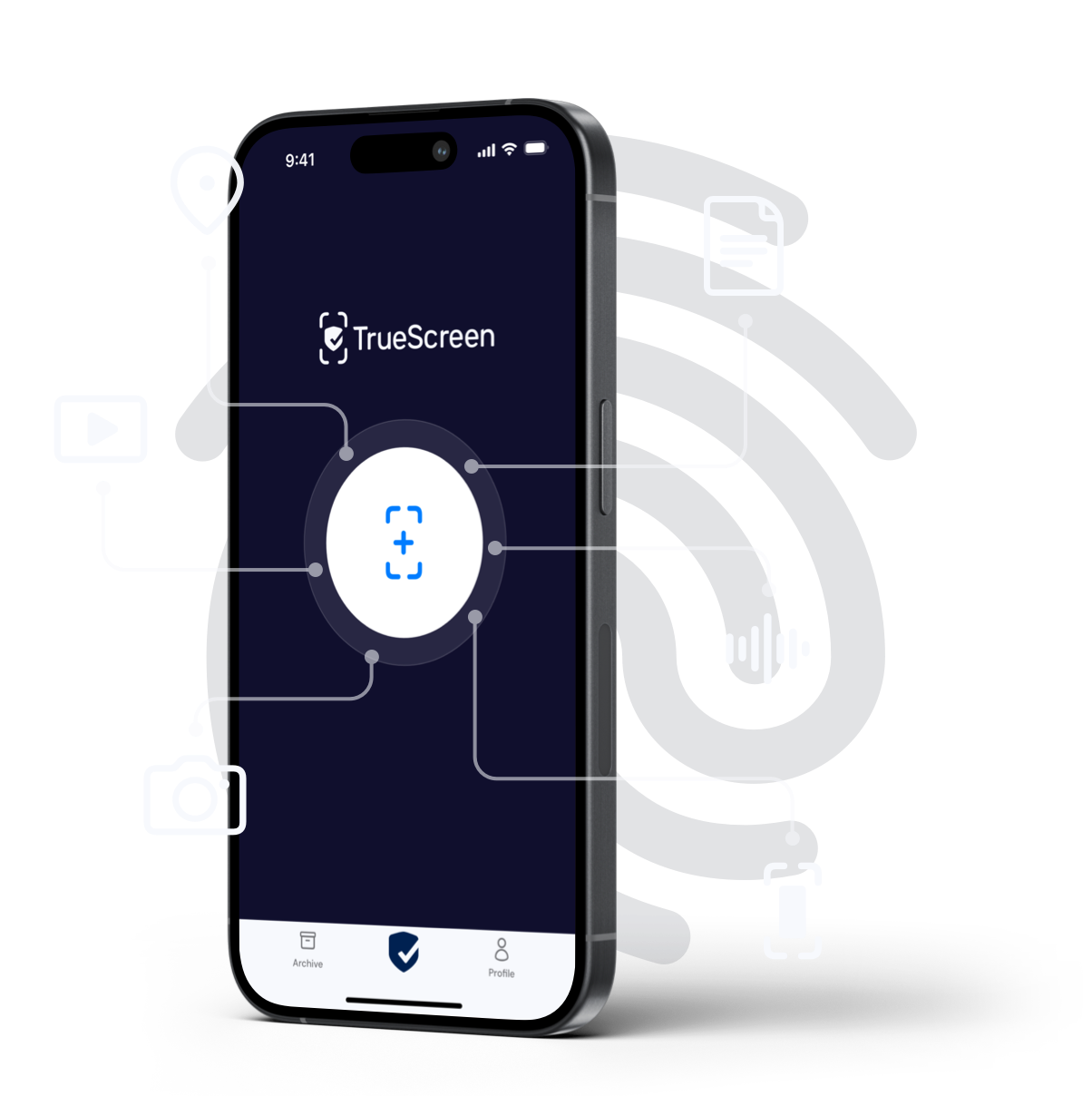
The TrueScreen mobile app allows candidates, campaign staff, journalists, and electoral observers to certify content directly from their smartphone. Every recorded video, captured photo, or audio recording is acquired with forensic metadata (GPS location, verified date and time, device identifier) and sealed with a digital signature and timestamp. The result is a legally valid certificate proving the content's authenticity and integrity over time.
Platform: an authentic archive for candidates, journalists, and observers
The TrueScreen platform enables managing, archiving, and sharing certified content with third parties. A candidate who certifies every interview and public statement progressively builds a verifiable archive. When a deepfake emerges, there is no need to analyze it: simply compare the circulating content with the certified original. If it does not match, the manipulation is evident. Certification thus becomes a preventive infrastructure, not merely a defensive tool.
Regulatory landscape: EU AI Act, Digital Services Act, and proposed FRE 707
The international regulatory framework is evolving. But the speed and depth of responses remain insufficient relative to the scale of the threat.
EU AI Act: mandatory labeling of AI content from 2026
The EU AI Act, whose transparency provisions take effect in August 2026, introduces mandatory labeling of content generated or modified by artificial intelligence that imitates real people, objects, or events. For political content, labeling alone is not enough: the Code of Practice being finalized (expected May-June 2026) also requires fact-checking and editorial approval by qualified personnel. The Digital Services Act imposes transparency and disinformation removal obligations on online platforms, but its concrete enforcement remains fragmented.
Federal Rule of Evidence 707: an insufficient first step
In the United States, the proposed Federal Rule of Evidence 707, released for public comment in August 2025 and discussed in hearing on January 29, 2026, attempts to regulate the admissibility of AI-generated evidence in courts. The rule requires such evidence to meet the reliability standards of Rule 702 (expert witnesses). But the limitation is clear: FRE 707 applies only to evidence that the proponent acknowledges as AI-generated. It does not address the problem of undisclosed deepfakes, which is the core of the electoral threat. Bridging this gap requires an authenticity certification infrastructure: not rules about how to treat recognized fakes, but tools to prove truth at the source.