Corporate disinformation security: building a structured defense program
Every day, organizations produce, share and store thousands of digital assets: photos, videos, documents, screenshots. These data feed operational decisions, institutional communications and legal proceedings. We take their reliability for granted.
But the landscape has shifted dramatically. The World Economic Forum ranked disinformation as the top global short-term risk for the second consecutive year. Gartner predicts that by 2027, 50% of enterprises will invest in disinformation security solutions. This is no longer just a government or media problem: disinformation has become a direct business risk, with targeted attacks on brands, supply chains and commercial relationships.
The question every CISO, risk manager and communications leader should ask today is not whether their organization will be targeted, but whether it is prepared to respond with verifiable evidence. An effective disinformation security program requires a structured approach combining governance, processes and technology, where the ability to make digital evidence immediately verifiable becomes the foundation of every response strategy.
Digital disinformation: from political phenomenon to concrete business risk
The risk in numbers: what global reports tell us
The Global Risks Report 2025 from the World Economic Forum ranks misinformation and disinformation as the top global risk over the 2025-2027 period. The threat is not new, but its evolution has accelerated: generative AI tools make it increasingly difficult to distinguish authentic content from synthetic material.
The data is clear. According to Gartner, global enterprise spending on combating misinformation and disinformation will surpass $30 billion by 2028, consuming 10% of marketing and cybersecurity budgets. Fifty percent of enterprises will invest in disinformation security programs by 2027, up from less than 5% today. These numbers are redefining investment priorities worldwide.
Targeted reputational attacks: how they hit brands and supply chains
Corporate disinformation does not follow the patterns of political disinformation. Attacks are surgical: a manipulated video of a CEO, a fake press release circulated on social media, forged documents sent to business partners. The goal is not general chaos but specific economic and reputational damage.
A recent survey shows that 8 out of 10 executives are concerned about the impact of AI-driven disinformation on their company’s reputation. A reputational crisis can reduce revenue by up to 20% within days, and 60% of European consumers abandon a company after a perceived breach of trust. Disinformation is no longer an abstract risk: it carries a measurable and direct cost.
Why fact-checking and monitoring are no longer enough
The verification paradox: when the evidence itself is unreliable
The traditional response to disinformation relies on two pillars: digital channel monitoring and reactive fact-checking. The problem is structural: both assume that the evidence used to debunk claims is itself reliable. But in a context where any digital content can be generated or manipulated with widely accessible tools, even defensive evidence loses credibility.
An organization that responds to a fake video of its facility with “authentic” photos of the same plant has no real advantage if those photos lack verifiable, certified metadata. Attacker and defender are using the same unverifiable media. The defense cannot be symmetrical.
The asymmetric race between generation and detection
Detecting manipulated content suffers from a fundamental economic problem. Every improvement in detection systems is rapidly outpaced by advances in generation. Generative AI improves at a pace that detection cannot sustain: in 2025, the volume of fake content identified online grew by 40%, and the trend is accelerating.
This does not mean monitoring is useless. It serves as an early warning system. But it cannot be the foundation of a strategy: it is the difference between having a fire alarm and having a fireproof structure. The sustainable approach is not to recognize the false, but to guarantee the true.
Operational framework for corporate disinformation security
The disinformation response team: roles and responsibilities
An effective disinformation security program starts with governance. Gartner recommends establishing Trust Councils composed of representatives from communications, IT, finance, legal, HR and marketing, led by C-Suite executives. This is not about adding another corporate function: it is about coordinating capabilities that currently operate in separate silos.
The disinformation response team operates across the organization. The CISO brings expertise in data security and digital threat analysis. The communications lead manages public response and media relations. The legal team assesses regulatory and evidentiary implications. Marketing monitors social channels and brand perception impact. Each has a specific role, but the response is coordinated.
Escalation criteria and decision tree
Not every disinformation incident requires the same response. An operational framework must define clear classification and escalation criteria:
- Level 1: Continuous monitoring. Anomalies in mention volumes, reports from employees or partners, alerts from media intelligence systems.
- Level 2: Impact assessment. Who is the specific target of the attack? What digital evidence is being used or manipulated? What is the potential reach in terms of spread and damage?
- Level 3: Coordinated response. Internal and external communication, collection of certified evidence and, where necessary, legal action.
Each level has specific triggers and defined activation times. The decision tree eliminates improvisation and ensures a response proportionate to the actual severity of the threat.
From alert to response: the end-to-end process
The complete process involves four phases: detection, classification, response and post-analysis. The detection phase combines automated monitoring and human reporting. Classification applies escalation criteria to determine severity and urgency.
The response phase is where evidence quality makes the difference. An organization that has proactively certified its critical content (official communications, product images, contractual documents, compliance reports) can respond with verifiable, legally valid evidence. Those that have not find themselves needing to prove the authenticity of content that has no built-in verification mechanism.
Post-analysis documents the incident, evaluates response effectiveness and feeds continuous improvement of the program.
Digital provenance: making corporate evidence immediately verifiable
Certification at source vs post-hoc verification
Digital provenance represents a paradigm shift in data reliability management. Instead of attempting to verify the authenticity of content after it has been produced and distributed (reactive approach), provenance certifies content at the moment of its creation (proactive approach).
The principle is simple but powerful: every piece of digital data, from the moment of capture, carries a chain of verifiable metadata: digital signature, certified timestamp, verified GPS coordinates, cryptographic hash of the original content. These metadata cannot be retroactively altered. If someone circulates a manipulated version, the certified original becomes incontestable proof of the truth.
This difference is not theoretical. In a legal context, evidence certified at source has incomparably greater probative value than a file without verifiable metadata. In a reputational context, an organization that responds with certified digital evidence communicates credibility and preparedness.
Certified evidence as a tool for countering false narratives
Disinformation security is not built solely through defensive processes. The best protection is making your data inherently trustworthy. If an organization’s official content is certified at source, any alternative or manipulated version becomes automatically contestable.
Consider a concrete scenario. A manufacturing company faces a reputational attack: images are circulated showing alleged non-compliance at its facilities. If the company has proactively certified its quality inspections with photos, videos and checklists bearing digital signatures, verified timestamps and GPS data, it can respond within hours, not weeks. Certified evidence becomes the foundation of a rapid, credible response that is, when necessary, admissible in court.
The TrueScreen infrastructure for corporate evidence management
Forensic-grade certification of photos, videos and documents
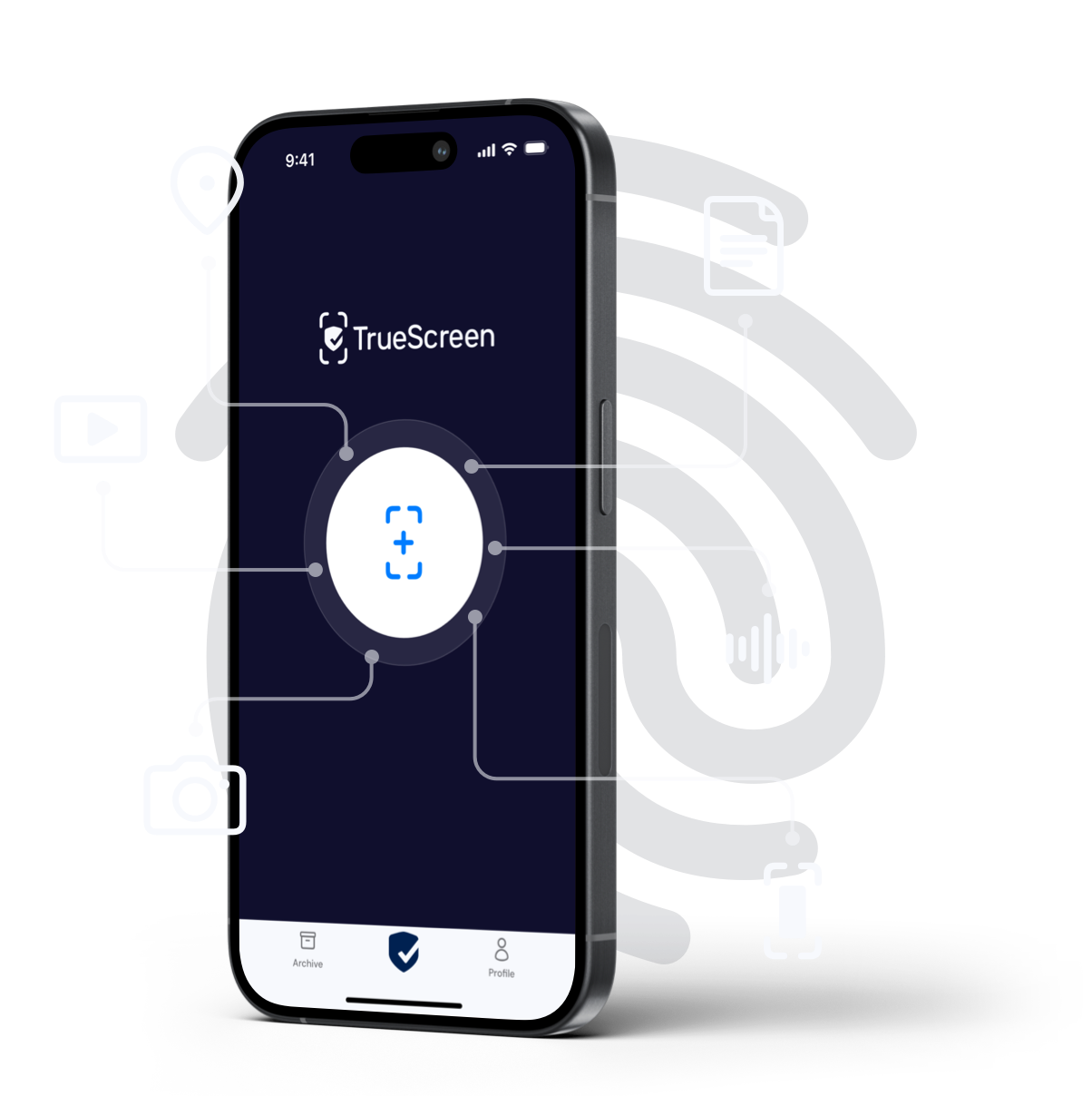
TrueScreen is the Data Authenticity Platform that enables organizations and professionals to certify the authenticity and integrity of any digital content. Through a forensic-grade process of acquisition, verification and certification, every photo, video, document, screenshot or email acquired through TrueScreen is equipped with a digital signature, verified timestamp and immutable metadata.
This approach transforms digital content from potentially contestable files into evidence with legal and probative value. Certification happens at the moment of capture, not afterwards: it is the principle of provenance applied to corporate data. Whether it involves field inspections, institutional communications or compliance documentation, every piece of evidence becomes immediately verifiable.
Digital chain of custody and legal value
The platform guarantees a complete chain of custody for certified evidence. Acquisition processes comply with international standards defined by ISO/IEC 27037 for digital evidence management. This means that every piece of evidence collected with TrueScreen is not only authentic: it is collected, preserved and presentable according to globally recognized criteria.
For a disinformation security program, this infrastructure represents the technology layer that makes strategy operational. The disinformation response team does not need to improvise evidence collection when an attack is already underway. It has access to an archive of certified evidence and a system for acquiring new evidence in real time, with the certainty that every piece of data is immediately defensible.