AI document fraud in insurance: how to protect claims evidence
AI document fraud in insurance is escalating at a pace few in the industry anticipated. European insurers lose over EUR 13 billion annually to fraud, and generative AI has fundamentally rewritten the rules. Creating a convincing fake document now takes minutes, not expertise. For insurers, the question is no longer whether they will receive manipulated evidence, but how much of it is already slipping through undetected.
The answer to this challenge does not lie in trying to spot the fake, an approach destined to always lag behind generation techniques. It lies in guaranteeing authenticity at the source: certifying data the moment it is captured, before any manipulation is possible.
How generative AI is transforming insurance fraud
The scale of insurance fraud in Europe
Insurance fraud is not a new problem, but its scale keeps growing. According to Insurance Europe, estimated costs exceed EUR 13 billion per year across the continent. In Italy alone, ANIA 2024 data shows that 24.5% of motor insurance claims present fraud risk indicators. Similar patterns emerge across major European markets.
These figures, already substantial, do not account for the multiplier effect of generative AI. Traditional fraud techniques required specific skills and time. Artificial intelligence has removed both barriers, dramatically lowering the entry threshold for document forgery.
Deepfakes and synthetic documents: the new fraud toolkit
The fraud landscape has shifted dramatically in the past two years. An analysis by Insurance Business UK reports a 300% increase in AI-manipulated vehicle images. A Pindrop (2025) report documents a 475% surge in synthetic voice fraud, used to simulate claims notification calls.
Generative tools can alter damage photographs, produce credible medical reports, and modify dates and metadata in digital files. The result is industrial-scale production of fake evidence that traditional verification systems struggle to intercept.
Why traditional detection methods are no longer enough
The limits of human and algorithmic verification
The numbers speak for themselves. A Milliman (2025) study found that humans correctly identify AI-generated images only 50% of the time: barely better than a coin toss. Meanwhile, the TruthScan 2025 report reveals that 92% of insurance companies have already encountered AI-driven fraud in their claims processes.
Detection software, for its part, chases generation techniques. Each new AI model produces more realistic outputs, forcing detection systems into a constant update cycle that cannot guarantee comprehensive coverage.
The detection race: a structurally fragile approach
The fundamental issue is conceptual. Relying on detection means accepting that you will always operate behind those creating fakes. For every detection technique developed, countermeasures emerge that reduce its effectiveness. It is an asymmetric race where the attacker holds a structural advantage.
This reactive approach exposes insurers to mounting risk: settling claims based on evidence whose authenticity cannot be verified. Breaking out of this cycle requires a paradigm shift.
Source certification: guaranteeing authenticity before manipulation
Digital Provenance and digital signatures for insurance evidence
The alternative paradigm is structural and preventive. Instead of analyzing a document after creation to determine whether it is authentic, the data is certified at the moment of capture. Digital Provenance works exactly this way: every piece of digital content carries proof of its origin, integrity, and chain of custody.
In practice, when an adjuster, policyholder, or operator captures a photo, video, or document, the system automatically applies a digital signature with a timestamp, records device metadata (geolocation, timestamp, sensors), and creates a cryptographic hash that makes any subsequent modification immediately detectable.
How TrueScreen protects insurance companies
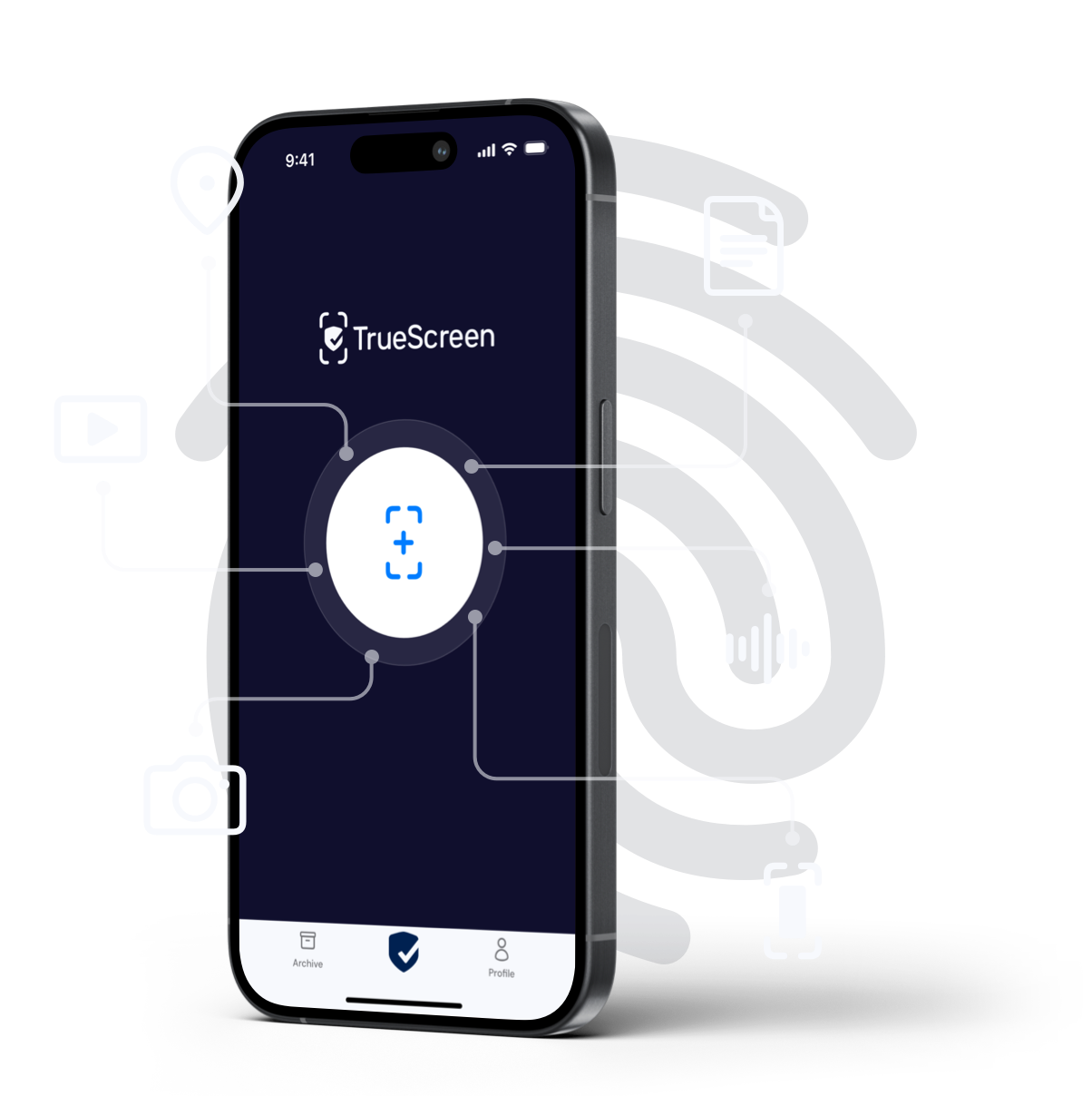
TrueScreen is the Data Authenticity Platform that enables insurance companies to certify evidence at the source. The operator captures content directly through the app or platform, and TrueScreen generates a legally binding certificate attesting to the date, location, integrity, and provenance of the data.
In the insurance context, this translates into a concrete benefit: every claim photo, every inspection video, every digitally acquired document becomes independently verifiable. There is no need to wonder whether an image has been manipulated. If it is certified at the source, its authenticity is guaranteed. If it is not, it becomes subject to enhanced scrutiny.
Compliance with EU AI Act transparency requirements, which from 2026 mandate labeling and traceability of AI-generated content, finds in source certification a solution that is already operational.
Operational roadmap for insurance companies
From capture to settlement: a certified workflow
Integrating source certification into the claims management process follows a clear path:
- Field capture: adjusters and policyholders use the certification app to capture photos, videos, and documents during claims assessment
- Automatic certification: every piece of content receives a digital signature, timestamp, and verifiable metadata at the moment of capture
- Document assessment: anti-fraud teams can immediately distinguish certified evidence from uncertified evidence, focusing verification resources where they are truly needed
- Complete audit trail: every step is tracked and verifiable, from initial capture to final settlement
Operational benefits of source-level prevention
Adopting a source certification system delivers results across multiple dimensions. Companies that certify evidence at the source can reduce document verification times, lower costs related to disputes, and create an effective deterrent against fraud attempts. Those who know that evidence is certified at the source have fewer incentives to attempt manipulation.
The competitive advantage is twofold: on one hand, fraud losses decrease; on the other, settlement processes accelerate for legitimate claims. The result is an improved experience for honest policyholders and more effective protection for the company.