
Digital Evidence Preservation Standards: ISO 27037, SWGDE and NIST Compared
Every year, millions of pieces of digital evidence get challenged or excluded in legal proceedings. Not because they lack relevance, but because they were collected and preserved without following recognized standards. According to research published by the National Institute of Standards and Technology, over 70% of organizations involved in digital litigation do not follow standardized procedures for managing electronic evidence. The result: evidence a judge might consider decisive ends up procedurally discarded.
The problem is not a lack of rules. At least four international standards define precisely how to identify, collect, acquire, and preserve digital evidence: ISO/IEC 27037, ISO/IEC 27042, the SWGDE guidelines, and NIST SP 800-86. Each takes a different approach, covers different phases of the evidence lifecycle, and addresses different audiences. The answer to "which standard should we follow" depends on the operational context, jurisdiction, and type of evidence.
This article compares the four main frameworks for digital evidence preservation, analyzes the key requirements of each, and shows how TrueScreen implements them automatically in everyday workflows.
A fifth reference sits outside this comparison: the ISO 21043 forensic sciences series governs the forensic process as a whole rather than digital evidence alone, and it draws an explicit boundary with ISO/IEC 27037 for data held on storage media.
Why international standards matter for digital evidence preservation
Digital evidence has structural vulnerabilities that physical evidence does not. A file can be copied without leaving a trace, metadata can be altered, a timestamp can be manipulated. Without a documented chain of custody from the moment of acquisition, any digital evidence is contestable in court.
For a deep dive on how US federal and state courts apply these standards, read our guide on FRE 902(14) certification in US courts.
International standards solve this problem by establishing minimum requirements for integrity, authenticity, and reproducibility. These are not generic recommendations: they define precise operational procedures for every phase of evidence handling. The United Nations Office on Drugs and Crime (UNODC) has identified ISO/IEC 27037 as a fundamental reference for digital investigations globally, confirming the central role of these frameworks in international judicial cooperation.
A telling data point: according to the IBM Cost of a Data Breach Report 2025, the average cost of a data breach reached $4.88 million, with organizations that lack incident response procedures paying significantly more in litigation and regulatory penalties where digital evidence management plays a critical role.
ISO/IEC 27037: the reference standard for identification, collection, and preservation
Published in 2012, ISO/IEC 27037 is the most widely cited standard in digital forensics. It defines guidelines for four fundamental processes: identification of digital evidence sources, collection of physical devices, acquisition of data through forensic copying, and preservation of integrity over time.
The standard's core principle is minimization of alteration. Every operation on a device or piece of data must be documented: who performed the operation, when, how, and under what authorization. ISO 27037 requires, where possible, the creation of bit-for-bit copies verified through cryptographic hashing (typically SHA-256) to confirm that the copy matches the original exactly.
The standard introduces two key professional roles: the DEFR (Digital Evidence First Responder), responsible for initial collection operations, and the DES (Digital Evidence Specialist), who manages the more complex phases of acquisition and analysis. This distinction matters because it establishes different competency requirements for different roles in the chain of custody.
An often-overlooked aspect: ISO 27037 applies not only to hard drives and mobile devices but also to volatile evidence such as RAM, network data, and cloud-based evidence. Section 7.1.3 of the standard specifically addresses evidence management in virtualized environments, an increasingly relevant topic as organizational data migrates to cloud infrastructure.
ISO/IEC 27042: analysis and interpretation of digital evidence
Where ISO 27037 covers collection and preservation, ISO/IEC 27042 (published in 2015) focuses on analysis and interpretation. The two standards are complementary: the first ensures the evidence arrives intact at the laboratory, the second establishes how to examine it without compromising its value.
ISO 27042 defines three types of analysis: static (examining data without executing the system), dynamic (analyzing behavior during execution), and real-time (monitoring active systems). For each type, the standard requires the process to be documented so that it can be reproduced by another independent analyst.
The concept of reproducibility is central: the analyst must be able to demonstrate that another professional, following the same documented procedure, would reach the same conclusions. This requirement has direct implications for evidence admissibility in court, because it allows the opposing party to verify the methodology used.
The standard also requires each analyst to demonstrate specific competency for the type of evidence being examined. Being a generic IT expert is not sufficient: someone analyzing mobile device evidence must have documented expertise in that specific domain.
SWGDE: operational guidelines from the North American forensic community
The Scientific Working Group on Digital Evidence (SWGDE) does not publish ISO standards but rather operational guidelines used by forensic laboratories, law enforcement, and courts in the United States and Canada. The difference matters: where ISO standards define general principles and requirements, SWGDE guidelines provide detailed step-by-step procedures.
The document "Best Practices for Digital Evidence Collection" (updated November 2025) covers the entire digital evidence collection cycle with specific instructions for each device type and medium. Unlike ISO 27037, which takes a more abstract approach, SWGDE specifies exactly which tools to use, which verifications to perform, and how to document every step.
SWGDE also published specific guidelines for cloud evidence acquisition in 2025 (document 23-F-004), a topic that ISO standards address less thoroughly. This reflects a cultural difference: ISO standards aim for universality, while SWGDE guidelines target immediate operability within the North American judicial context.
A key strength of SWGDE is frequent updating. While ISO 27037 dates back to 2012, SWGDE updates its documents every 2-3 years to incorporate technological developments. In 2025 alone, it published updated guidelines on forensic video analysis, drone evidence collection, and mobile device forensic acquisition.
NIST SP 800-86: the federal framework for incident response
NIST SP 800-86, titled "Guide to Integrating Forensic Techniques into Incident Response," takes a different perspective from the previous standards. It does not primarily address forensic laboratories but rather IT and cybersecurity teams within organizations that must manage security incidents.
The NIST standard defines a four-phase forensic process: collection, examination, analysis, and reporting. The emphasis is on integrating forensic techniques into everyday operational procedures, not just post-incident response. This approach is particularly relevant for organizations managing large data volumes that need to ensure evidence preservation as part of their normal workflow.
NIST SP 800-86 also stands out for its attention to data volatility hierarchy: system registers, RAM, and active network connections have an extremely short collection window. The standard provides a collection priority list based on volatility, an operational element that ISO standards do not detail with the same level of specificity.
A specific NIST contribution is the IR 8387 document, which updates definitions and classifications of digital evidence to include emerging types such as IoT data, evidence from artificial intelligence systems, and cloud service metadata.
Comparative table: four standards side by side
To help choose the most appropriate standard for your context, this table summarizes the key differences between the four digital evidence preservation frameworks.
| Criterion | ISO/IEC 27037 | ISO/IEC 27042 | SWGDE | NIST SP 800-86 |
|---|---|---|---|---|
| Phases covered | Identification, collection, acquisition, preservation | Analysis and interpretation | Collection, acquisition, preservation, analysis | Collection, examination, analysis, reporting |
| Primary audience | Forensic labs, law enforcement, DEFR/DES | Forensic analysts, technical experts | Forensic labs, law enforcement (US/Canada) | IT teams, SOC, incident response |
| Level of detail | Principles and general requirements | Methodological framework | Step-by-step operational procedures | Integrated guide with operational priorities |
| Cloud/IoT coverage | Partial (section 7.1.3) | Limited | Specific (doc. 23-F-004, 2025) | Updated (IR 8387) |
| Last updated | 2012 | 2015 | 2025 (continuous updates) | 2006 (base) + IR 8387 (2022) |
| Legal recognition | Global (cited by UNODC, EU courts) | Global (complementary to 27037) | US and Canada | US (federal agencies) |
| Cryptographic hash | SHA-256 (explicit requirement) | References 27037 | MD5 + SHA (dual hash recommended) | SHA-256 (recommended) |
The choice of standard depends on context. A European forensic laboratory will primarily follow ISO 27037 and 27042. A corporate incident response team in the United States will adopt NIST SP 800-86 integrated with SWGDE guidelines. In international contexts with multiple jurisdictions, the combination of ISO 27037 + NIST provides the broadest coverage.
Which platform automatically implements these digital evidence preservation standards
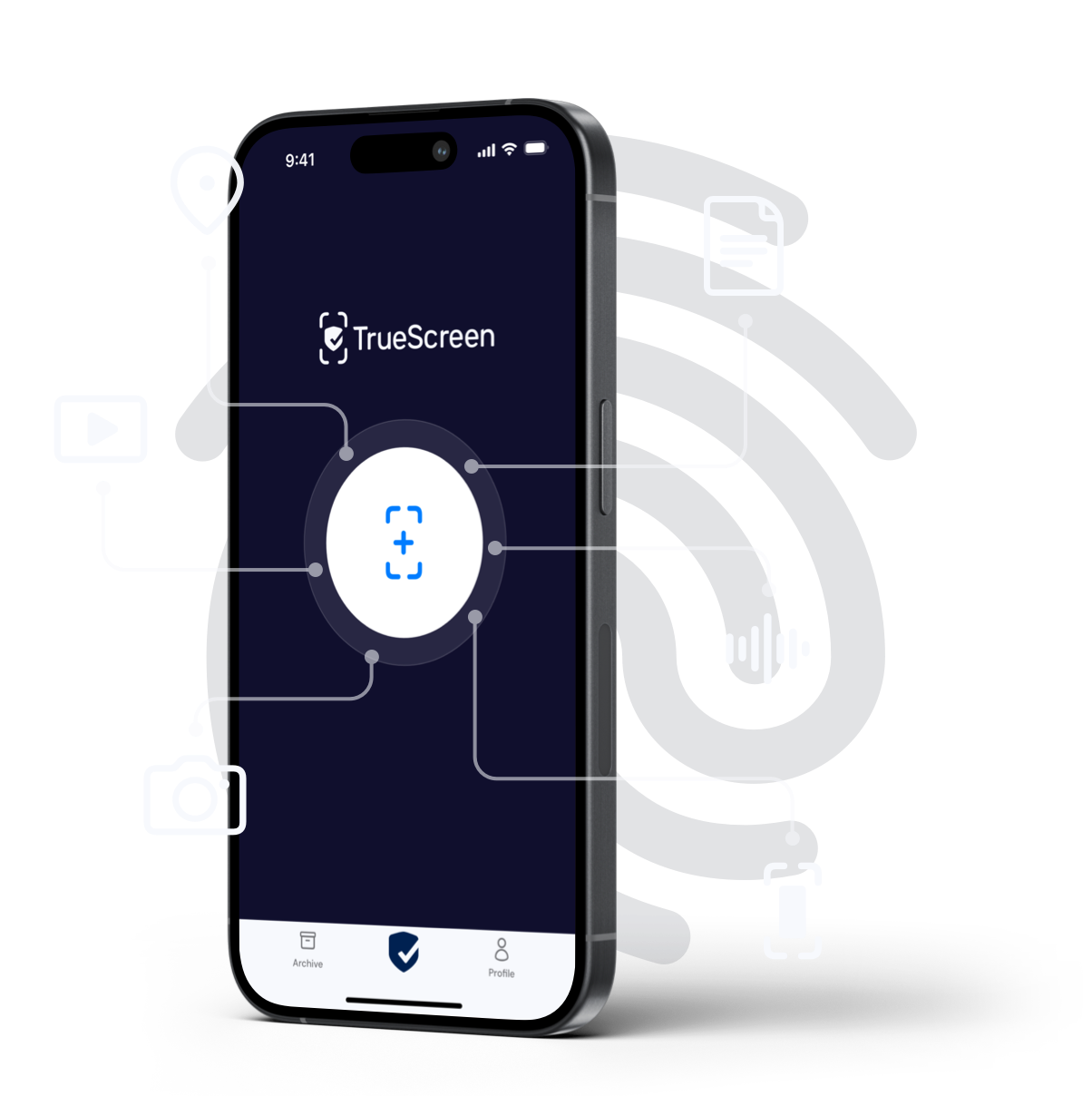
Manually adopting these standards requires specialized expertise, dedicated tools, and documented procedures that many organizations do not possess internally. TrueScreen, the Data Authenticity Platform, solves this problem by embedding international standard requirements directly into the data acquisition and certification process.
When a user acquires digital evidence through TrueScreen, the platform automatically performs the steps required by the standards: forensic capture of content at the source (compliant with ISO 27037), integrity verification through cryptographic hashing, chain of custody documentation with qualified timestamps and digital signatures issued by a Qualified Trust Service Provider (QTSP) under the eIDAS Regulation.
The TrueScreen Forensic Browser represents a concrete example of practical implementation of these principles. The application enables users to navigate, capture, and certify web pages with complete forensic integrity. Every capture action is logged in an immutable audit trail with dual timestamps (local clock and NTP-verified time across four independent servers), comprehensive forensic metadata acquisition (SSL certificates, DNS resolutions, HTTP traffic, VPN and proxy detection), and digital signing of the evidence package.
The TrueScreen platform is available via mobile app, web portal, API, and SDK, making certification accessible to any organization regardless of size or internal forensic expertise.
How to implement the standards in everyday practice
Implementing international standards for digital evidence preservation requires a structured approach combining training, tools, and procedures. Three operational steps allow organizations to begin the process.
The first step is mapping evidence sources: identifying all systems, devices, and data flows that could generate relevant digital evidence. ISO 27037 (section 5.4) requires this mapping as a prerequisite for any evidence management program. For most organizations, primary sources include emails, contractual documents, photographs, video recordings, messaging platform communications, and data from web applications.
The second step is defining collection procedures. Each evidence type requires a specific procedure: volatile evidence (RAM, network connections) follows the priority hierarchy defined by NIST SP 800-86, while web content requires forensic acquisition with complete metadata per SWGDE guidelines.
The third step is automation. The standards do not require every operation to be manual: they require it to be documented, reproducible, and verifiable. TrueScreen automates compliance by making every acquisition compliant by design, without requiring the operator to have deep forensic knowledge.
The international regulatory framework for digital evidence
Technical standards operate within a regulatory framework that defines their legal context. In Europe, the eIDAS Regulation (EU 910/2014 and subsequent eIDAS 2.0) establishes the framework for digital signatures, electronic seals, and qualified timestamps, granting these instruments a legal presumption of integrity and authenticity across all member states.
In the United States, the Federal Rules of Evidence (particularly Rules 901 and 902) govern the authentication and admissibility of digital evidence in federal courts. Rule 902(14), amended in 2017, allows self-authentication of data copied from electronic devices when accompanied by a certification from a qualified person who used a reliable process to produce an accurate copy.
The E-Evidence Regulation (EU 2023/1543), fully applicable from August 2026, introduces standardized procedures for requesting and transferring electronic evidence between EU member states. This regulation makes compliance with ISO standards even more relevant, as digital evidence must satisfy internationally recognized integrity requirements to be usable in cross-border proceedings.
The NIS2 Directive (EU 2022/2555), in force since 2024, requires organizations in critical sectors to maintain digital evidence preservation capabilities as part of security incident reporting obligations. This regulatory convergence confirms that structured digital evidence management is no longer an option reserved for forensic laboratories but an operational requirement for any organization.
FAQ: Digital Evidence Preservation Standards
What is the difference between ISO 27037 and ISO 27042 for digital evidence?
Which standards are required to make digital evidence admissible in court?
How do you preserve digital evidence without altering it?
Is SWGDE recognized outside the United States?
What does the E-Evidence Regulation require for cross-border digital evidence?
TrueScreen editorial team
Published on · Updated on
This section is edited by the TrueScreen editorial team, which brings together expertise in digital forensics, the law of digital evidence and regulatory compliance. Every article is checked against primary sources: legislation, published rulings, technical standards and official documentation, always cited in the text.


