
Forensic Copy of a Website: What It Is, How It Works and Legal Value
Updated on
A forensic copy of a website is the complete, certified acquisition of a web page as it appeared at a given moment: HTML code, resources, network traffic, certificates and metadata, each sealed with a cryptographic hash and a qualified timestamp in line with ISO/IEC 27037. It differs from a screenshot or a saved page because its integrity can be verified by anyone, at any time, without trusting whoever produced it: that is what makes it defensible as evidence. Below you will find the full list of what a forensic copy must contain, a comparison with screenshots and the Wayback Machine, and the step-by-step procedure.
Lawyers, forensic examiners, compliance teams and investigators all run into the same problem: they need to lock down web-based evidence before it vanishes. A defamatory social media post, a competitor’s misleading advertisement, a contractual clause quietly altered on a portal. The same technique is what lets a business protect your online reputation with legally valid evidence when harmful content has to be locked down fast. The content is live today. Tomorrow it could be edited, taken down, or simply gone. Most people’s first move is a screenshot, or maybe a quick check on the Wayback Machine. Neither produces a forensic copy of a website with verifiable integrity. A screenshot is just an image file: no certified metadata, editable in seconds with any graphics tool. The Wayback Machine provides no chain of custody, applies no qualified timestamp, and, as the U.S. 5th Circuit ruled in Weinhoffer v. Davie Shoring, requires additional authentication before courts will accept it as evidence. If a forensic copy website is going to hold up in court, the path looks very different: acquisition compliant with ISO/IEC 27037, unbroken chain of custody, qualified digital seal, and qualified timestamp. The Forensic Browser by TrueScreen puts this process within reach of any professional, no forensics background needed.
This insight is part of our guide: Forensic Browser
What is a forensic copy of a website?
A forensic copy of a website is the complete, bit-level reproduction of a web page, including HTML source, multimedia assets, HTTP headers, network traffic, and technical metadata, acquired with validated tools and sealed with cryptographic hashes and a qualified timestamp. The result is a court-ready evidence package compliant with ISO/IEC 27037. Also called a forensic image or bit-stream image, it differs from a screenshot or Wayback Machine archive because it captures the full technical environment and guarantees integrity through an unbroken digital chain of custody.
Screenshots, Wayback Machine and forensic copies compared
A forensic copy of a website is the complete, verifiable replica of a web page: DOM structure, loaded resources, network traffic, technical metadata, all acquired with tools that guarantee integrity and temporal attribution. Not a download or a cached version. A proper web page forensic acquisition (sometimes called website forensic capture or web evidence collection) preserves every technical element you would need to demonstrate authenticity in court or regulatory proceedings. The digital forensics market reached $15 billion in 2025, growing at 12% CAGR toward $22.8 billion by 2030 (MarketsandMarkets). Digital evidence management is on a similar curve: $8.7 billion in 2024, projected to hit $17.3 billion by 2030 (IMARC Group). Investigations involving digital crime have increased by 44% over the past year (Axon 2026 Digital Evidence Trends). At this scale, the gap between a solid acquisition and a contestable one can decide a case.
Why is a screenshot not enough for court?
Under the U.S. Federal Rules of Evidence, Rule 901(a) requires that the proponent of evidence produce sufficient proof to support a finding that the item is what it claims to be. A screenshot, on its own, falls short. It carries no cryptographic hash, records no network metadata, and does not certify when the capture happened. Anyone can alter a screenshot with basic editing software, and there is no built-in way to detect the change after the fact. Rules 902(13) and 902(14) of the FRE do allow self-authentication of electronic records through certification by a qualified person and a cryptographic hash, but a plain screenshot satisfies neither requirement. Courts across jurisdictions have excluded or discounted screenshot evidence once the opposing party challenged authenticity. The file simply has no intrinsic guarantee of integrity.
Does the Wayback Machine count as legal evidence?
The problems with using the Wayback Machine as legal evidence go well beyond the absence of certification. It does not capture dynamic content generated by JavaScript, ignores pages behind authentication, and records neither cookies nor user sessions. The 5th Circuit in Weinhoffer v. Davie Shoring denied judicial notice for archived content, requiring additional forms of authentication. The Budapest Convention on Cybercrime, ratified by over 60 countries, requires that digital evidence be acquired with validated tools preserving integrity from the moment of collection. A Wayback Machine printout meets none of these criteria: no chain of custody, no digital signature, no qualified timestamp.
| Criterion | Screenshot | Wayback Machine | Certified forensic copy |
|---|---|---|---|
| Cryptographic hash | None | None | SHA-512 per element |
| Chain of custody | Not guaranteed | Not guaranteed | Complete and verifiable |
| Timestamp | Editable metadata | Crawl date, not certified | Qualified timestamp (QTSP) |
| Digital signature | None | None | eIDAS qualified seal |
| Dynamic content | Static image only | Not captured | Live DOM + server HTML + MHTML |
| Network traffic | Not recorded | Not recorded | Full HAR + PCAP |
| Probative value | Contestable (FRE 901) | Requires additional authentication | Full legal value under eIDAS |

How do you perform a forensic copy of a web page?
A forensic copy of a web page is not the same thing as saving a file. It is a structured process with specific requirements, and skipping any of them can render the evidence inadmissible. The Budapest Convention on Cybercrime, ratified by over 60 countries, establishes that acquisition must occur with validated tools, producing an identical copy of the original without altering the data and demonstrating its subsequent immutability.
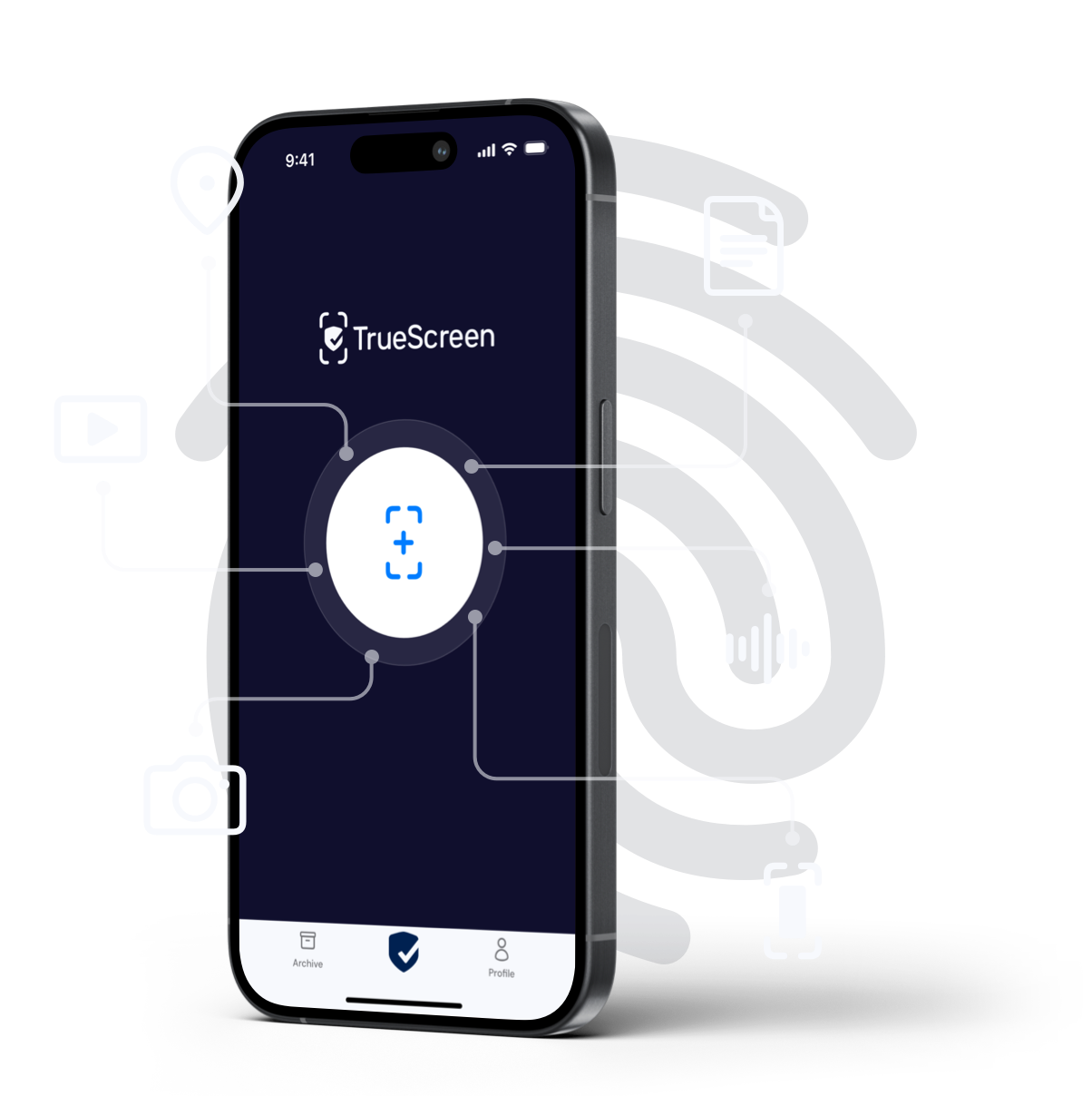
Alongside the Forensic Browser, an application for macOS and Windows that remains the main solution for desktop acquisition, TrueScreen also offers the Web Notarization extension for Chrome and Edge, which lets you quickly certify any content during normal browsing, and the TrueScreen app for iOS and Android, to acquire content from a smartphone: three complementary solutions depending on the device at hand, all feeding the same forensic certification workflow.
Technical Requirements Under ISO/IEC 27037
ISO/IEC 27037:2012 breaks the handling of digital evidence into four phases: identification, collection, acquisition, and preservation. Every phase must be fully documented with traceable operations. In the identification phase, the practitioner determines which page elements constitute potential evidence. Collection then secures the acquisition environment, making sure no external process interferes. Acquisition itself captures the full technical environment: DOM, loaded resources, TLS protocol, SSL certificates, DNS resolution, cookies, and network traffic. Grabbing just the visible content is not enough. Proper digital evidence preservation and web evidence collection demand a forensic browser that logs every interaction between client and server. Each element gets individually hashed to lock in its integrity. Finally, preservation: the entire package must be sealed with a qualified timestamp issued by a Qualified Trust Service Provider (QTSP) under eIDAS. That seal is what makes the data provably immutable over time.
What must a complete forensic copy include?
A complete forensic copy of a web page, compliant with ISO 27037 and aligned with FRE 902(13)-(14) self-authentication standards, must include: viewport and full-page screenshots, HTML source in both the live (client-rendered) and original (server-delivered) versions, MHTML archive, complete HTTP traffic log (HAR format), raw network traffic (PCAP format), SSL certificates with full chain in PEM format, DNS resolution records, TLS protocol analysis, VPN/proxy/Tor detection, NTP time verification against independent servers, and SHA-512 hash of every individual element acquired. Whether the final package meets the bar for digital evidence admissibility comes down to one thing: an unbroken, documented chain of custody from first interaction to final storage.
Forensic web capture tools: a comparison
Several tools exist for website forensic capture, each with different capabilities. Traditional solutions like FAW (Forensic Acquisition of Websites) and HTTrack require local installation and manual configuration. Cloud-based alternatives like WebPreserver and Magnet Web Page Saver simplify the process but vary in certification depth. Here is how they compare:
| Feature | FAW / HTTrack | WebPreserver / Magnet | TrueScreen Forensic Browser |
|---|---|---|---|
| Deployment | Local install required | Browser extension or cloud | Desktop app (macOS + Windows) |
| Qualified timestamp (QTSP) | No | Varies by provider | Yes (eIDAS compliant) |
| Network traffic capture | Partial (HTTP only) | No | Full HAR + raw PCAP |
| Video recording | No | No | Yes (16 fps + audio) |
| Anti-tampering checks | Limited | Limited | VPN/Tor/VM detection, DevTools blocked |
| EU legal validity (eIDAS) | No | Varies | Yes (27 EU member states) |
| Technical expertise needed | High | Medium | Low (standard browsing interface) |
When do you need a forensic copy of a website?
Forensic web acquisition is required across a wide range of legal proceedings: online defamation, product counterfeiting on marketplaces, trademark and intellectual property infringement, cyberbullying, stalking, revenge porn, commercial fraud, and unfair competition. In civil litigation, it is also common for documenting contractual agreements made via email or chat, and in administrative proceedings challenging public tenders published online. Traditional tools like FAW or HTTrack require local installation and technical expertise. The Forensic Browser by TrueScreen makes forensic acquisition accessible to any professional, automatically generating a certified report with a complete chain of custody.
TrueScreen Forensic Browser: Certified Forensic Acquisition for Everyone
For years, performing a website forensic capture the right way meant hiring a specialist, buying expensive tools, and following long manual procedures. The Forensic Browser by TrueScreen, the Data Authenticity Platform, changes this. Organizations use TrueScreen to create certified forensic copies of websites that meet both eIDAS and Budapest Convention requirements, without needing specialist training. It is a desktop application for macOS and Windows: browse any website and acquire pages with forensic integrity, no specialist training required. The output is a structured ZIP package containing media, DOM, web archive, and forensic data in JSON format, signed with RSA-2048 and sealed with an eIDAS qualified seal plus a qualified timestamp from a QTSP. Final reports are generated in PDF, JSON, and XML.
How does the acquisition process work?
Two modes are available. Page Screenshots captures viewport and full-page screenshots, live and server-delivered HTML, MHTML archive, cookies, browser fingerprint, and DOM integrity checks. Every screenshot gets hashed with SHA-512. Video Recording captures continuous navigation at 16 fps with audio, and you can take on-demand snapshots at any point during the session. Either way, all forensic metadata is collected automatically: operator IP at session start and end, VPN/proxy/Tor detection, DNS resolution, TLS analysis, virtual machine detection, full HTTP and network traffic, SSL certificates with PEM chain.
eIDAS Compliance and Legal Value Across Europe
Under eIDAS, a qualified electronic seal guarantees origin and integrity of the document with legal presumption across all 27 EU member states. Article 42 goes further: a qualified timestamp enjoys a presumption of accuracy for the date and time it records. A forensic copy produced with the Forensic Browser carries full legal value, with no need for additional expert testimony to prove data integrity. Together, the eIDAS seal and ISO 27037 compliance form the strongest normative foundation for web page certification with legal value in cross-border proceedings.
FAQ: Frequently Asked Questions About Website Forensic Copies
Does a screenshot of a web page hold legal value in court?
How do you perform a forensic copy of a website?
What is the difference between saving a web page and acquiring it forensically?
Is a forensic copy of a web page a non-repeatable act?
Who can perform a forensic copy of a website?
What does a forensic copy report of a web page contain?
What is the difference between a forensic copy and a forensic image?
What is the best evidence rule for screenshots?
How do you authenticate a screenshot for court?
What tools can create a forensic copy of a website?
Is the Wayback Machine admissible as evidence in court?
TrueScreen editorial team
This section is edited by the TrueScreen editorial team, which brings together expertise in digital forensics, the law of digital evidence and regulatory compliance. Every article is checked against primary sources: legislation, published rulings, technical standards and official documentation, always cited in the text.


