The cost of Disinformation for businesses: risks and defenses
The scale of the disinformation risk
The World Economic Forum ranked disinformation as the number one global short-term risk in 2025, and confirmed it in second place in 2026, just behind geoeconomic tensions. Swiss Re, in its SONAR 2025 report, documents how deepfakes and generative AI are amplifying insurance fraud, with an estimated impact of hundreds of millions of euros in operational losses for European non-life insurers alone. The numbers are clear: disinformation is not a social media problem. It is an operational risk with quantifiable costs.
Yet most organizations still treat it as a political or media issue. There is no structured framework for measuring the damage or building defences. That gap is becoming expensive.
WEF, Swiss Re, and the data businesses are ignoring
The WEF Global Risks Report 2025 placed disinformation at the top of short-term risks, based on a survey of over 1,300 global leaders. In the 2026 report, published in January, it remains in second place across all time horizons: not a decline in relevance, but the emergence of new geopolitical tensions compounding the problem.
The Edelman Trust Barometer 2026, conducted across nearly 34,000 respondents in 28 countries, captures the erosion of digital trust: only 48% trust journalists, and 70% say they do not trust people who hold different values or rely on different information sources. Fear that foreign governments are deliberately contaminating domestic media with falsehoods has risen 11 points since 2021, reaching 65%.
For businesses, these numbers translate into a more hostile operating environment. When trust in media collapses, corporate communications lose credibility too. When synthetic content becomes indistinguishable from reality, any piece of digital evidence can be challenged.
When a deepfake reaches the courtroom
The Mendones v. Cushman & Wakefield case (California, September 2025) set a significant precedent: the judge issued a terminating sanction after one party submitted two deepfake videos as digital evidence. Not a fine, not a warning: the case was decided against the party that attempted to use fabricated proof.
For businesses, the message is twofold. On one hand, the risk of receiving fabricated evidence in litigation is real. On the other, organizations that cannot demonstrate the authenticity of their own evidence are in an increasingly weak position. The burden of proof is shifting: presenting a document is no longer enough. You must be able to prove it is authentic.
Types of information attacks targeting businesses
Brand impersonation and synthetic content
Generative AI has driven the cost of producing credible fake content to near zero. A deepfake video of a CEO announcing false financial results, a synthetic press release attributed to a publicly listed company, a voice email replicating an executive’s voice to authorize a wire transfer: these scenarios required advanced technical skills just two years ago. Today, they are accessible to anyone.
Deepfake-related incidents in fintech surged 700% in 2023 alone, according to Swiss Re. The cost of creating a fake tends to zero. The cost of discovering it is fake and managing the consequences grows exponentially.
Fabrication of digital evidence
In the insurance sector, Swiss Re documents a growing use of deepfakes in document fraud: photos of non-existent damage generated with diffusion models, videos of incidents that never occurred, manipulated documents to inflate claims. Some motor insurers found that fraudsters were using AI to add scratches and cracks to photos of intact bumpers, with an average inflation of approximately GBP 13,000 per claim.
The problem is not limited to insurance. Every industry that relies on digital evidence for decision-making is exposed: from real estate to logistics, from legal services to healthcare.
Information attacks on the supply chain
Disinformation can strike at commercial relationships. A supplier whose reputation is damaged by false content may lose contracts. A company receiving manipulated compliance certificates may face legal liability. The supply chain is becoming an information attack vector just as much as it is a target for traditional cyber attacks.
Why detection is not enough
The cost asymmetry between creating and debunking
The disinformation paradox is structural: producing fake content costs pennies, while proving it false can take weeks of forensic analysis and thousands of euros. Detected deepfake cases grew 900% between 2023 and 2025, rising from 500,000 to 8 million. Detection systems improve, but they are chasing a generation technology that evolves faster.
This is the core issue: detection operates after the fact, on content already in circulation. By the time a deepfake is identified, the reputational or operational damage is often already done. A different approach is needed: not trying to recognize the fake after the fact, but guaranteeing the authentic at the source.
Building a structural defence: the authenticity infrastructure
Certification at source vs post-hoc verification
The alternative to detection is certification at the moment of creation. Every photo, video, document, or business data asset is captured with cryptographic metadata attesting to its origin, integrity, GPS location, and timestamp. Content certified at source carries its own proof of authenticity: it does not need to be “verified later” because it is verifiable by anyone, at any time.
In the event of a dispute, the organization has evidence with a complete chain of custody, legally admissible and verifiable by any independent third party. The cost of certifying is minimal; the evidentiary value is maximum.
The operational framework for organizations
A corporate disinformation security programme is built on four steps. First: assess the disinformation risk specific to your industry and organization. Second: identify critical digital assets that require protection, including contractual evidence, compliance documentation, executive communications, and operational records. Third: implement certification at source for all critical assets. Fourth: establish a rapid response protocol with certified evidence already available when needed.
The role of TrueScreen in disinformation security
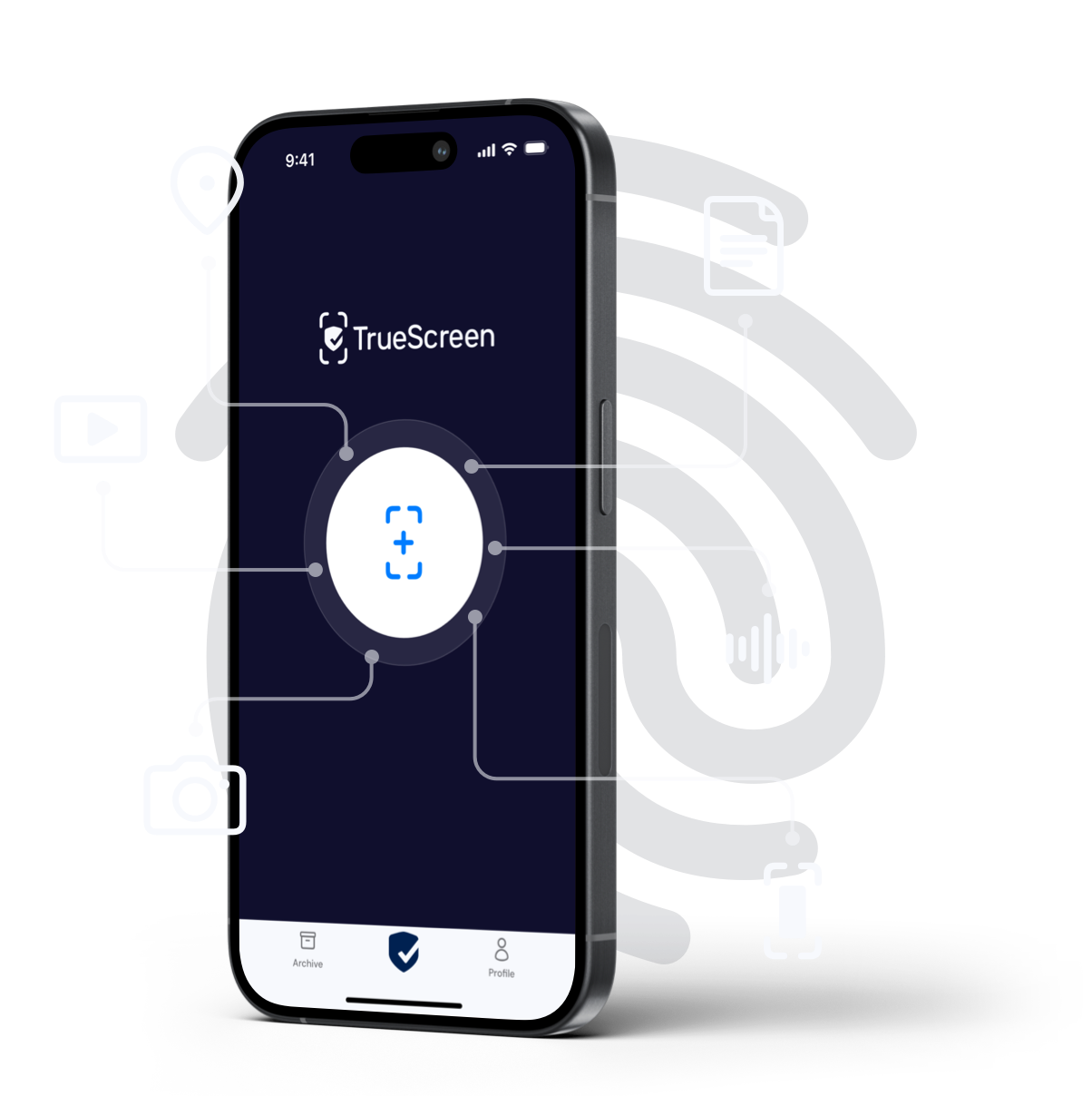
TrueScreen, the Data Authenticity Platform, enables organizations to certify every piece of digital evidence with legal and forensic validity. Photos, videos, documents, emails, screen recordings, and web browsing sessions are captured with a digital signature, qualified timestamp, verified GPS data, and a complete chain of custody.
In a landscape where disinformation is the second-highest global risk and deepfakes have grown 900% in two years, TrueScreen provides the operational infrastructure to move from reactive detection to proactive certification. Every data asset acquired through the platform is independently verifiable, admissible in court, and compliant with international standards including eIDAS and ISO/IEC 27037. The platform integrates into business processes via API and SDK, with white-label options for system integrators.
FAQ: disinformation risk and business impact
How much does disinformation cost businesses?
Why is deepfake detection not sufficient?
How can a business protect itself from disinformation?
What is disinformation security?
Which industries are most exposed to disinformation risk?
TrueScreen editorial team
Published on · Updated on
This section is edited by the TrueScreen editorial team, which brings together expertise in digital forensics, the law of digital evidence and regulatory compliance. Every article is checked against primary sources: legislation, published rulings, technical standards and official documentation, always cited in the text.


