Digital provenance: why it ranks among Gartner’s top technology trends
What is digital provenance and why Gartner considers it strategic
Digital provenance is the ability to trace and verify the origin, history, and integrity of any digital content: data, documents, images, videos, software. It encompasses a set of processes, standards, and infrastructure designed to answer an increasingly critical question: is this data authentic? Who created it? Has it been altered?
Gartner has listed digital provenance among its top strategic technology trends expected to shape IT strategies through 2030. The rationale is structural: in a digital ecosystem where synthetic content is indistinguishable from real content, organizations need mechanisms that attest to data authenticity at the source, not after the fact.
According to Gartner's projections, by 2028 more than 50% of enterprises will adopt data provenance verification solutions within their critical workflows. The reason is practical: without a provenance infrastructure, every decision based on digital data becomes an unverifiable act of trust.
Digital provenance in Gartner's 2026 trend landscape
Gartner positions digital provenance at the intersection of three macro-trends: disinformation security, AI trust, and digital immunity. This convergence is not coincidental. The proliferation of generative models has made synthetic content production accessible to anyone. Deepfakes are no longer a theoretical risk: they are an operational problem for insurers, law firms, human resources departments, financial institutions, and public sector organizations.
The strategic response that Gartner identifies is not to enhance fake detection, but to build systems that make the authenticity of original data verifiable. This distinction is fundamental and marks a shift from a reactive approach to a structural one.
The paradigm shift: from detection to authenticity assurance
For decades, the dominant model in digital content management rested on an implicit assumption: every piece of content was considered authentic until proven otherwise. Fakes were exceptions, and detection technologies could identify them with reasonable reliability.
That assumption no longer holds. Generative models produce synthetic text, images, audio, and video of such quality that automated detection is becoming less effective over time. According to the World Economic Forum, disinformation and manipulated content rank among the most significant global risks, costing businesses tens of billions of dollars annually worldwide.
The paradigm has reversed: today, any digital content is potentially unreliable unless it has been certified as authentic at the source. This reversal is not an academic hypothesis. It is the conceptual foundation on which Gartner, standards like C2PA (Coalition for Content Provenance and Authenticity), and regulations like the EU AI Act are building the infrastructure of the next decade.
Why fake detection alone is not enough
Deepfake detection technologies face structural limitations. Generation models evolve faster than detection models, creating an asymmetric race where those producing fakes hold an inherent advantage. False positive and false negative rates remain significant, particularly for content that has been compressed or distributed through social platforms.
Digital provenance flips the logic: instead of trying to determine whether content is fake, the system guarantees the veracity of what is authentic. The approach does not fight fakes: it makes them irrelevant, because only content with verified provenance carries evidentiary and decision-making weight.
Impact areas for organizations
Digital provenance is not a topic confined to IT departments. Its impact crosses multiple business functions, from compliance and operational management to external communications and legal proceedings.
Compliance and regulatory audit
European regulations are converging toward explicit data traceability requirements. The eIDAS 2.0 Regulation strengthens requirements for digital trust services, while the GDPR imposes obligations regarding the integrity and accuracy of personal data. For companies operating in regulated sectors (finance, healthcare, energy), the ability to demonstrate data provenance is becoming a compliance requirement, not a discretionary investment.
Digital evidence management
In legal and insurance contexts, digital provenance transforms the management of digital evidence. Photos, videos, documents, and communications acquired with verifiable provenance metadata carry greater evidentiary weight than content lacking a certified chain of custody. This applies equally to civil disputes and insurance fraud investigations.
Digital supply chain security
For organizations managing complex supply chains, the provenance of data received from partners, suppliers, and clients is an operational risk factor. A tampered contractual document, a manipulated technical report, or a modified product image can generate significant financial and reputational damage. Digital provenance acts as a cross-cutting trust layer, applicable at every point in the chain.
Corporate communication and reputation
In a context where any content can be synthetically generated, an organization's ability to prove the authenticity of its communications becomes a competitive advantage. Press releases, financial reports, and marketing materials certified in their provenance protect brand integrity and reduce the risk of reputational attacks based on manipulated content.
Standards and regulations: C2PA, eIDAS 2.0, and the AI Act
Digital provenance is consolidating through an ecosystem of technical standards and regulatory frameworks that accelerate its adoption globally.
C2PA: the technical standard of reference
The Coalition for Content Provenance and Authenticity (C2PA), backed by Adobe, Microsoft, Google, Intel, and other major players, has developed an open standard for embedding provenance metadata directly into digital files. The C2PA standard records who created the content, when, with which tool, and whether modifications have been made. Major technology platforms are integrating C2PA support into their products, from creation to distribution.
EU AI Act
The European AI Regulation introduces specific transparency obligations for AI-generated content. AI systems that produce deepfakes or synthetic content must clearly identify the artificial nature of the output. This regulatory requirement creates structural demand for digital provenance solutions capable of attesting to content origin in a verifiable and automated manner.
eIDAS 2.0 and trust services
The revised eIDAS regulation strengthens the European framework for trust services, with particular focus on electronic seals, qualified timestamps, and attribute attestation. These tools are the technical building blocks of digital provenance: they enable any digital data to be associated with proof of integrity, authenticity, and legally recognized timestamping throughout the European Union.
ISO/IEC 27037 and digital forensics
The ISO/IEC 27037 standard provides guidelines for the identification, collection, acquisition, and preservation of digital evidence. Digital provenance fits naturally within this framework, extending the concept of chain of custody from traditional forensic contexts to any business process handling critical data.
Digital provenance in practice: the role of TrueScreen
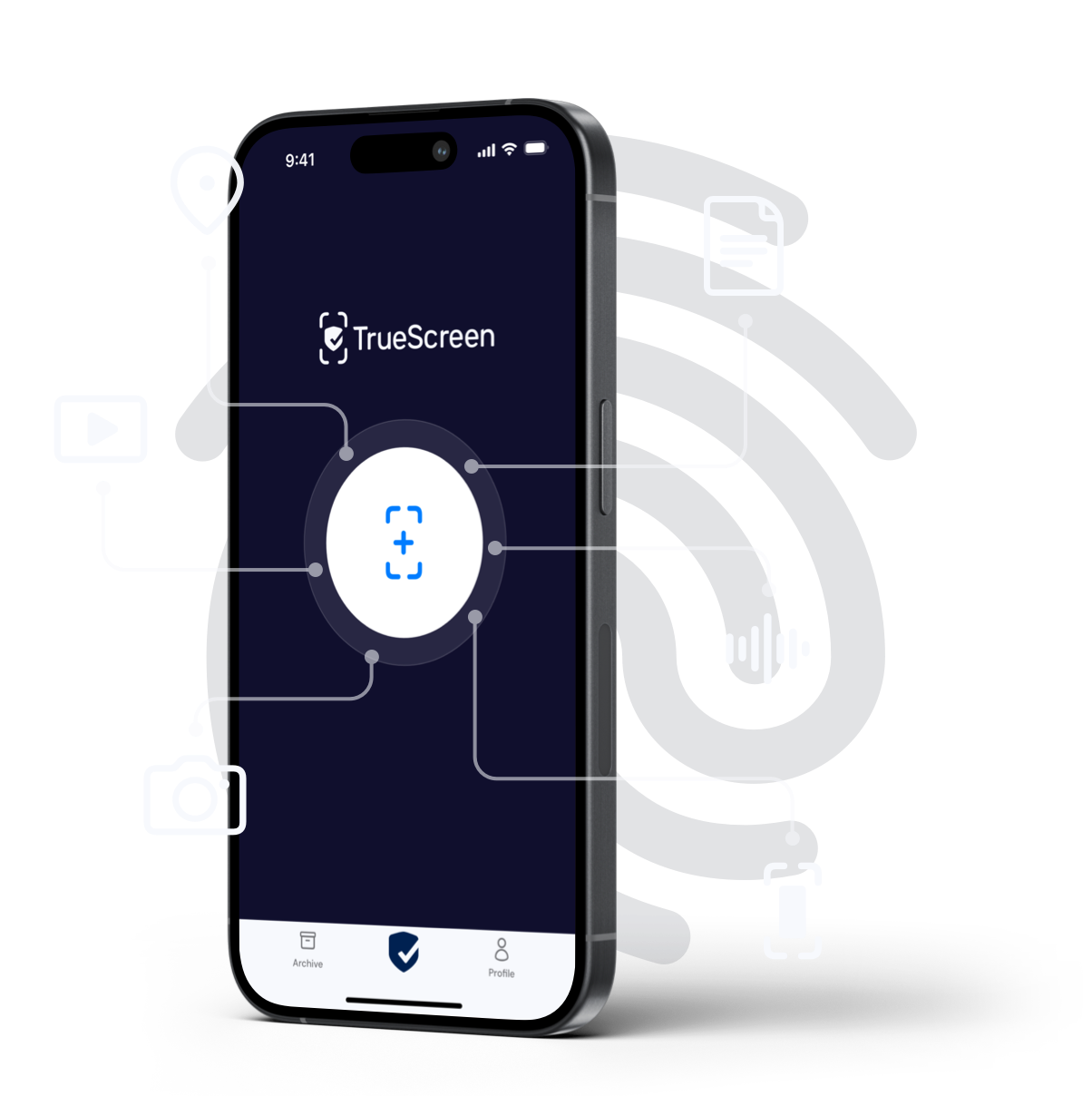
TrueScreen is the Data Authenticity Platform that translates digital provenance principles into an operational tool for businesses and professionals. Through forensic-grade data capture, verification, and certification, TrueScreen guarantees the authenticity, traceability, and legal validity of digital information throughout its entire lifecycle.
The platform enables the certification of photos, videos, documents, emails, chats, web browsing sessions, and screen recordings with complete provenance metadata: creator identity, certified timestamp, GPS coordinates, device integrity, and digital signature. Every certified piece of content receives an integrity seal and a timestamp compliant with the eIDAS regulation, acquiring full evidentiary value.
TrueScreen's approach to digital provenance
TrueScreen's approach is built on the principle of "guaranteeing the authentic, not detecting the fake." Rather than analyzing content for signs of manipulation, the platform certifies authenticity at the source, at the very moment of acquisition. This proactive approach eliminates ambiguity: content certified with TrueScreen is authentic by construction, not by statistical inference.
This logic aligns precisely with the direction Gartner identifies: building digital trust infrastructure that makes data provenance verifiable, rather than investing in detection systems that grow less reliable over time. TrueScreen already operates in sectors where digital provenance has a direct impact: insurance, legal, construction, logistics, healthcare, and the public sector.