When generative AI can imitate a writing style, generate photorealistic images, or clone a voice in minutes, the hardest part of being a creator is no longer “creating”. It is being believed.
That challenge hits individuals and organizations alike: independent creators, journalists, public figures, photographers, filmmakers, and also the agencies and teams who manage their work. A single altered clip, a manipulated screenshot, or a re-upload stripped of context can trigger disputes that are expensive, slow, and reputationally corrosive.
At the same time, it is important to stay precise and level-headed. Deepfakes and AI manipulation are a real operational risk, especially in fraud and impersonation scenarios. For example, Entrust reported that deepfake attempts occurred at a rate of one every five minutes in 2024. Source: Entrust, 2025 Identity Fraud Report (PDF)
Yet there is also a tendency to overstate the “deepfake apocalypse”, and some analyses note that the impact can be uneven depending on the domain and the measurement approach. Source: World Economic Forum (Jan 2025)
So what is the practical, defensible response for creators?
Not more outrage. Not more “trust me”.
A more robust method: digital provenance, grounded in forensic methodology.
Who counts as a creator (and why they are more exposed now)
A useful starting point is a broad definition. A content creator is “someone who creates content (video, images, writing, etc.) for the internet, especially for a social media website”. Source: Cambridge Dictionary
In practice, “creator” now covers a wide range of professional and semi-professional roles:
- social creators and streamers
- journalists and newsroom contributors
- politicians and public institutions’ communication teams
- commentators, educators, analysts, philosophers and public intellectuals
- photographers, actors, directors, filmmakers, production crews
- agencies: PR, talent management, media agencies, creative studios, production houses
What they share is that their output has public reach and economic value, and therefore becomes a target for manipulation and decontextualization, impersonation, hostile re-edits and “remixes”, and synthetic look-alikes built on their identity or style.
When the audience can no longer tell what is original, the default becomes suspicion. And suspicion is where disputes start.
The real damage is not only “the fake”: it is permanent contestability
In the pre-AI era, a creator could often rely on reputation and platform signals. Today, many controversies do not even require a convincing fake. They only require plausible doubt.
Reputational damage
Common patterns look familiar:
- “Did you really say this?”
- “Is this your original photo, or AI generated?”
- “Was this clip edited?”
- “Is the screenshot real, and from when?”
For journalists, political communicators, and agencies, this becomes operational friction: verification loops, takedown attempts, corrections, and ongoing narrative control.
Economic damage
Contested authenticity affects money in direct and indirect ways:
- licensing disputes and content ownership conflicts
- sponsorship risk (brands avoid “controversy zones”)
- impersonation scams that exploit a creator’s identity
- monetization leakage when copies spread faster than the original
- long-term dilution of a creator’s distinctive “signature”
In short, a creator’s asset is no longer only the content. It is the credibility of the content.
Digital provenance: the definition creators actually need
Digital provenance is often described in technical terms, but the creator’s version can be simple:
Digital provenance is the ability to prove where a piece of content came from, whether it stayed intact, and what happened to it over time, using evidence that others can verify.
This is the key shift:
- Saying “this is authentic” is a claim.
- Providing verifiable provenance is an evidentiary posture.
The 4 practical pillars of provenance
For creators and agencies, provenance becomes actionable when it covers four pillars:
- Origin: who created it, when, and under what conditions?
- Integrity: if the file changes later, can that change be detected?
- Authenticity: can the content be reliably traced back to an identifiable source/author, with verifiable provenance as genuine and unaltered?
- History (timeline): can you show a defensible record of acquisition, preservation, and relevant events?
This is not about “winning arguments online”. It is about being able to respond to disputes with facts, logs, and verifiable artifacts.
Why watermarks and platform labels are not enough (by themselves)
Watermarks, labels, and platform integrity signals can help. They can reduce casual confusion, and they can communicate that “something may be synthetic”.
But creators and agencies run into gaps that labels do not solve:
- Off-platform circulation: content spreads via messaging apps, reuploads, screen recordings, and mirrors.
- Context stripping: screenshots and clips lose the original post, caption, or date.
- Derivatives and edits: legitimate post-production or resizing can complicate “simple” authenticity signals.
- Dispute-level scrutiny: when money, reputation, or legal claims are involved, you need evidence that holds up beyond a UI badge.
When the stakes rise, the question changes from “is this labeled?” to “can we demonstrate provenance in a way that is technically and procedurally defensible?”
That is where forensic methodology matters.
A creator-ready approach: forensic methodology applied to content
“Forensics” is often misunderstood as something that only happens in court. In reality, it is a discipline of acquisition and preservation designed to produce material that can be verified later, by third parties, under scrutiny.
What “forensic-first” means in practice
A forensic-first provenance approach aims to ensure that:
- content is acquired in a controlled way (so the acquisition itself can be defended)
- content is sealed and time-referenced (so integrity over time can be checked)
- logs and metadata relevant to the acquisition are preserved
- the workflow supports a traceable chain of custody
This is the difference between “I saved a file” and “I preserved evidence”.
What robust certification artifacts typically include
In a rigorous workflow, certification artifacts commonly include:
- cryptographic hashes (integrity checks)
- timestamps (time anchoring)
- operational logs and metadata
- a report that can be reviewed and shared
- structured data for integration into organizational workflows
A crucial nuance for global audiences: admissibility and legal weight can depend on jurisdiction and case context. The practical goal is to produce provenance and integrity evidence that is designed to support legal and regulatory requirements, not to promise outcomes.
How TrueScreen supports digital provenance for creators and agencies
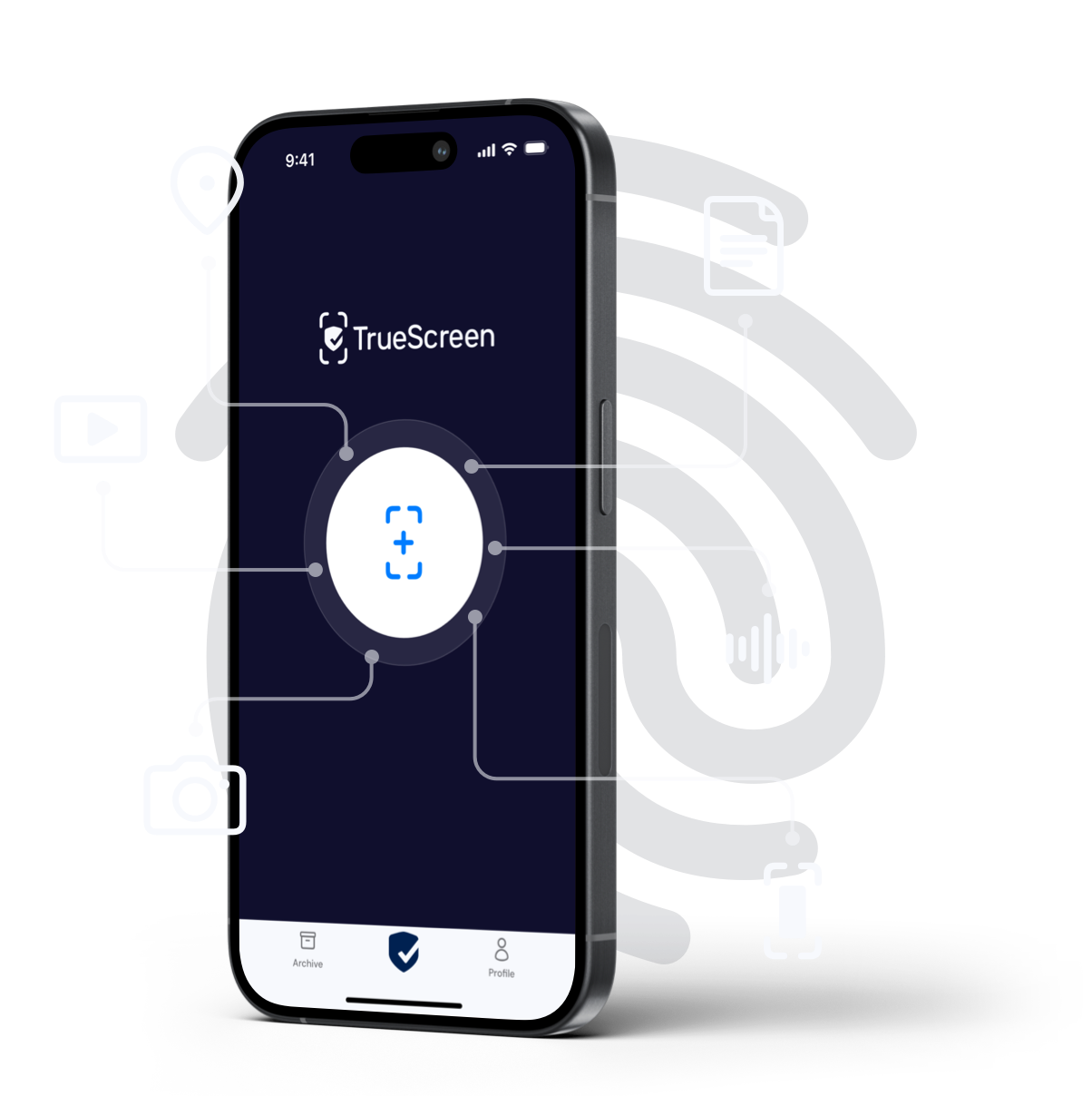
TrueScreen is positioned as a Data Authenticity platform: it helps professionals and organizations protect, verify, and certify the origin and history of digital content, with a methodology designed for defensible integrity and authenticity.
From a creator and agency point of view, this means building a repeatable, organization-ready approach to digital provenance, rather than relying on ad hoc screenshots, manual archive folders, or “trust my account”.
1) Certify content at the source, before it becomes contestable
When content is acquired and certified through a controlled process, you create an origin anchor. That anchor is what you use later when someone claims “this was edited” or “this is AI”.
This is particularly relevant for journalists documenting events, political teams publishing sensitive statements or media, photographers and filmmakers working with high-value assets, and agencies managing multi-channel publishing and approvals.
2) Preserve integrity with verifiable evidence
The practical promise is not “nobody can ever dispute you”. The practical promise is: if a dispute happens, you can respond with verifiable integrity evidence and a clear timeline of acquisition and preservation.
This changes the nature of the conversation. It moves from social debate to evidentiary review.
3) Produce outputs built for sharing, review, and workflows
Creators often need to prove authenticity to platforms and trust & safety teams, editors and publishers, brand partners, legal counsel, and internal compliance teams (for agencies).
A provenance approach is only useful if it is shareable, reviewable, and consistent across cases.
4) When content is external: assess trustworthiness (without “magic” claims)
Sometimes the content is not captured through a certified acquisition workflow: user-generated content sent to a newsroom, a clip that appears “out of nowhere”, alleged leaks, impersonation content using a creator’s identity.
TrueScreen also supports analysis workflows designed to help assess whether content may show signals of synthetic generation or manipulation. This can reduce risk and speed up decisions, but it should be treated as supporting analysis, not an infallible oracle.
Real-world scenarios (creators + agencies)
Scenarios make digital provenance concrete. Here are typical situations where a forensic-first provenance approach changes outcomes.
Photographer: “This image was manipulated”
A photographer publishes a documentary image. A counter-narrative claims it was edited to mislead, or it was generated. If the creator can produce a provenance package tied to the original acquisition, integrity checks, and timeline, the discussion shifts from “opinions” to verifiable artifacts.
Journalist and newsroom: verifying UGC under deadline
A newsroom receives a video via messaging apps. It might be real, edited, or synthetic. Publishing it without verification is risky. Ignoring it might miss a story. A provenance workflow creates a standard: preserve what you received, document the process, and, when possible, certify acquisitions and store verification outputs consistently.
Political communication: combating decontextualized clips
Short clips travel faster than full speeches. A sentence is cut, re-ordered, or paired with unrelated images. Provenance helps build a defensible timeline: original recording, original release, and integrity evidence showing what was actually published and when.
Actor, director, production: leaked cuts and disputed versions
Production assets often exist in multiple versions: rough cuts, trailers, final edits. A leaked or altered version can create contractual and reputational fallout. Provenance supports version control that is defensible under dispute: which file existed when, what was approved, and whether a circulating clip matches the certified version.
Agencies: scaling trust across multiple talents and brands
Agencies need repeatable workflows. The goal is not that every post becomes a legal exhibit. The goal is that when high-stakes content is published, the agency can prove origin and integrity quickly, and when disputes arise, response is consistent and evidence-based.
Five operational principles for creators (and the teams behind them)
This is not a step-by-step manual, but these principles help you turn provenance into habit:
- Create an “authenticity anchor” before publishing for sensitive or high-value content.
- Separate originals from derivatives (edits, crops, subtitles, platform-optimized versions).
- Preserve evidence, not just files: integrity checks, timestamps, logs, and context.
- Share verifiable artifacts when trust is questioned (not screenshots of screenshots).
- Standardize a response playbook across your team or agency: who collects what, where it’s archived, how it’s shared, and how claims are handled.
The consistent theme is procedural: digital provenance is not a single feature. It is a method.
FAQ: the most common questions about digital provenance for creators
These answers clarify how digital provenance helps creators and agencies prove authenticity, reduce disputes, and protect economic value without overclaiming outcomes.
Is digital provenance the same as “proving copyright”?
No. Copyright and ownership are legal concepts. Digital provenance focuses on verifiable evidence of origin, integrity, and history of content. It can support rights-related discussions, but it is not a legal shortcut.
What is the difference between authenticity and integrity?
Integrity answers: “Has this file changed?” Authenticity answers: “Can we reliably trace this content back to its origin/author and verify its provenance as genuine?” Both are needed when disputes arise.
If someone manipulates my content, can provenance stop it?
No method can fully prevent copying or alteration once content circulates. What digital provenance can do is make manipulation detectable and contestable with evidence, strengthening your position in disputes.
Do I need to be a forensic expert to use forensic-grade provenance?
No. A platform approach embeds forensic methodology into a usable workflow, so creators and teams can produce consistent evidence without reinventing procedures every time.
Does provenance work across platforms and reuploads?
That is one of the reasons organizations invest in digital provenance. Platform labels can disappear when content leaves the platform, while verifiable evidence can be shared independently of where the content circulates.
Is this only for “big” creators or public figures?
No. Smaller creators can be disproportionately harmed by impersonation and false claims because they have less institutional credibility. Agencies can also apply digital provenance to protect emerging talent and standardize trust across portfolios.
Does digital provenance have legal value worldwide?
Legal weight and admissibility depend on jurisdiction and case context. A forensic methodology based on verifiable artifacts can support legal and regulatory needs, but outcomes are case-dependent.
How does this help with economic rights?
By reducing ambiguity. You can demonstrate origin and integrity, support licensing discussions, and respond faster to disputes that affect monetization, partnerships, and reputation.
Closing thought: from “trust me” to “verify this”
Creators do not need a louder voice. They need a stronger foundation for their voice.
Digital provenance is that foundation: a way to protect creativity, competence, and economic value with evidence that is designed to be checked, not merely believed.
If you are a creator, a newsroom, or an agency, the question is not whether synthetic media will exist. It already does. The question is whether your content can carry its truth with it, even when it travels far from its original context.
Discover our solutions
TrueScreen helps creators and agencies establish verifiable origin, integrity, and history for high-stakes content, reducing disputes and manipulation risk with a forensic-grade methodology.