For a long time, digital information inherited a convenient default from the physical world. A photo, a PDF, a timestamp, a GPS coordinate, a screenshot. In most workflows, it was treated as usable unless someone could clearly prove it was false.
That default is changing. In more and more critical processes, the baseline is reversing: it’s no longer “true until disproven.” It’s “untrusted until verified.”
This shift is often reduced to one word: deepfakes. But the operational reality for B2B is broader. The hardest part is not only synthetic media. It is that digital context can be rewritten: date, time, GPS, file history, metadata, framing. And once context becomes negotiable, evidence becomes negotiable too.
The uncomfortable question organizations are being forced to answer is simple: When this is challenged, can we defend how it was created and preserved?
Why the problem is bigger than AI-generated content
Deepfakes get attention because they are visually dramatic. They also map neatly onto a fear we all understand: “I can’t trust what I see.”
But many high-impact manipulations do not require generative AI at all. They require something more ordinary: editing the parts of the record that give it meaning.
Common examples include:
- shifting date and time to move an event into a different window
- editing GPS coordinates to relocate the scene
- altering or stripping EXIF metadata from photos
- changing file creation and modified times to support a timeline
- re-encoding/resaving to break traceability
- cropping or partial screenshots to remove context
For many workflows, this is the real risk: you may still be looking at a real photo, of a real place, but it is now carrying a false narrative.
This is why trust is increasingly discussed as a systemic risk. The World Economic Forum’s Global Risks work has repeatedly highlighted misinformation and disinformation as major short-term threats, because trust is not a moral preference. It is infrastructure for cooperation. When it erodes, coordination becomes slower and conflict becomes harder to resolve. Source: WEF press release (Global Risks Report 2025)
Three practical examples that show the stakes
Words that were never spoken
A video circulates of a public figure apparently making an inflammatory statement. Maybe it is a deepfake. Maybe it is authentic footage spliced into a new sequence. Maybe the audio is edited. Maybe subtitles are changed to steer interpretation.
The impact is immediate because persuasion travels faster than verification. By the time experts weigh in, the narrative has already produced consequences.
This is the first face of the paradigm shift: we are moving from “believe first, check later” to “check first, or accept the cost.”
Evidence that becomes negotiable in a dispute
In B2B disputes, screenshots and PDFs often become stand-ins for reality. A counterparty shares a screenshot “showing” a commitment, a clause, a configuration, a message. Your team believes it is incomplete, selectively captured, or altered. Their team insists it is accurate.
If you cannot demonstrate provenance and integrity, the discussion collapses into: your claim against mine.
And when truth cannot be established, outcomes drift toward leverage: who can afford delay, who can fund escalation, who can impose cost.
Workplace safety inspection evidence
Consider a safety inspection after a near-miss incident. The inspection team documents:
- a missing guard on machinery
- a blocked emergency exit
- PPE non-compliance in a specific area
- signage that is present or absent
- housekeeping conditions that create hazards
They capture photos and short videos and attach them to the inspection report. Corrective actions are assigned. Weeks later, the evidence is challenged.
- A contractor says the photos were taken after the area had been modified.
- A supervisor claims the location is wrong.
- Someone argues the timestamps don’t match the reported sequence.
- Another person suggests the images refer to a different site.
Now the focus shifts from safety improvement to defensibility: what can be proven, what will stand up to scrutiny, what can be used in audits or proceedings.
If the organization only has a folder of files, it is exposed:
- timestamps can be altered
- GPS metadata can be changed or removed
- content can be resaved with context lost
- chain of custody is unclear
The inspection may have been conducted correctly, but the evidence can still be contested because the proof of capture is weak.
This is the core of the trust paradigm shift in one sentence: it is no longer enough to have evidence; you need evidence you can defend.
When trust becomes expensive: what changes in operations
Social engineering becomes more persuasive
A large share of incidents still hinges on human behavior and manipulation. Summaries of the Verizon DBIR 2025 commonly cite that roughly 60% of confirmed breaches involve a human element. Source: ClearanceJobs summary citing Verizon DBIR 2025
Believable content is often the lever: urgency, authority, a “proof” attachment, a request that looks normal until it isn’t.
Disputes multiply around ambiguity
Weak evidence creates loops:
- “send a clearer version”
- “show the full context”
- “prove where and when it was captured”
- “prove it wasn’t altered”
Even without fraud, ambiguity costs time. Over time, this becomes an invisible tax on process speed.
Audit pressure increases
When evidence quality is inconsistent, organizations compensate with manual controls and heavier documentation. That slows down work and increases compliance costs.
The key distinction: “looks authentic” vs “is defensible”
Many conversations stop at realism: can we tell if something is fake by looking at it?
In critical workflows, the decisive question is different: If it is challenged, can we defend the acquisition and preservation process?
To do that, it helps to separate three concepts:
- Integrity: has the content remained unchanged since capture?
- Authenticity: can it be credibly linked to its claimed origin?
- Digital provenance: what is the content’s history across its lifecycle?
This is also why digital provenance initiatives matter, but must be framed precisely. C2PA, for example, states explicitly that provenance information can help establish origin and history, but it does not guarantee that what the content depicts is factually true. Source: C2PA Explainer
For B2B, this is not a limitation. It is clarity. The goal is not automatic truth. The goal is defensible context.
Where forensic certification becomes a practical tool
If the baseline is shifting toward “prove it’s real,” capture cannot remain informal.
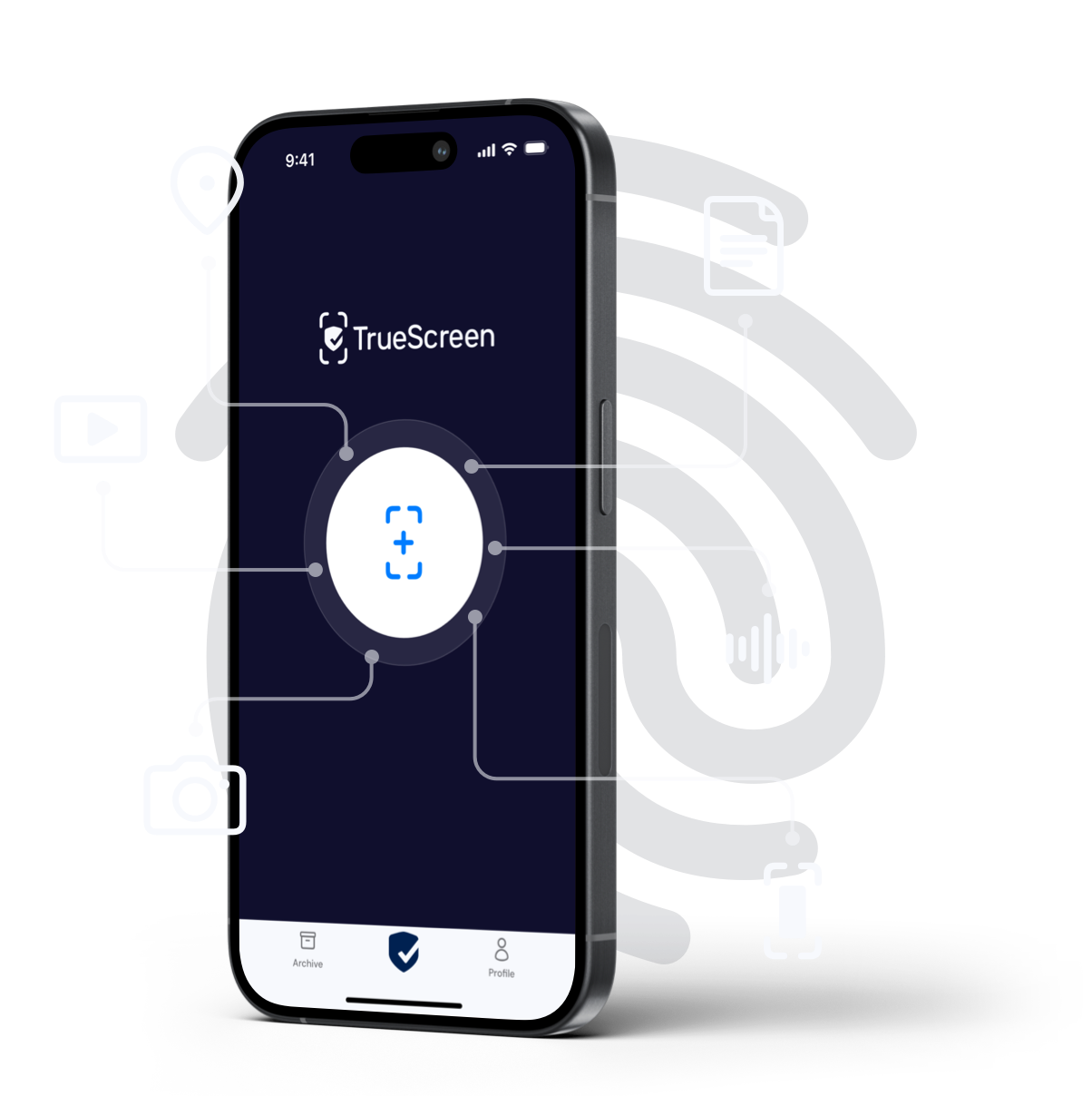
This is where TrueScreen fits as a forensic certification tool: designed to help organizations capture and certify digital content and associated metadata with a rigorous, traceable methodology and documentation that is harder to contest and easier to share across stakeholders.
The value is not in claiming perfection. The value is in changing the dispute dynamics:
- from “trust me”
- to “here is the evidence, here is how it was captured, here is how integrity is preserved”
Receiving data from outside
Any organization that accepts external evidence faces the same tension: accept quickly and absorb risk, or distrust everything and slow down operations.
A forensic certification approach supports a third option: define when external submissions must be captured or provided under verifiable conditions, so the organization can process them with confidence and reduce disputes.
Providing data outward
When evidence must be shared with counterparties, auditors, insurers, or legal teams, certified and traceable capture can reduce room for opportunistic challenges and shorten resolution cycles.
Final admissibility and evidentiary weight always depend on jurisdiction and case context, but stronger chain of custody typically improves defensibility.
Three rules to start without over-engineering
- Identify high-impact evidence moments. Where do photos, videos, documents, timestamps, or GPS coordinates trigger money, liability, or compliance actions?
- Define minimum evidence requirements. What must be captured, what metadata must be preserved, how integrity must be demonstrated, how evidence is stored and shared.
- Treat evidence as an asset with a lifecycle. Acquisition, retention, access controls, export, audit trail.
The aim is not to verify everything. It is to ensure that what matters is not structurally weak.
FAQ: the most common questions about the trust paradigm shift
These answers clarify what “untrusted until verified” means in practice, and how digital provenance and forensic certification can reduce ambiguity in critical workflows.
Why is the new default “untrusted until verified”?
Because the cost of producing plausible content and rewriting context has dropped, while the cost of being wrong has increased. In critical workflows, relying on “looks real” is no longer acceptable risk management.
Is the main problem deepfakes?
Deepfakes are part of it, but not the whole story. Manipulating date, time, GPS, file history, and metadata can be enough to tilt disputes and decisions without generating any synthetic media.
What does “chain of custody” mean for digital evidence?
It is the documented sequence of how evidence is captured, stored, accessed, transferred, and exported, so integrity and handling can be defended if challenged.
Can provenance standards guarantee truth?
No. C2PA itself clarifies that provenance can help establish origin and history, but it does not guarantee factual accuracy. Provenance supports defensible context; it does not replace judgment.
Is forensic certification always admissible in court?
It can strengthen defensibility and support legal and compliance requirements, but admissibility and evidentiary weight depend on jurisdiction and case context.
How can we apply this to workplace safety inspections?
Define which inspection outputs must be defensible (photos/videos of hazards, corrective actions, timestamps), standardize capture procedures, preserve metadata and integrity, and ensure evidence is exportable with documentation.
Request a demo
If you want to explore how forensic certification can be integrated into your workflows, you can request a demo of TrueScreen.
Discover our solutions
TrueScreen helps you build defensible digital provenance for critical evidence, so teams can verify integrity and reduce fraud, disputes, and audit friction.