Not long ago, most legal teams operated with an implicit assumption: a piece of digital evidence was generally treated as authentic until someone could show a concrete reason to doubt it. That assumption is eroding quickly.
Today, the more realistic and accessible manipulation becomes, the easier it is to raise a challenge: “How do we know this wasn’t altered?” “How do we know it wasn’t generated?” “Where did it come from, exactly?” In practice, this shifts the evidentiary baseline toward default doubt. It does not mean “nothing is real.” It means that, without a defensible digital provenance story, almost anything can become contestable and contestability changes litigation strategy, cost, and timelines.
The paradigm shift: authenticity is no longer implied
The legal system depends on the ability to establish facts. But the information environment around courts, businesses, and individuals is changing. The World Economic Forum’s Global Risks Report 2024 frames misinformation and disinformation as a leading short-term global risk, pointing to how fast synthetic and manipulated content is accelerating.
For legal work, the consequence is specific: if high-fidelity fakes are cheap to produce and hard to detect reliably, then even genuine evidence is easier to challenge. The National Center for State Courts describes how courts are already confronting AI-generated and doctored submissions, and how the mere plausibility of deepfakes creates room for what practitioners call the “deepfake defense,” where authentic recordings are dismissed as fabricated.
This does not imply paralysis is inevitable. But it does imply that legal teams who can prove provenance will spend less time arguing about whether something is real and more time arguing about what it means.
What gets challenged when evidence is digital
In disputes and investigations, digital evidence often fails not because it is false, but because it is insufficiently attributable, traceable, or defensibly handled. In the default-doubt era, challenges tend to cluster around four areas:
- Authenticity (source attribution): Who created it? On which device or system? Is the author identifiable, or could it be synthetic?
- Integrity (tamper evidence): Was it modified after capture? If yes, can you show what changed and when?
- Context (metadata and surrounding facts): Time, location, device data, file properties, message headers, or platform context can matter as much as the content itself.
- Chain of custody (handling history): Who collected it, who accessed it, where it was stored, and whether the process was repeatable and documented.
Courts and opposing parties do not need perfect proof to raise doubts. They often need only a credible path to dispute, especially when manipulation is feasible and documentation is thin.
Digital provenance: a practical definition for legal teams
Digital provenance is the ability to demonstrate, with verifiable records, the origin and history of a digital item across its lifecycle: capture or creation, preservation, handling, and presentation.
In legal and investigative contexts, digital provenance is typically built through a combination of:
- Forensic-grade acquisition (capturing content in a controlled way)
- Metadata preservation (keeping what matters, without contaminating it)
- Audit logs (who did what, when, and how)
- Cryptographic integrity checks (detecting any later modification)
- Time-stamping and sealing (depending on jurisdiction and trust services)
- A defensible chain of custody (documented and repeatable)
A key point: digital provenance is not “a guarantee that evidence will be admitted everywhere.” Admissibility depends on jurisdiction, procedure, and case context. Provenance is a way to make your evidence posture more defensible and more efficient.
Why chain of custody is now a strategic asset, not a formality
In digital forensics, chain of custody has always mattered. What is changing is how frequently it will be challenged, and how early.
NIST defines chain of custody as a process that tracks the movement of evidence through collection, safeguarding, and analysis by documenting each handler, timestamps for collection/transfer, and the purpose of transfers.
Source: NIST CSRC Glossary, “Chain of custody”
This definition maps cleanly to the needs of legal teams:
- If evidence moves through multiple hands (client, investigator, counsel, external experts), you need a clear record.
- If evidence originates on consumer devices or third-party platforms, you need a robust capture method.
- If evidence is shared, exported, or converted, you need a way to detect changes.
In a world where a screenshot can be generated, a chat can be reconstructed, and a video can be synthesized, chain of custody becomes part of persuasion. Not persuasion by rhetoric, but by documentation.
The slowdown risk: why authenticity disputes can expand timelines
The National Center for State Courts warns about a practical bottleneck: if every disputed voicemail, video, or screenshot requires deeper forensic examination, the system can slow significantly, and resource imbalances can widen.
Source: NCSC, “AI-generated evidence is a threat to public trust in the courts”
From a litigation strategy perspective, this creates a new kind of procedural leverage:
- Contest authenticity to force additional discovery and expert work
- Raise “AI-generated” doubt to undermine a key exhibit’s impact
- Push settlement pressure by increasing the cost of proving the obvious
Digital provenance does not remove adversarial tactics. It reduces the surface area that those tactics can exploit.
What “provenance-ready” evidence looks like in practice
For lawyers and in-house investigation teams, “provenance-ready” does not mean building a lab. It means adopting a repeatable workflow and generating outputs that are easy to explain to non-technical stakeholders.
A strong digital provenance posture typically includes:
- A clear narrative of who collected the item and why
- Capture methods that reduce opportunities for alteration during acquisition
- Preserved originals and preserved metadata where relevant
- A documented handling trail (access, storage, transfer)
- Integrity verification that can be independently checked
- A shareable package that supports external review (counsel, experts, court)
This also supports internal governance: investigations that may later become disputes can be handled in a way that is litigation-ready from day one.
How TrueScreen supports digital provenance for legal and investigative teams
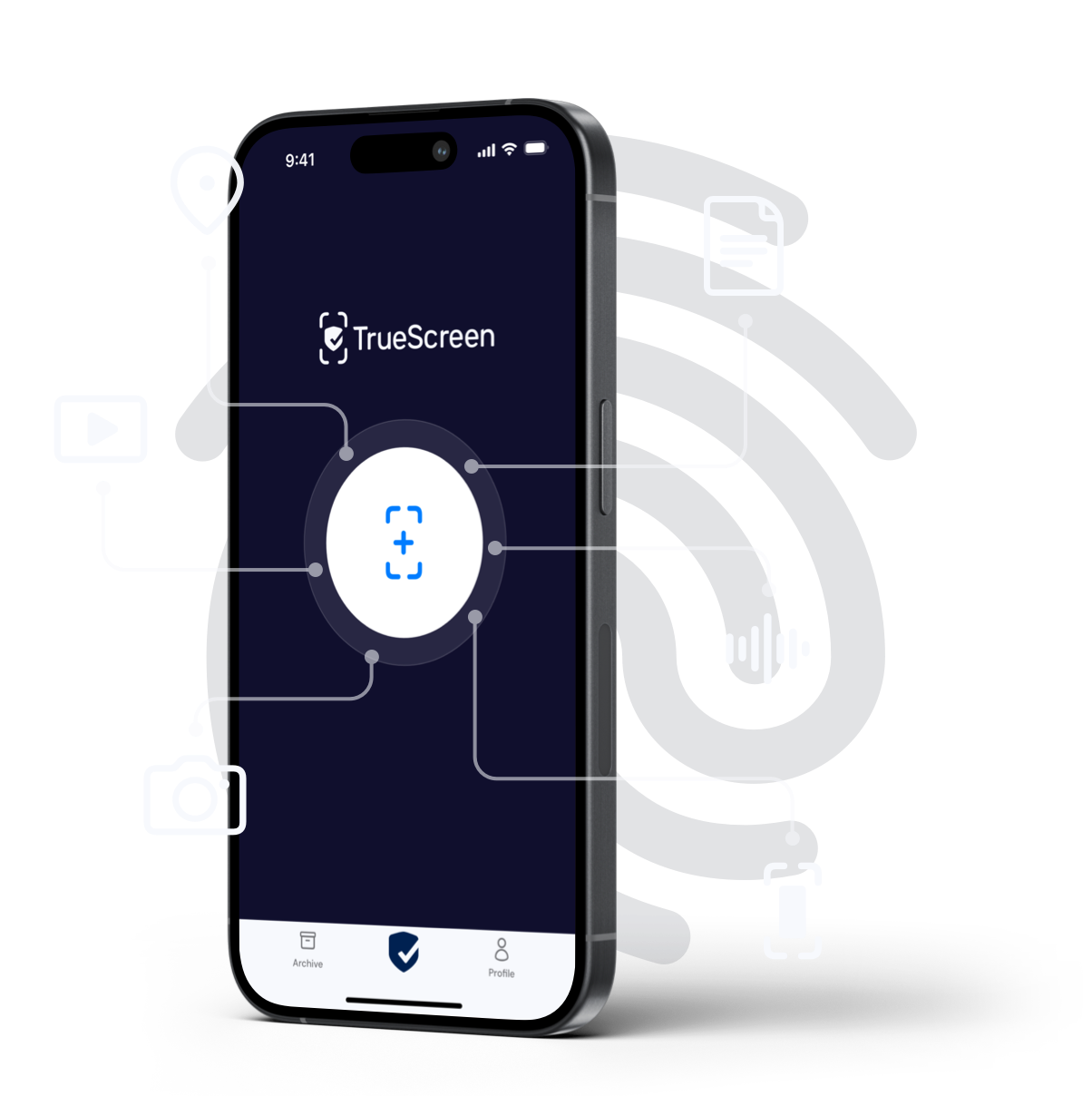
In this context, TrueScreen works as a data authenticity layer designed to support forensic-grade acquisition and certification of digital content, helping teams preserve integrity, capture relevant metadata, and document the workflow in a verifiable way.
In practical terms, TrueScreen is built to support evidence types legal teams routinely rely on, including:
- Photos and videos
- Screenshots
- Chats and messages
- Emails
- Documents and files
- Web content (where applicable)
The goal is to make the evidence lifecycle easier to defend: acquire, certify, package, share, verify. This is a pragmatic way to operationalize digital provenance across everyday legal workflows.
Who should adopt digital provenance first (and why)
Law firms
Digital provenance is most valuable when:
- The case is document-heavy and timeline-sensitive
- The dispute depends on digital interactions, media, or platform content
- You expect an aggressive authenticity strategy from the other side
- You need to reduce the cost of “proving the basics”
In-house investigation teams
Digital provenance is most valuable when:
- Investigations may escalate into external litigation or regulatory scrutiny
- Multiple departments touch the evidence (security, HR, legal, compliance)
- You rely on mobile content captured in the field
- You need consistent handling across regions and vendors
A simple maturity path:
- Start with high-risk evidence types (video, audio, screenshots, chats)
- Standardize capture and documentation
- Scale across teams and external partners
- Integrate provenance into case management and reporting
Conclusion: from reactive disputes to proactive trust
Legal practice has always adapted to new information technologies. What’s different now is the speed and scale at which believable manipulation can be produced, and the ease with which doubt can be introduced.
Digital provenance is not a buzzword. It is an emerging baseline for credibility when digital content carries legal weight. Teams that operationalize provenance early will spend less time defending the legitimacy of their materials and more time arguing the merits of their case.
FAQ: the most common questions about digital provenance in the legal sector
These answers clarify how digital provenance relates to authenticity, integrity and chain of custody in real legal and investigative workflows.
Is digital provenance the same as chain of custody?
Not exactly. Chain of custody is a core component: it documents how evidence is collected, transferred, stored and accessed. Digital provenance is broader: it also covers origin, capture methodology, integrity verification, and the evidence’s history across time.
Will digital provenance guarantee admissibility in court?
No tool can guarantee admissibility universally. Admissibility depends on jurisdiction, procedure and context. Digital provenance helps you present a clearer, more defensible foundation for authenticity and integrity, which can reduce disputes and friction.
Does the “deepfake defense” affect only video and audio?
No. The same doubt can extend to screenshots, documents, chats, emails and platform exports. The challenge is not only “is this fake,” but also “can we show a defensible history of how it was collected and handled?”
What evidence types benefit most from provenance workflows?
High-impact items that are easy to manipulate or easy to dispute: screenshots, chat excerpts, audio, video, and web content captured from third-party platforms. These are also the areas where digital provenance can reduce the most friction.
Is this only relevant for criminal cases?
No. Civil litigation, arbitration, corporate disputes, IP enforcement, insurance claims, HR investigations, and regulatory-facing matters increasingly depend on digital content and benefit from consistent authenticity and integrity practices.
What is the first operational step for a legal or investigation team?
Pick one workflow (for example, field-captured photos and videos, or chat evidence), standardize acquisition, and require documented handling and verifiable integrity checks from the moment evidence is collected. Then expand the policy across teams and external partners.
Sources
- World Economic Forum – Global Risks Report 2024
- National Center for State Courts – AI-generated evidence and public trust in courts
- NIST CSRC Glossary – Chain of custody
Build defensible digital evidence, faster
TrueScreen helps legal and investigation teams capture and certify digital content with a verifiable chain of custody, supporting authenticity and integrity in a default-doubt era.