For years, cybersecurity has worked on one assumption: if you control access, vulnerabilities, and configurations, “the data is correct.” Today that assumption can no longer be the only one.
A document can be stored in a well-protected repository and still be false.
Or it can be authentic at the source, but slightly modified during a handoff: a number changed, a clause rewritten, an audio clip cut, a video re-edited.
In 2026, in an era of synthetic content, AI impersonations, and scalable manipulation, you can no longer limit yourself to simply “protecting data.”
To truly build digital trust, you first need to question the authenticity, origin, and validity of the information in front of your eyes.
This article maps the key trends that in 2026 converge toward a simple but increasingly relevant idea: content must be authentic and defensible.
Trend 1: Digital Provenance as the baseline for information integrity
The World Economic Forum identified misinformation and disinformation as the most severe global risk in the short term (the “next 2 years” horizon) in its Global Risks Report 2024. In practice, a very concrete question is growing: it is not enough to know that content “is circulating”, you need to know where it comes from, who produced it, whether it has been modified and through which steps. (Source: World Economic Forum, Global Risks Report 2024 (PDF))
This is where Digital Provenance comes in.
In practical terms, it means having a verifiable history of the content: origin, handoffs, changes, context, and involved parties. It is both a technical and organizational answer to the question that always comes back in critical processes: “How do you prove it?”.
Digital Provenance becomes an operational baseline because it affects everyday activities such as:
- validating a document before approving it (e.g., revisions, clauses, numbers, attachments);
- verifying evidence in case of a dispute (emails, screenshots, reports, photos, recordings);
- reconstructing the chain of events after an incident (who shared what, when, and in which version).
What really changes is the method: you move from “I assess whether it looks authentic” to “I verify a pathway and integrity signals (traceability, attestations, evidence)”.
In addition, Digital Provenance helps solve a typical information governance problem: when content is “sensitive”, you need to prove that the version consulted today is the same as the one that was valid yesterday, and that every relevant step is reconstructable.
When claims, disputes, and audits come into play, pure detection becomes fragile: even if technically good, it still generates false positives and false negatives. In high-impact workflows you need prevention and verifiable context from the source: building a layer of trust that does not depend on a single “after-the-fact” analysis, but on signals and data that follow the content over time.
Trend 2: Social engineering becomes increasingly sophisticated
Social engineering is an increasingly sophisticated cyber attack technique because it does not only aim to “break into” a system, but to steer human decisions: convincing someone to pay, approve, share documents, change an IBAN, grant access, or bypass a procedure.
It is a low-friction, high-return attack for the attacker, because it exploits the hardest point to fully lock down in any organization: trust, urgency, and context.
Today this threat directly targets employees with synthetic video, audio, and photos that make impersonations credible: smishing, voice fraud, fake CEO/CFO messages, fake calls from vendors or consultants.
With GenAI, the attacker can generate communications at scale in the right language, with the right tone, tailored to the victim’s role and to the moment.
In 2026, social engineering will become even harder to manage for three reasons:
- More realistic and contextualized impersonations: the attack becomes credible because it integrates real elements such as names, projects, vendors, references to tickets or previous conversations, and it arrives in the most effective format: voice note, real-time audio, short video, “urgent” attachment, “proof” screenshot. People no longer evaluate only the content, but react to the context, using cognitive shortcuts like “it looks real” or “it sounds right”.
- Abuse of legitimate tools: attackers will use legitimate browser prompts to bypass traditional controls and induce users to execute harmful commands. The attacker builds a pathway that looks like a normal work operation (authentication, installing an update, accessing a shared document, confirming a transaction), thinning the line between legitimate experience and harmful action.
- Speed and variants: GenAI reduces the cost of creating variants such as language change, tone, apparent sender, storyline, attachment, call-to-action. This increases the probability that at least one variant “gets through” filters and, above all, hooks the victim at the right moment.
For this reason, against attacks that exploit human trust combined with indistinguishable GenAI content, a proactive multi-level verification is needed: protocols that go beyond the human eye, with objective and repeatable controls and checks, for example:
- verification of the authenticity and integrity of content that triggers decisions such as approvals, payments, banking detail changes, authorizations;
- provenance and context checks: who generated what, from where, with which chain of handoffs;
- automated forensic analysis on suspicious media (audio, video, images) to identify signals of manipulation or synthetic generation;
- process rules: escalation and a mandatory “second channel” for high-impact actions (e.g., phone confirmation on a known number, verification in an internal system, two-person approval).
Trend 3: AI transparency, from declaration to evidence
The global market for AI content detection software is expected to grow from USD 1.79 billion in 2025 to USD 6.96 billion by 2032 (with a CAGR of 21.4% indicated in the report). (Source: Coherent Market Insights, AI Content Detection Software Market (2025-2032))
In 2026 it is no longer enough to say “we use AI responsibly”: you need to prove how you use it, where, and with which controls to internal and external stakeholders.
In this regard, people increasingly talk about “AI-Transparency”, which refers to the degree to which the internal functioning, data, and decision-making processes of an artificial intelligence system are open and understandable to users, regulators, and developers.
This becomes a real security issue because:
- many business decisions depend on AI outputs;
- an error or a manipulation becomes a reputational, legal, and fraud risk.
In this context, there are also emerging regulations such as the EU AI Act.
In particular, Article 50 defines transparency obligations for synthetic or manipulated content (including forms comparable to deepfakes) and indicates that these provisions will apply from 2 August 2026.
At the implementation level, the European Commission is also working on a Code of Practice on marking and labelling AI-generated content to support compliance with the regulation’s transparency obligations.
Trend 4: Preemptive cybersecurity, preventing before impact
GenAI attacks evolve too quickly for reactive responses, which intervene only after the impact.
Predictive cybersecurity tries to change the logic: it shifts defense from reactive to proactive, moving the focus from incident response alone to the early prevention of threats.
This approach combines three elements:
- Risk prediction and anticipation: use of AI and analytics to identify patterns, weak signals, and anomalies before they become incidents. The goal is to intercept behaviors and chains of events “compatible” with an attack (e.g., abnormal escalations, unusual access, deviations from normal flows), before they turn into exfiltration or operational disruption.
- Deception and controlled misdirection: creating assets and paths that should not be touched under normal conditions. If they are triggered, they provide a high-precision signal: you are no longer chasing generic indicators, you are observing a behavior typical of an attacker. This reduces false positives and speeds up response, because the alert is more “qualified”.
- Automation and containment before propagation: playbooks and controls able to intervene quickly and proportionately when predictive signals emerge. The idea is to block or isolate “upstream” accounts, endpoints, sessions, and flows before the attack can scale laterally or hit critical assets.
The reason this trend accelerates in 2026 is also economic: the real cost of an incident is not only the initial event, but its propagation: downtime, recovery, litigation, loss of trust, impact on customers and the supply chain. A preventive approach aims to reduce the incident’s “surface area” precisely when it is still small and manageable.
In this direction, Gartner predicts that by 2030 preemptive cybersecurity solutions will account for 50% of IT security spending, up from less than 5% in 2024. (Source: Gartner, press release 18 Sep 2025)
It is an important signal: defense is no longer measured only by how quickly you recover after an impact, but by how often you manage to prevent the impact from happening.
TrueScreen: making digital trust verifiable
In 2026, data authenticity and integrity are essential.
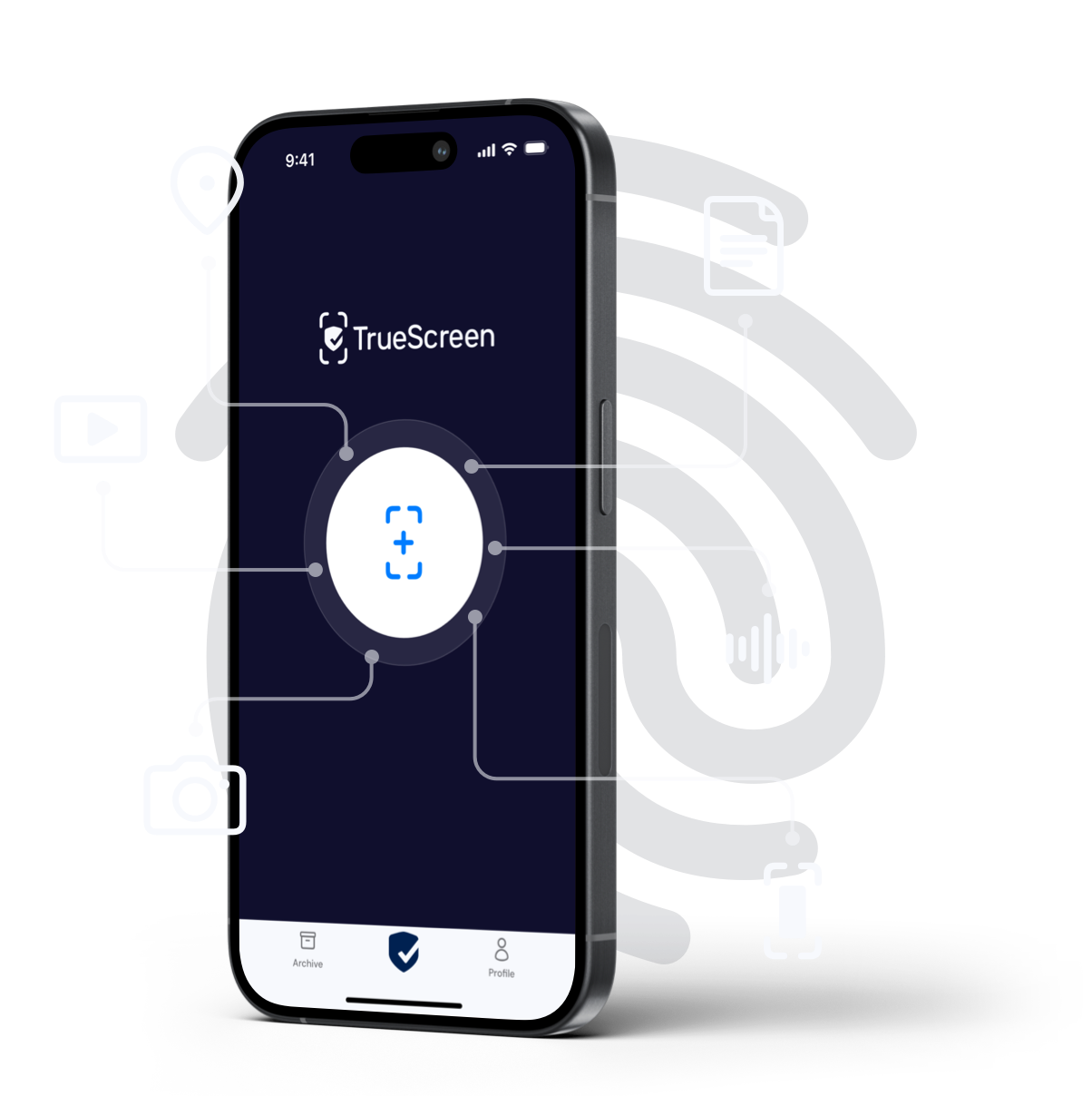
TrueScreen is the Data Authenticity Platform designed to help companies and professionals protect, verify, and certify the origin, history, and integrity of digital content, building a layer of trust based on Digital Provenance and verifiable processes.
In particular, TrueScreen is already aligned with two key trends:
- Trend 1 (digital provenance): it enables certifying the origin of content and making its history verifiable in critical contexts.
- Trend 3 (AI transparency): it enables detecting and identifying AI-generated or AI-manipulated content, supporting stronger governance and disclosure processes.
These trends require companies to build processes and tools that make trust verifiable: every organization needs mechanisms to do so, and tools like TrueScreen move exactly in this direction.
FAQ: the most frequent questions about digital trust 2026
An operational summary of the most common doubts when talking about authenticity, traceability, and synthetic content in business processes.
Are digital provenance and chain of custody the same thing?
No. Digital Provenance describes the content’s history (origin and transformations).
Chain of custody describes the handling history when the content becomes evidence, with management and tracking logics oriented to disputes, audits, and proceedings.
Why isn’t deepfake detection enough for digital trust 2026?
Because it can produce false positives and false negatives. In critical processes you often need something more defensible: traceability, integrity, and verifiable context over time, not only an “after-the-fact” assessment.
Make your digital evidence indisputable
TrueScreen is a Data Authenticity Platform that helps companies and professionals protect, verify, and certify the origin, history, and integrity of any digital content, turning it into evidence with legal value.